

You've found a few softboards online, but the lengths don't tell you which one will help you catch waves. Perhaps you're buying for a child who didn't enjoy their first attempt, or you want a family board for summer trips without paying for something everyone outgrows straight away. A useful softboard NZ buying decision starts with the rider, the beach and the board's shape, not its colour or how short it looks under someone else's arm.
Beginner Softboards to Shortlist in NZ
Ocean and Earth Ezi-Rider, Gnaraloo and Softech Coaster are sensible starting points for absolute beginners. Each offers forgiving shapes at accessible prices, but the right choice still needs to fit the person who'll paddle it.
Beginner softboards to shortlist in NZ
| Range | Lengths | Buying role | What it forgives |
|---|---|---|---|
| Ocean and Earth Ezi-Rider | 5'6 to 9'0 | Quality for the price across ages | Late pop-ups on a stable outline |
| Gnaraloo | Several sizes in the range | Lower price, still great quality | Wobbly first trim and crossed feet |
| Softech Coaster | A spread of sizes | Strong price in a known learner shape | Weak paddle and small whitewash |
The Ezi-Rider offers good quality for the price across a broad length range. That makes it a useful range to investigate when you're choosing for a child, teenager or heavier adult. It doesn't mean the shortest and longest versions are interchangeable, or that one size will suit the whole family equally well.
Gnaraloo makes sense when the budget matters but you still want a usable learning board. A forgiving outline gives a beginner room to stand imperfectly, recover their balance and finish a whitewash ride. Crossed feet and late pop-ups still need correcting, but they don't have to end every attempt. A centrally located handle helps humans with shorter arms carry the board down the beach
The Softech Coaster is another strong-value option, with a wide, approachable shape and a spread of sizes. Check it when you want learning support rather than a short performance outline that happens to have a soft covering. Another model with a very handy carry handle.
Choose the size after the range
Use the table to narrow your choice, then match the actual board to height, weight, paddling ability and carrying ability. Our beginner surfboards NZ guide helps separate those fit questions from brand preference.
- For a smaller child: Check whether they can reach around the board, paddle comfortably and turn it towards shore.
- For a larger beginner: Prioritise usable flotation and a stable standing area rather than choosing the shortest board that floats them.
- For shared use: Identify the largest learner first. A compromise board shouldn't leave that person struggling every session.
Practical rule: Buy for the waves you can regularly reach, not the waves you hope to surf eventually.
Gisborne riders can choose between beaches with very different exposure, so there isn't a single foam density or outline that solves every local need. A varied selection is more useful than declaring one model the local answer.
These beginner shapes favour easy paddling, buoyancy and forgiving contact over a crisp response on a steep face. Confirm the current size selection before ordering, and have the board's dimensions ready when arranging freight.
Deck Core and Fin Construction Compared
A softboard isn't one lump of foam. It's a combination of deck skin, foam core, reinforcement, bottom skin and fins, and each part changes how the board feels.
A thick, comfortable deck doesn't automatically mean better performance. Equally, a board that feels light in the shop isn't necessarily the toughest choice for repeated family use.
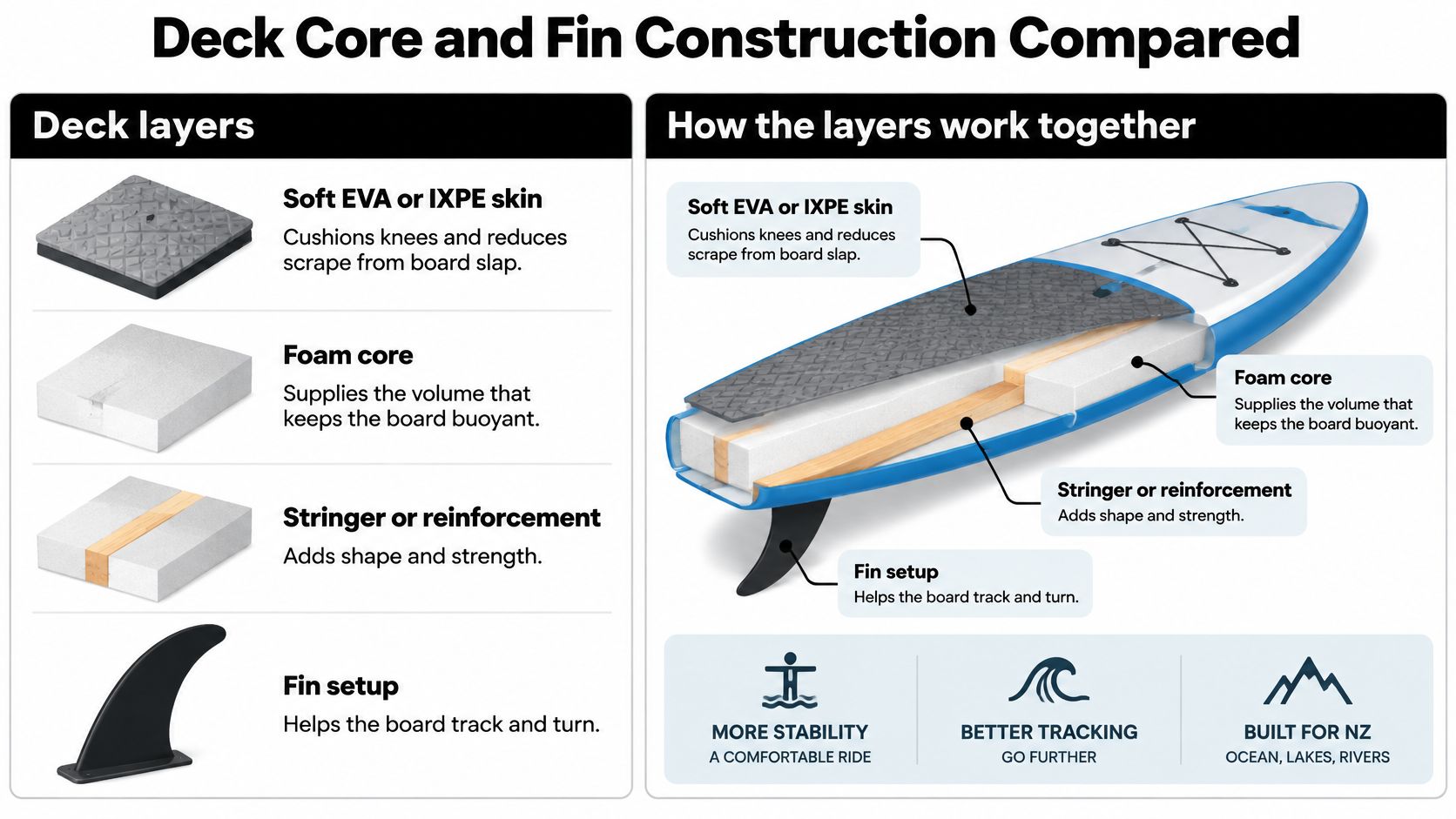
Softboard layers and what they change
| Part | Typical material | What the rider feels | Limit |
|---|---|---|---|
| Deck | Soft EVA or IXPE | Cushion under knees and chest | Excessive heat and UV can soften or peel it eg left in a hot car in summer |
| Core | Foam, lighter or tougher grades | Paddle float and easy wave catching | Too much flex feels vague in stronger surf |
| Slick | Thin plastic bottom skin | Glide once the board is trimming | Tears are hard to separate from the foam for recycling |
| Rails | Rounded soft edge | Less harsh board contact | Still heavy enough to bruise in a collision |
| Fins | Soft or flexible set | Less cut risk, easy handling | Less hold than hard fins on a steep face |
What's underneath the soft deck
The deck skin is the surface your chest, knees and feet touch. EVA or IXPE coverings provide cushioning, but their thickness alone tells you little about the board's ability to hold its shape under load. More padding can feel comfortable without making the board more responsive.
The core supplies the volume. A lighter construction can be easier to carry, while a tougher construction may better suit repeated handling, lessons and family use. Don't judge durability by foam density alone, because the bonding, reinforcement and outer skins also matter.
A stringer or other reinforcement helps resist excessive bending. Some flex feels forgiving in small surf, but too much can make the board feel vague when the rider tries to set a line. The thin plastic slick bottom provides the smooth running surface once the board is moving across the wave.
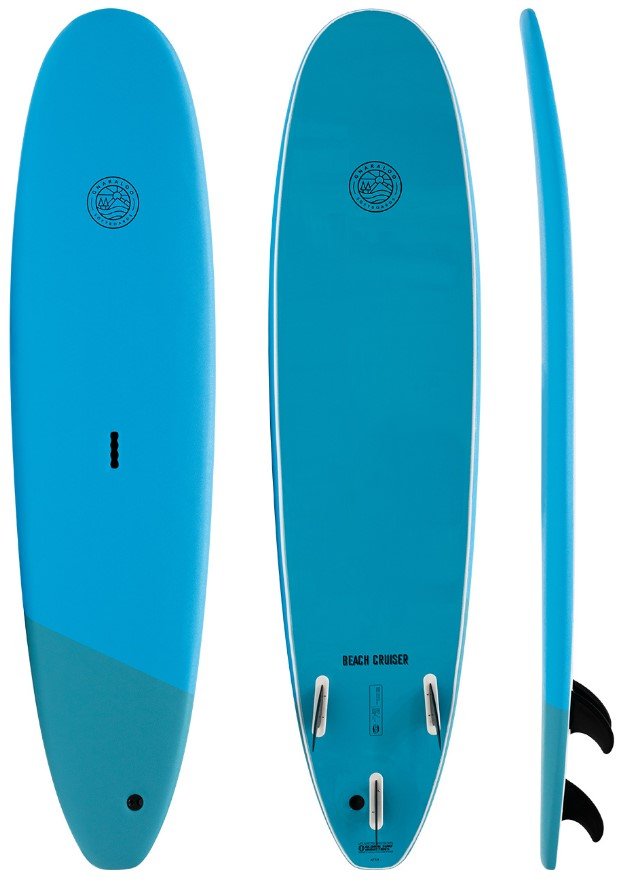
Rails and fins change the response
Rounded soft rails make the board's contact edge less harsh, but they don't behave like sharply defined performance rails. On an easy whitewash ride, that's usually an acceptable trade. On a steeper face, an experienced rider may want a more precise edge and firmer fin response.
Soft or flexible fins suit learning because they're less cutting than rigid fibreglass fins. They can also bend under load, so they generally provide less positive hold when pushed hard. Check the mounting system before buying replacements, because fin compatibility isn't universal.
Our surfboard fins guide explains the hardware choices in more detail. For a first board, secure fitting and appropriate flexibility matter more than chasing a performance fin upgrade.
Before accepting a board, inspect the slick for bubbles or lifting edges, check that the fins seat firmly, and feel for localised soft spots. A sun-yellowed deck, loose fin fitting or separating bottom deserves closer inspection, not an assumption that all foam boards age that way.
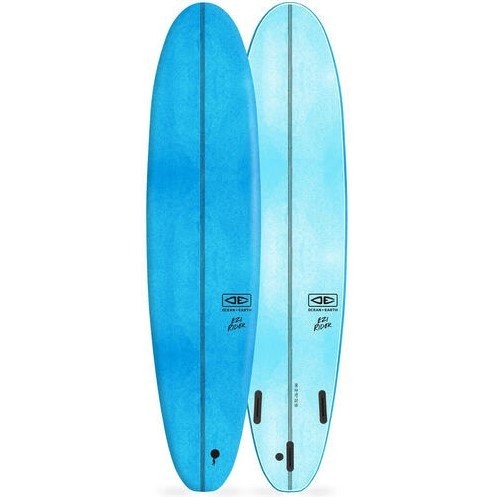
Why length isn't enough
A wide outline and fuller tail give a learner a steadier platform. Useful volume supports paddling and helps the board pick up weak waves, while a suitable multi-fin setup helps it track. That's why a learner-oriented Ezi-Rider, Gnaraloo or Coaster is a more sensible starting point for gentle beachbreaks than a narrow, short performance shape.
Rocker, the board's lengthwise curve, also matters. A flatter board can carry speed through weak sections, while more nose curve can help accommodate a steeper entry. Neither feature overrides poor timing or makes an unsuitable break appropriate.
Use our surfboard volume calculator guide as a starting point, then consider how that volume is distributed. Boards with similar flotation can have quite different standing platforms and handling. Softboards tend to have around 30-50% more volume than hard boards of the same length
Gisborne needs more than one shape
Refraction and diffraction around Poverty Bay's headlands help explain its narrow favourable swell window. Beach orientation and exposure still change what the rider meets at the shore, so Midway, Waikanae and Wainui shouldn't be treated as interchangeable.
Extra foam helps you float. It doesn't give you control over a powerful wave.
Only consider stepping down after the rider can reliably pop up, trim and manage the board around others. Match the leash and fins to the actual board, and choose another beach or another day when conditions exceed the rider's ability.
Which Rider and Beach Each Board Fits
A seven-year-old who found a small hard board difficult may get an earlier taste of success on a buoyant, manageable softboard. An adult learning to paddle into weak summer waves usually benefits from a longer board. Choose for the rider's next skill, then match it to a suitable beach and day.
Rider situation and the board to check first
| Rider | Board to check first | Length or reason |
|---|---|---|
| Young child building confidence | Softech Sally Fitz | A 6' option may suit a smaller rider who needs a buoyant, manageable board |
| Adult absolute beginner, one board for several years | Ocean and Earth Ezi-Rider | 8'0 to 9'0 for paddle speed in weak summer waves |
| Budget family sharing one first board | Gnaraloo range | Choose around the main learner; shared length is a compromise |
| Learner already standing in whitewash | Softech Coaster | Sized to body weight, with a wide platform |
A child who needs an easier first success
A buoyant board that a child can control may make whitewash practice more rewarding than struggling with a small hard board. A 6' Softech Sally Fitz is one option to check, but the right size depends on the child and their ability to handle the board. Start in gentle whitewash with capable supervision, not at an exposed peak.
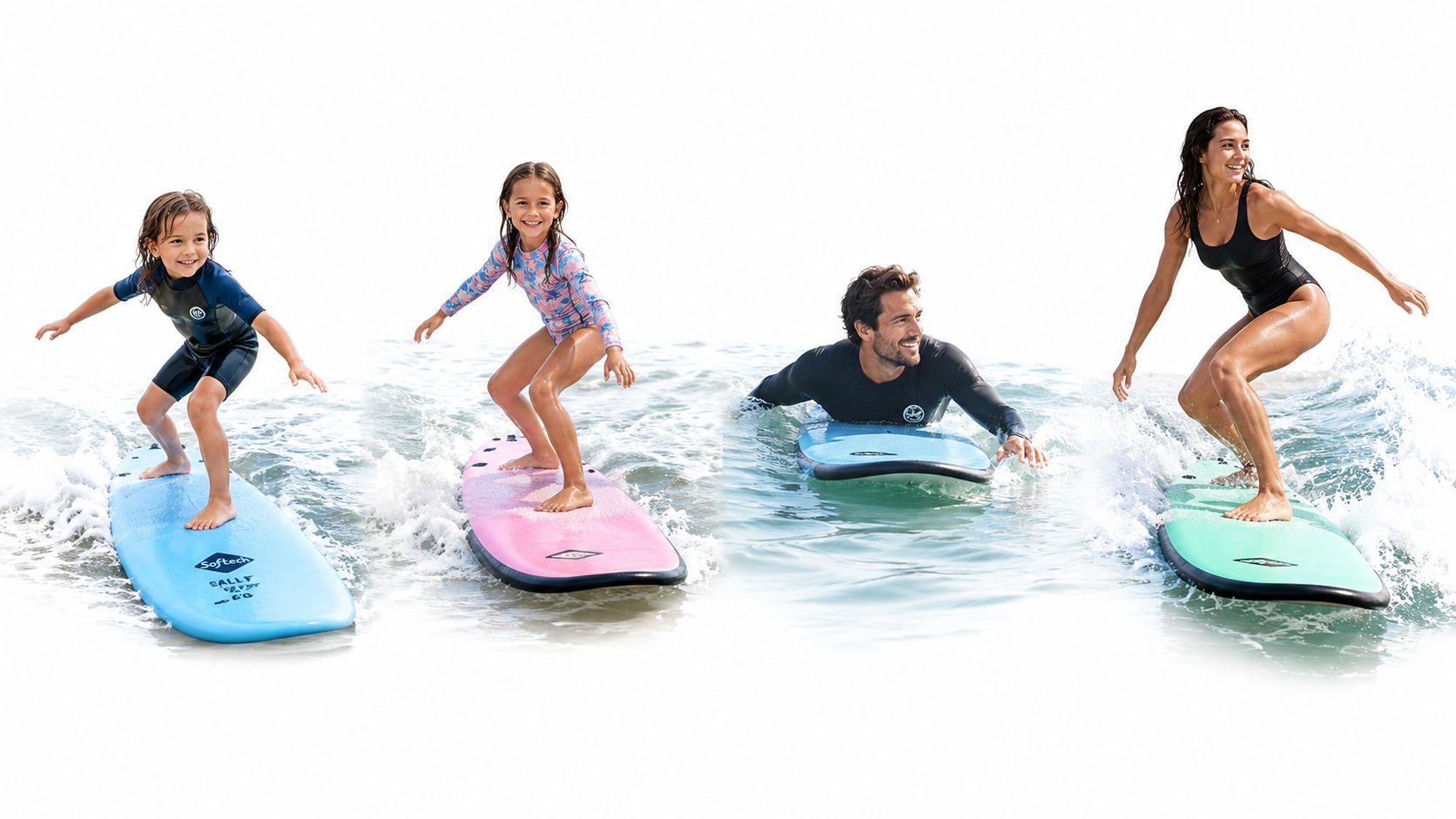
An adult, a sharing family and a progressing learner
For an adult beginner, the longer end of the Ezi-Rider range is worth considering. An 8'0 to 9'0 board can help with paddle speed in weak summer waves, while body weight and the ability to carry and control it still matter. A board that supports steady practice may remain useful beyond the first few sessions.
A family sharing a board can compare the Gnaraloo range and choose for the person who needs the most support. That choice may be less convenient for other riders. Shared value depends on whether the main learner can use the board comfortably.
A learner who can already stand in whitewash might consider a Softech Coaster sized to their weight. Retaining width gives more room to practise looking along the wave and trimming under control. On a smaller day, a sheltered beach can offer a more suitable next step than a powerful exposed session.
Summer is a popular time to surf in New Zealand. Sport New Zealand's 2013–14 surfing profile identifies December through February as the most popular participation months, with March and November as important shoulder months. This historical pattern can help with seasonal planning, but it is not a forecast of current beach conditions.
What a Soft Deck Does and Does Not Prevent
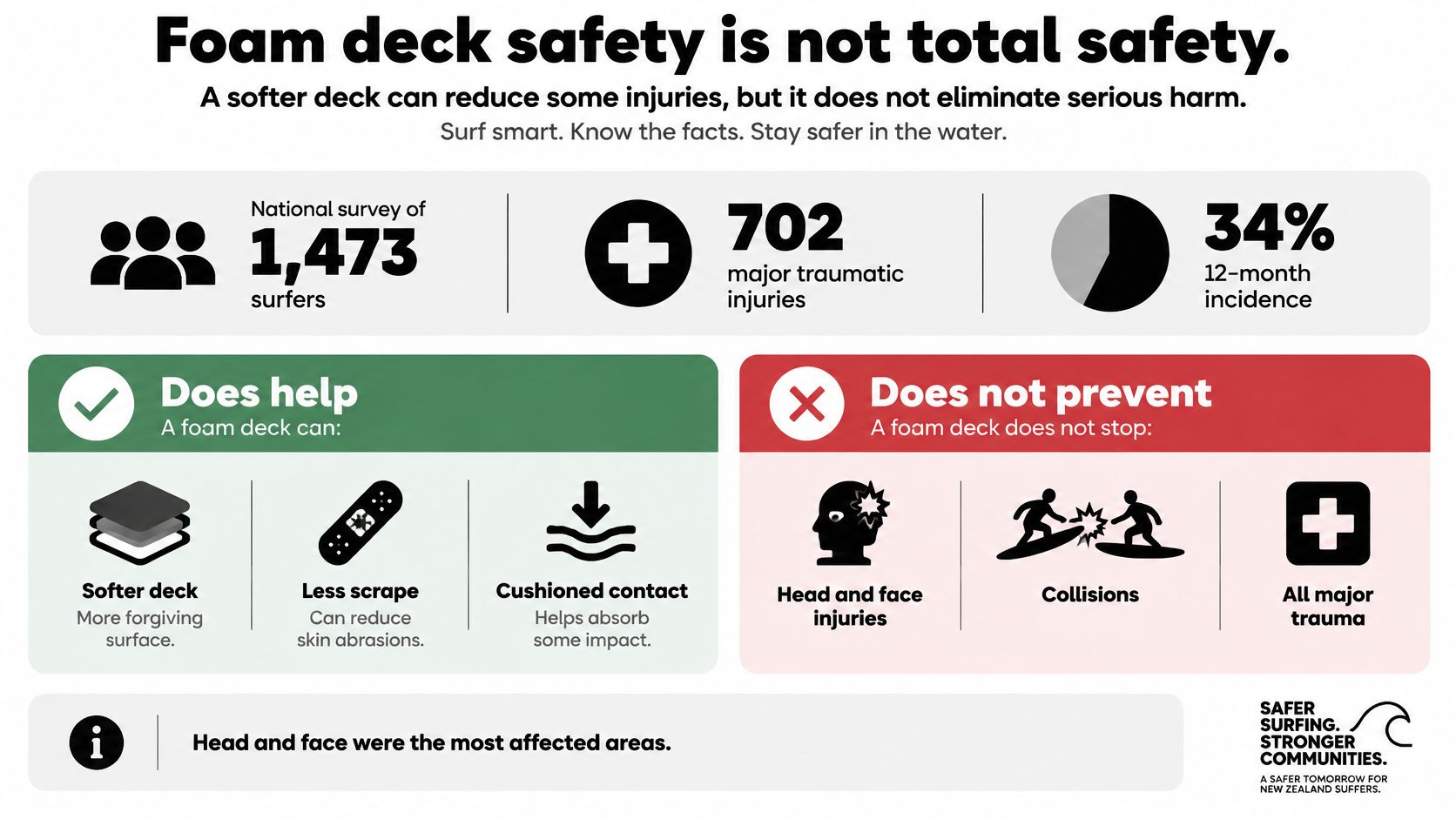
A softboard can make contact with its deck or rails less harsh, but softness is not a safety guarantee. In a crowded lineup, a board can still strike another surfer, and fins, leashes, shallow water and powerful waves carry their own risks.
Softer contact is still contact
A compliant deck, rounded rails and flexible fins may soften some board contact. They cannot prevent every collision, fin cut or impact, and they do not prevent drowning. ACC's outdoor recreation injury figures recorded 5,821 surfing injury claims in 2024, compared with 5,532 in 2023. Those totals count claims; they do not show that a particular board construction caused or prevented an injury.
Safety boundary: If the rider can't manage the water without relying on the board, a softer deck isn't the missing solution.
A conditions check for Wainui and other NZ breaks
A learner's skill, the break and the day's conditions matter more than a board's soft surface. At Wainui and other NZ beaches, use these checks before paddling out:
- Swimming ability first: Choose water the rider can manage if separated from the board. A leash isn't a rescue device.
- Supervise children actively: Stay close enough to recognise changing conditions and intervene.
- Leave space: Keep clear of surfers and swimmers. A long board and its leash can reach beyond the rider.
- Check equipment: Use a leash suited to the board and inspect its attachment. Secure suitable soft fins while learning.
- Consider head protection: A purpose-made surf helmet may add protection where impact is a concern. Crowded or shallow water may still be unsuitable.
- Leave early: Get out if the surf becomes powerful, the rider can't return unaided, or the crowd leaves too little room.
A helmet, soft fins or padded deck cannot make a bigger or crowded session suitable. Choose conditions the rider can manage, and treat softer construction as a way to reduce some contact impacts, not as protection from the ocean.
Carry Repair and Ship a Softboard in NZ
A softboard needs its own freight arrangement. We offer door to door shipping on boards up to 7 foot within NZ and door to Toll Depot on boards over 7'
We ship within New Zealand and also send clothing and small items to Australia. Don't assume the small-item service applies to a surfboard; confirm the board's destination, delivery timing and freight before paying.
Carry and store it without crushing it
Use a padded boardbag and support the board properly on roof racks. Tighten straps enough to prevent movement without digging into the rails, and protect the fins or remove them if their system allows. Don't drag the tail through a car park.
Rinse off salt and sand, then store the board flat on suitable supports in shade. Avoid a closed hot car and prolonged hard sun, which can damage the deck and the bond between layers. Don't leave a loaded roof-rack strap pressing into warm foam.
Repair before retiring it
- Stop using damaged areas: A loose fin plug or lifting slick can worsen under load. Let the board dry and have the construction assessed before applying adhesive.
- Match the repair material: Use products compatible with the foam and skin. Some solvents attack foam, so ordinary household glue isn't a reliable substitute.
- Recover useful life: Repair a sound board where practical, or pass it to another learner once it's suitable to use.
Our surfboard repair guide helps you distinguish a manageable repair from damage needing specialist attention.
End-of-life disposal is less straightforward. Mixed foam, plastic skin, adhesive and hardware shouldn't go into household recycling unless your local service explicitly accepts them.
Bag crumbling foam so it can't scatter. Check whether a repairer can recover usable parts, then follow council disposal guidance for what remains.
Check Stock, Freight and Conditions Before You Buy
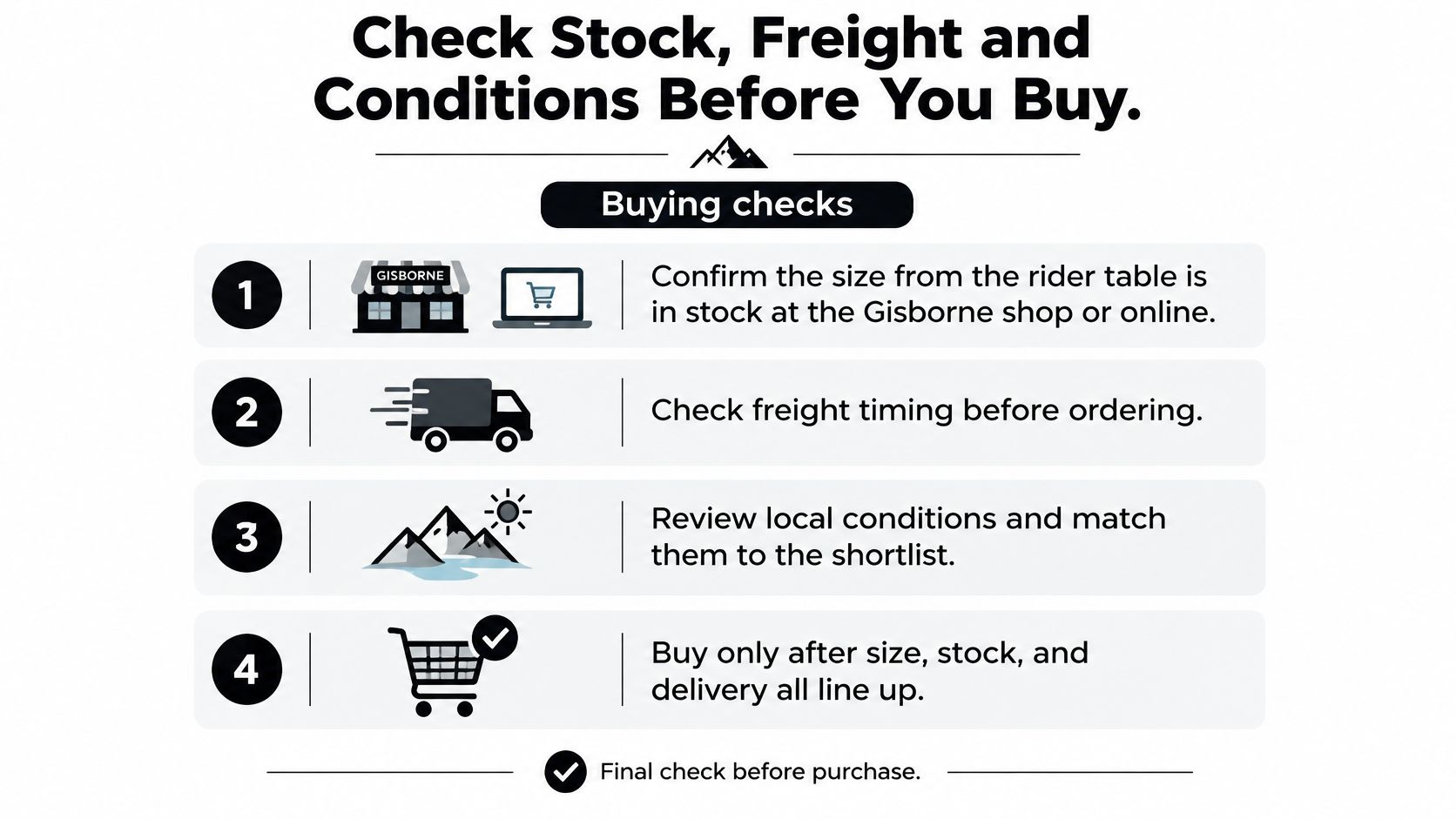
Finish with a practical buying check, not another brand ranking. We're based in Gisborne and serve Gisborne, the East Coast, visitors and online buyers across New Zealand. Established in 1983, Blitz Surf Shop is New Zealand's second oldest established surf shop.
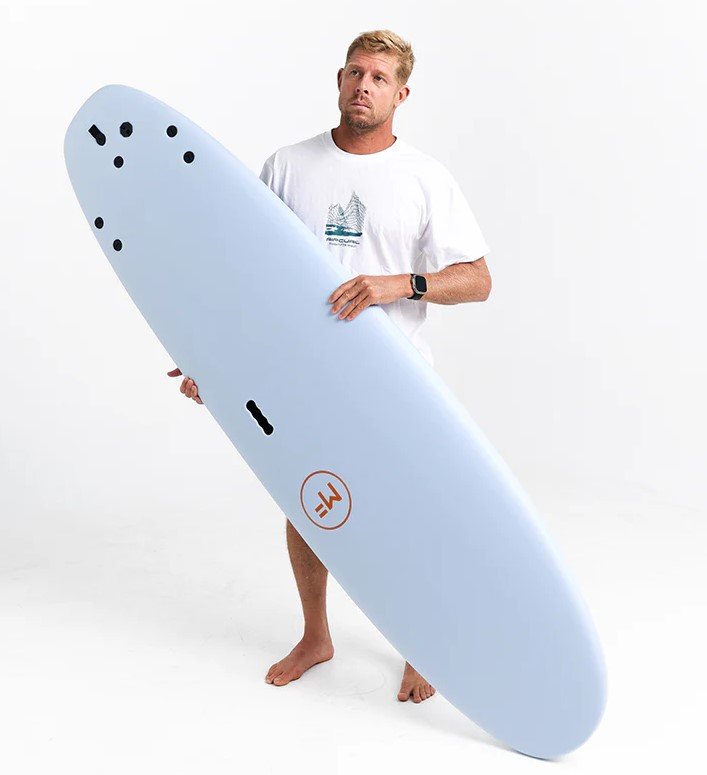
Our softboard selection includes brands such as Gnaraloo, Mick Fanning and Softech. Current sizes matter more than a general brand list, so use our NZ online shopping guide alongside your board choice and delivery details.
Make the purchase fit the next session
- Confirm the actual size. Take your shortlisted range and rider fit, then check availability at the Gisborne shop or online. Don't substitute a shorter size just because it's available.
- Complete the learning setup. Check the board's fin system and choose a suitable leash. Make sure any replacement soft fins fit that system.
- Confirm freight separately. Surfboards remain excluded from the free-shipping offer, even when eligible accessories share the order. Check delivery timing before planning a trip around the board.
- Inspect where possible. Look for a fully bonded slick, secure fins and an evenly supported deck without suspicious soft spots or sun damage.
- Check the day's conditions. Look at the Wainui surf cam and seek local advice before paddling out. Choose a more sheltered option or stay ashore when the rider or board isn't suited to the surf.
Check the displayed currency before checkout. New Zealand purchases should be compared in New Zealand dollars, while the website also displays Australian dollars.
Visit Blitz Surf Shop to compare softboards, suitable leashes and learning fins for your next beach session. Bring the rider's height, weight and usual beach, and we can help narrow the size choice and confirm stock and NZ freight before you order.


