

Your surfboard fins are the bits that give your board direction, stability, and control out in the water. Think of them as the engine and steering all rolled into one. Without them, a surfboard is just a slippery piece of foam, almost impossible to control. Getting the right fins is probably one of the most important gear decisions you'll make.
Buy surfboard fins online here
Why Your Fins Are Your Board's Engine
Ever tried to hold your line on a perfect, peeling wave at Raglan Point, only to feel your tail slide out from under you? Or maybe you've been trying to pump up some speed on a fun day at Gisborne’s Wainui Beach, but your board just feels dead and sluggish.
In both cases, the culprit probably isn't your board or even your surfing—it's your fins. Heaps of surfers, especially when they're starting out, just see fins as an afterthought. But honestly, they have the biggest single impact after the shape of your board, on how your board performs.
Choosing the right fins can completely transform how your board feels under your feet. They're what dictates your speed, defines how you turn, and gives you the grip you need when the waves have a bit of push. It's the difference between a session that feels like a battle and one where everything just clicks. This is a common hurdle for new surfers, and you can learn more about avoiding similar equipment mistakes in our guide to common gear mistakes.
Your surfboard only comes alive when you add the right set of fins. They are the true connection between you, your board, and the wave, translating your movements into performance on the water.
This guide is here to cut through the jargon and make sense of the world of surfboard fins. We'll break down everything you need to know in simple, practical terms so you can feel good about your next choice.
We'll get into:
-
The basic parts of a fin and how each little bit changes your ride.
-
Common fin setups like thrusters and quads, and figure out which is right for you.
-
Major fin systems, including FCS and Futures, so you always buy a set that actually fits your board.
-
How materials and sizing affect performance for different surfers and conditions.
By the end of this, you’ll have a solid understanding of how to pick the perfect fins for your board, your style, and the awesome, varied waves we're lucky to have here in New Zealand. With the right knowledge and a bit of guidance from us here at Blitz Surf Shop, you can unlock what your board's really capable of and push your surfing to the next level.
Getting to Grips with Fin Anatomy and Performance
To really understand how a set of fins will change your ride, you’ve got to get familiar with their anatomy. Every curve, edge, and angle is there for a reason, and knowing what’s what is the secret to predicting how a board will feel under your feet. It's a bit like being a chef—once you know your ingredients, you can start creating magic.
Let's break down the core components that shape a fin's personality. No engineering degree required, just a few simple concepts.
The Foundation: Drive and Stability
Everything starts where the fin meets the board. The two most important measurements here are the base and the depth, and they're all about giving you drive and keeping things steady.
-
Base: This is the part of the fin that sits flush against your surfboard. A longer base gives you more surface area to push against the water, which translates directly into more drive and acceleration. Think of it like putting wider tyres on a car—you get more grip to push harder through turns.
-
Depth (or Height): This measures how far the fin extends down into the water. A deeper fin acts like a keel on a boat, giving you more stability and hold. It's what stops the tail of your board from sliding out, especially when you’re leaning into a hard turn or surfing more powerful waves.
A long base helps you get up and go, while a deep fin keeps you locked in and in control. It's this balance that sets the foundation for your whole ride.
The Turning Radius: Sweep and Rake
Next up is sweep, also known as rake. This is all about how far the tip of the fin curves back from its base, and it has a massive impact on how your board turns.
A fin with a lot of sweep (a high rake angle) will draw out your turns, creating a longer, smoother arc. This is perfect for those big, open-faced point breaks where you want to connect long, flowing carves.
On the other hand, a fin with less sweep (a more upright, vertical fin) lets you pivot much more quickly. It makes the board feel looser and more responsive, ready for sharp, snappy turns right in the pocket of a beach break.
Quick tip: More rake = longer, drawn-out carves. Less rake = sharp, snappy pivots.
The diagram below shows how these elements combine to influence your board's speed, control, and overall performance.
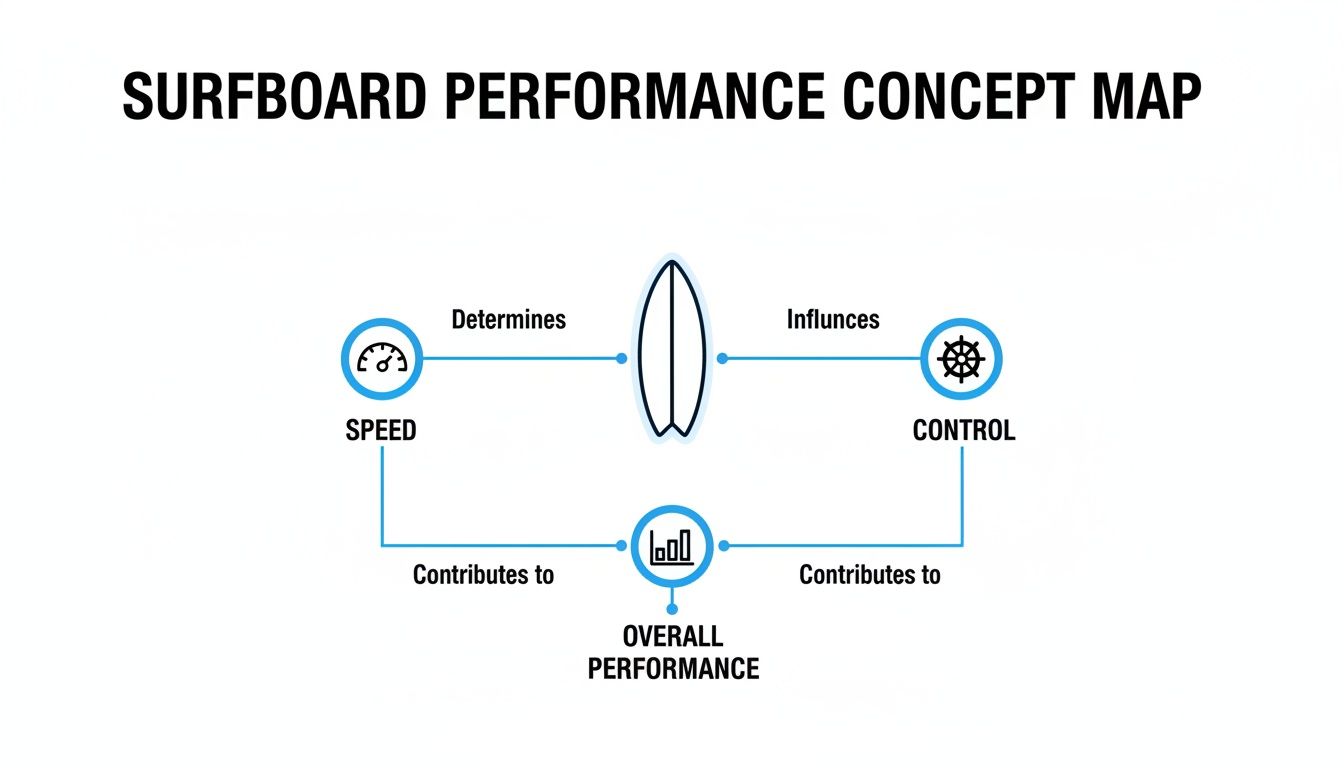
As you can see, fin design is a constant trade-off between generating speed and maintaining control to get the performance you're after.
The Engine Room: Foil and Cant
Now let’s get into the nitty-gritty: foil and cant. These are the subtle, three-dimensional shapes that really act as the engine of your surfboard, creating speed and influencing how your board feels on rail.
Foil is the aerodynamic shape of the fin from front to back, just like an aeroplane wing. As you surf, water flows faster over the curved outer surface and slower over the flat inner one. This pressure difference creates lift, which propels your board forward and generates speed. To see how this works in a standard three-fin setup, check out our guide on understanding your FCS II thruster fins.
Cant is the angle of the side fins as they tilt outwards from the bottom of the board. A fin with more cant will make your board feel more responsive and lively when you lay it on its rail, helping you initiate turns with less effort. Less cant (a more vertical fin) gives you more drive and straight-line speed but can feel a bit stiffer through turns.
Once you understand how base, depth, sweep, foil, and cant all work together, you're well on your way to choosing the perfect fins for your board and the conditions. It's this knowledge that will help you fine-tune your gear and get the most out of every single wave.
Surfboard Fin Anatomy at a Glance
To make it even simpler, here's a quick rundown of the key parts of a fin and what they do for your surfing.
| Fin Component | What It Is | How It Affects Performance |
|---|---|---|
| Base | The length of the fin where it joins the board. | More base = more drive and acceleration. Think wider tyres for more grip. |
| Depth | How far the fin extends into the water. | More depth = more hold and stability. Prevents the tail from sliding out. |
| Sweep/Rake | The angle the fin curves back from its base. | More sweep = longer, drawn-out turns. Less sweep = tighter, quicker pivots. |
| Foil | The curved shape of the fin from front to back. | Generates lift and forward momentum, creating speed. |
| Cant | The outward tilt of the side fins from the board's bottom. | More cant = more responsiveness and liveliness in turns. Less cant = more drive and speed. |
Keep this table handy as a cheat sheet. Before you know it, looking at a set of fins will tell you a whole story about how they're going to ride.
Common Fin Setups and How to Choose Yours
Alright, so you’ve got the basics of fin anatomy down. Now for the fun part: exploring how different combinations—or setups—can completely change how your board feels and performs in the water.
Picking the right configuration isn't about what looks coolest; it's about matching your board to your style and, most importantly, the waves you're actually surfing. From the classic, cruisy glide of a single fin to the lightning-fast grip of a quad, each setup has its own personality.
Let's break down the five most common setups out there. We'll get into the feel of each one, where they shine, and what boards they pair best with. This will help you figure out if you need the soulful trim of a longboard fin or the high-performance bite of a thruster for a chunky West Coast swell.

The Single Fin: The Classic Glide
The single fin is where it all started. It offers a smooth, drawn-out ride that encourages a more flowing, soulful style of surfing. With just one large centre fin slicing through the water, you get minimal drag. This helps the board carry momentum and glide effortlessly.
This setup is all about patience and precision. Forget quick, snappy turns; a single fin teaches you to set your rail and draw long, graceful arcs down the line. It's the perfect match for longboards and mid-lengths, helping you connect with the wave's energy instead of trying to force manoeuvres.

The Twin Fin: Loose and Skatey Fun
A twin fin setup uses two larger side fins and no centre fin, creating a fast, loose, and incredibly fun ride. Without that middle fin acting as a pivot point, the board feels exceptionally free and "skatey," perfect for quick direction changes and a playful feel in smaller, weaker surf.

This setup is brilliant for generating its own speed, which is why it's a fantastic choice for a fun day at a spot like Wainui Beach. You’ll typically find them on fish-style boards and other alternative shapes, turning even marginal conditions into a super fun, rippable playground.
Twin fins offer a unique blend of speed and freedom. Their design encourages a more front-footed approach, letting you fly down the line and slide the tail with ease.
This unique feel has led to a massive comeback in their popularity. In fact, twin-fin setups, which are perfect for New Zealand's fast point breaks like Raglan, now represent 32% of fin sales nationwide—a huge jump from just 10% in 2010.
The Thruster: The All-Round Performer
Invented by the legendary Simon Anderson back in 1980, the thruster is hands-down the most popular and versatile fin setup in modern surfing. It uses three fins of a similar size—two on the sides and one in the centre—to deliver a perfect balance of speed, control, and manoeuvrability.

This is the go-to setup for most high-performance shortboards for a reason. The side fins generate speed and drive, while the centre fin adds stability and a solid pivot point through turns. It’s a reliable configuration that just works, from two-foot beachies to overhead reef breaks. It's the trusted choice for good reason and a solid starting point for any surfer. If you're looking to upgrade your three-fin setup, check out our guide on the top 5 FCS fins every NZ surfer should try.
The Quad Fin: High-Speed Drive
A quad setup uses four fins—two larger ones near the rail and two smaller ones positioned slightly behind them. By ditching the centre fin, you eliminate the drag that comes with it, resulting in some serious down-the-line speed.

The four fins work together to channel water through the tail, giving you excellent hold and drive, especially in fast, hollow waves. Quads are great for generating speed in weaker surf, but they really come alive in powerful, barreling conditions where their grip and acceleration are second to none. We've seen a 22% rise in quad fin sales at Blitz since 2022, as they give intermediate surfers a noticeable boost in performance.
The 2+1: Versatility for Longer Boards
The 2+1 is a hybrid setup you'll most often see on mid-lengths, eggs, and modern longboards. It combines a large single centre fin with two small side fins, often called "side bites."
This setup really does offer the best of both worlds. You get the classic glide and pivot of a single fin, but with the added drive and control of a thruster when you really lean on your rail. It’s a super versatile option that lets you adapt your surfing on the fly—enjoying a smooth trim on one wave and laying into a more progressive turn on the next. It’s a popular choice for surfers who want one board that can handle a wide variety of conditions.
Decoding Fin Systems: FCS vs Futures
So, you’ve figured out what fin setup you want to run. Awesome. But there’s one more crucial piece to the puzzle: making sure the fins you buy will actually fit your board. This is where fin systems come into play. The easiest way to think about it is like a lock and a key – the fin box on your board is the lock, and the base of your fin is the key. They have to match perfectly.
For years, fins were permanently "glassed-on" to the board, but removable systems changed the game. They made it super easy for surfers to travel and, more importantly, to experiment with different fins to dial in their ride. Today, two brands dominate the scene: FCS (Fin Control System) and Futures. They are not compatible with each other, so knowing which system your board has is essential.

Let's break down these two major players, plus the classic glass-on option, so you can instantly identify what’s on your board and grab your next set of surf board fins with total confidence.
The FCS System: A Tale Of Two Plugs
FCS is probably the most common fin system you'll see out in the water, and it's gone through a bit of an evolution. You'll generally run into two versions: the original dual-tab system (FCS I) and the newer, tool-less FCS II system.
-
FCS I (Dual-Tab): This is the original that started it all. You'll spot it by the two separate, smaller plugs for each fin. The fin itself has two tabs that slot into these plugs and are then locked down with tiny grub screws. You'll need a fin key to tighten them. It's a solid, reliable system that was the global standard for years.
-
FCS II (Tool-less): The modern version, FCS II, is all about convenience. It uses a single, longer box with a clever mechanism inside. You just push the fin in, and it clicks securely into place—no tools needed. A huge bonus is that it's backwards compatible; you can still use your old FCS I dual-tab fins in an FCS II box with a simple compatibility kit.
The real win with FCS II is swapping fins in seconds. This means you can easily tweak your board's performance for the conditions right there on the sand. You can browse the full FCS II PC Carbon fin range here.
The Futures System: The Strong Single Tab
The other heavyweight in the fin world is the Futures Fin System. Where FCS uses two contact points, Futures goes for one long, solid base that runs the full length of the fin box. This design creates an incredibly strong connection between the fin and the surfboard.
A Futures box is easy to identify—it’s just a single, long slot. You slide the fin in from front to back, and a single grub screw at an angle locks the whole thing down tight. Many surfers reckon this single-base design feels more like a traditional glass-on fin, giving you a really direct and responsive feel underfoot. It’s known for being bombproof, which is why you see it on so many high-performance boards.
A solid connection between the fin and the board is everything for performance. Futures' single-tab design creates one unified piece, while FCS distributes pressure across two points. Both are fantastic systems, but they offer a slightly different feel in the water.
Glass-On Fins: The Traditional Feel
Before removable systems took over, every fin was glassed directly onto the board by the shaper. Using fibreglass cloth and resin, the fins become a permanent, integrated part of the surfboard.
This creates the purest connection possible, offering a unique flex and a smooth, flowing feel that a lot of purists, especially on longboards, still swear by. The obvious downside is the lack of versatility. Travel is a pain, and repairs are a nightmare. If you ding a glass-on fin, you're looking at a proper repair job, whereas a broken removable fin can be replaced in minutes.
FCS vs Futures: Which Fin System Is for You?
So, which one is better? Honestly, for most of us, the choice is already made by the board we're riding. Just have a quick look at the fin boxes on your board, and you'll know what to buy. If you're lucky enough to be ordering a custom board, you'll get to choose.
There’s no single "best" system—it really boils down to what you prefer. FCS II offers amazing convenience for on-the-fly changes, while Futures is celebrated for its strength and connected feel. Both are top-tier systems trusted by the best surfers on the planet, so you know you’re getting peak performance either way.
To get a better idea of how different fin templates perform, check out these high-performance Futures fins available at Blitz Surf Shop.
| Feature | FCS II System | Futures System |
|---|---|---|
| Design | Two tabs (FCS I) or a single, long base with a click-in mechanism (FCS II). Two separate points of connection. | A single, solid base that runs the full length of the fin box. One continuous point of connection. |
| Installation | Tool-less click-in/click-out system. FCS I fins require a fin key. Super fast and convenient. | Single grub screw at the front of the box. Requires a fin key. Very secure and straightforward. |
| Feel | Often described as lively and quick. The two tabs allow for a unique flex pattern at the base. | Generally feels solid, responsive, and drivey. Many feel it’s closer to a glass-on fin feel. |
| Strength | Very strong and reliable for everyday surfing. The click-in mechanism is robust. | Known for being exceptionally strong and durable due to the single-piece base. |
| Compatibility | FCS II boxes can accept original FCS I fins with an adapter kit. | Not cross-compatible with any other system. Futures fins only fit Futures boxes. |
Ultimately, whether your board has FCS or Futures, you're in good hands. Both systems are at the forefront of fin technology and will let you get the absolute most out of your surfboard.
How Fin Materials Shape Your Ride
Beyond the shape and setup of your fins, the stuff they're actually made from plays a massive role in how they feel under your feet. It's a bit like the difference between a flimsy plastic ruler and a stiff wooden one; one bends easily while the other is rigid and direct. Fin construction works the same way, dictating everything from flex and weight to how responsive your board feels.
Getting your head around these materials helps you match a fin's personality to your own surfing style. Are you after a forgiving, cruisy feel for learning, or do you need that instant, explosive acceleration for high-performance moves? The answer is hiding in the construction.
The Foundation: Plastic and Composite Fins
For most surfers just starting out, plastic or composite fins are the perfect entry point. These are usually made from injection-moulded nylon or other tough composite materials. Their biggest plus is that they're durable, forgiving, and won't break the bank—making them a great option for your first board or for surfing over reef and rocky spots where you might knock a fin about.
Their defining feature is a whole lot of flex. This softer feel makes the board much more forgiving and easier to control, as the fins absorb some of the energy from your turns rather than reacting instantly. It’s a great way to build confidence without the board feeling twitchy or overly sensitive.
Stepping Up: Performance Core and Glass Flex
Once you start getting the hang of things, you’ll want a fin that gives you more back when you push on it. This is where materials like Performance Core (PC) and Glass Flex (GF) come into their own. These constructions blend fibreglass with other materials to create a fin that offers a much better flex pattern and more life than basic plastic.
-
Performance Core: These fins often have a lightweight honeycomb foam core that's pressed with fibreglass and resin. This build gives you a consistent, reliable flex that feels lively and responsive through your turns.
-
Glass Flex: This construction uses engineered flex and a specialised fibreglass layup to mimic the feel of a traditional fibreglass fin, but with a bit more forgiveness built in.
These materials are the perfect middle ground, offering a huge performance upgrade for intermediate surfers chasing more speed and drive. They give you a predictable flex that stores and releases energy, helping you generate momentum and flow through your turns.
The Peak of Performance: Fibreglass and Carbon Fibre
At the top end of the food chain, you'll find fins made from solid fibreglass, often called Performance Glass (PG), and those that bring carbon fibre into the mix. These materials are all about creating stiffness for maximum performance.
A solid fibreglass fin offers a solid, dependable feel with a flex pattern that’s consistent from the base right through to the tip. This stiffness translates your power directly into speed and drive, providing incredible hold in powerful waves.
When you add carbon fibre to the equation, things get even more exciting. Carbon is exceptionally light and stiff, so putting it in strategic spots—often at the base of the fin—creates a super responsive foundation. The result is a fin that feels incredibly lively underfoot, giving you an explosive burst of speed the moment you push through a turn.
This construction delivers instant feedback and is the go-to for advanced surfers who demand an immediate response and maximum energy from their board. While they're less forgiving, their ability to generate speed is unmatched. For a great example of this tech, check out the FCS II PC Carbon fin range we stock, designed for surfers who want to push their performance to the absolute limit.
Finding Your Perfect Fins at Blitz Surf Shop
Right, let's bring all that theory back home to your local break. Picking the right surf board fins isn't just about the tech specs on a website; it’s about matching your gear to your weight, your board, and the unique waves we get here in New Zealand. What works on a powerful day at Gisborne will feel worlds apart from what you need for a mellow session at the Mount's main beach.
Here at Blitz, we’ve been helping Gizzy and East Coast surfers get dialled in since 1983. We know our waves, and we know our gear. That local knowledge is crucial, especially with NZ’s surf scene exploding in popularity. Did you know that surf accessories, fins included, are the fastest-growing part of the market, fuelled by our massive 15,000+ km coastline? It’s true. It means roughly 40% of surfers are upgrading or replacing their fins each year, often because our powerful swells have pushed their old ones to the limit. You can geek out on more details in this market outlook.
Starter Setups for Beginners
When you're just starting out, the name of the game is predictability and control. You need a fin that feels stable and forgiving under your feet, something that builds your confidence without feeling overly twitchy or sensitive.
-
The Go-To Choice: A medium-sized thruster setup is the perfect place to start. It gives you a fantastic balance of stability for paddling and enough pivot to start learning turns.
-
Material Matters: Look for fins made from durable composite or Glass Flex materials. They have a softer, more forgiving flex profile that makes it much easier to initiate turns.
-
Blitz Recommendation: A versatile template like the FCS II Performer Neoglass or Glassflex Thruster set is an ideal first upgrade from stock fins. It’s a reliable all-rounder that will grow with you as you get better.
Upgrades for Intermediate Surfers
Once you're consistently trimming down the line and starting to properly link your turns, it's time for a fin that gives you more back. You're ready for something that will help you generate more speed and feel more responsive.
This is the stage where a new set of fins can unlock huge progression. By moving to a higher-performance construction, you’ll feel a noticeable increase in drive and speed out of your turns, making everything feel more connected.
This is a good time to explore different materials like Performance Core (PC) or fins that have a carbon base. These stiffer constructions transfer energy more efficiently, turning your effort into pure momentum. For a great example of fins built for this level, check out our guide on FCS Performance Glass fins.
Premium Fins for Advanced Riders
For the experienced surfers out there, fin selection becomes all about fine-tuning your board for specific conditions and squeezing out every last drop of performance. You’re looking for precision, speed, and an immediate response from your gear.
This is where premium constructions like solid carbon fibre or Performance Glass (PG) really shine. A stiffer fin with a more refined foil will give you instant feedback and explosive drive, letting you push your turns harder and connect those critical manoeuvres. We stock a wide range of high-performance fins from the top brands, all proven performers in NZ's most demanding waves, giving you the control and speed you need when the swell turns on.
Got Questions About Surf Fins?
To wrap things up, here are answers to a few of the most common questions we get asked in the shop. This should help you sort out any nagging issues and feel a bit more confident when you're picking out your next set of surfboard fins.
How Do I Know When It’s Time to Replace My Fins?
You’ll want to look for any visible signs of wear and tear. Keep an eye out for stress cracks creeping around the base, big chips on the leading edge, or if a fin feels wobbly in its box even after you've cranked the grub screw.
Performance is the other big clue. If your board suddenly feels unpredictable or starts sliding out on turns you usually stick, it’s a good sign your fins have lost their structural integrity. That means it’s time for a new set. Sand and reef can also slowly grind down the foil over time, which will kill performance. A fresh set of fins can honestly make an old board feel new again.
Should a Lighter Surfer Use Smaller Fins?
Generally, yes. Your body weight is what puts pressure on your fins when you're laying into a turn. Lighter surfers often find that smaller fins give them all the hold they need while making the board feel much looser and easier to throw around. A fin that's too big can make the board feel stiff and pretty hard to manoeuvre if you don't have the weight to drive it.
That said, if you find yourself in some bigger, more powerful waves, you might still want a standard-sized fin for that extra bit of control and stability when you need it most.
What’s the Best All-Around Fin Setup for NZ Conditions?
For the massive variety of waves we get across New Zealand, a medium-sized thruster (3-fin) setup is hands down the most versatile and reliable choice. It gives you a fantastic balance of speed, control, and manoeuvrability that works well pretty much everywhere, from your local beach break to an iconic East Coast point.
A thruster setup is the ultimate jack-of-all-trades. It feels predictable, helps you build speed in weaker surf, but still offers the hold you need when the waves have a bit of grunt.
If you’re looking for one set to do it all, grab some fins with a neutral template and medium flex. That'll cover the broadest spectrum of waves you're likely to paddle out in on any given weekend.
Ready to put this knowledge into action and find the perfect fins for your board? Explore our full collection at Blitz Surf Shop and feel the difference the right setup can make. Shop all surfboard fins online now.


