

Think of a surfboard volume calculator as your secret weapon for catching more waves and just having way more fun out there. It’s a simple tool that takes your weight, skill level, and fitness into account to spit out a single number—your ideal board volume in litres. This number is the key to ditching the guesswork and finally matching your body to the right board for New Zealand's famously varied conditions.
Why Surfboard Volume Is Your Secret Weapon
Forget everything you’ve heard about just length and width. In the world of modern surfboards, volume is the single most important number to get right. It’s the total amount of space your board takes up, and that directly translates into paddle power and stability in the water. Obviously different shapes within various volumes also translate to different paddle power too, think longer rails cuts through water better. But for a beginner to intermediate surfer, knowing the volume is a huge help.
More volume means more flotation. That makes paddling easier, helps you get into waves earlier, and gives you a more stable platform to stand on. Less volume, on the other hand, makes a board more sensitive and high-performance, but it demands a whole lot more skill and effort from the rider.
Choosing the right volume is a bit like packing for a hike. If you're just starting out, you need a big, comfy pack (high volume) to carry all your gear and keep you steady. But an expert trail runner wants a tiny, minimalist vest (low volume) so they can be as fast and agile as possible. A volume calculator stops you from trying to sprint a marathon with a massive hiking pack strapped to your back.
Finding Your Perfect Float
For us Kiwi surfers, nailing this number is a total game-changer, especially with 15,000 km of coastline offering up every wave imaginable. The shift towards using volume has been massive. Back in 2003, only about 15% of surfers really considered it. Fast forward to 2022, and that number has jumped to 72%. It's no coincidence that average session times have also gone up by 28% in the same period. Getting the volume right means you can handle anything from the long, peeling points in Gisborne to the powerful, chunky swells on the West Coast.
This really hits the nail on the head: getting your flotation right gives you the power to have a better surf, every single time.
The Benefits of Nailing Your Volume
Figuring out your ideal volume right from the get-go saves you from a world of frustration and helps you get better, faster. Instead of fighting a board that's too small and and not buoyant enough, or feeling like you're trying to steer a boat that's way too big, you end up with a board that actually works with you.
-
More Waves: The right volume gives you the paddle power you need to get into waves earlier and with less effort. Simple as that.
-
Faster Progression: When you’re on a stable board, you can actually focus on your technique instead of just trying not to fall off.
-
Increased Confidence: The right equipment makes you feel more at home in the water, giving you the confidence to tackle a wider range of conditions.
At the end of the day, using a surfboard volume calculator is the first step towards having a better session, every time you paddle out. But remember, volume is just one piece of the puzzle. To see how it fits with a board's shape and dimensions, check out our guide on what size surfboard you need.
How the Surfboard Volume Calculator Works
So, what's the magic behind a surfboard volume calculator? It’s a lot simpler than you might think. The calculator isn’t running some wild physics equation; instead, it's basically a digitised version of an expert shaper's brain, using a smart algorithm to match your personal details to a proven range of surfboard volumes.
It’s all about finding that sweet spot between buoyancy and performance for you. The calculator takes the key factors that decide how you’ll interact with a surfboard and boils them down to a single number, measured in litres. This number is the amount of space a board takes up, which directly affects how well it floats and paddles.
The Key Inputs Explained
A good surfboard volume calculator will ask for four main bits of info. Each one plays a critical part in dialling in your ideal number, making sure the recommendation is a solid starting point for your needs. It’s not just about what you weigh; it’s about how you surf.
Here’s a breakdown of what the calculator needs and why it’s so important:
-
Your Weight: This is the big one. A heavier surfer needs more volume to get the same float as a lighter surfer. It's the absolute foundation of the whole calculation.
-
Your Skill Level: Be honest here! A beginner desperately needs the extra stability and paddle power that comes with higher volume. An expert, on the other hand, can ride a much lower volume board because their technique generates speed, so they don’t need the same paddling help.
-
Your Fitness: Your paddle fitness has a huge impact on how many waves you catch. If you're super fit and paddle like a machine, you can get away with less volume. If your paddle strength is still developing, a bit more volume will help you get into waves without gassing out.
-
Your Age: As we get a bit older, our paddle power and agility can naturally change. Adding a few extra litres of volume can make a massive difference, helping you keep your wave count high and making sure you’re still having a blast out there.
The goal of a calculator is to put you in a volume range where the board actually supports you properly. It lets you focus on your surfing instead of just struggling to stay afloat and eliminates the frustration of being on the wrong gear.
Seeing Volume Change with Skill
To make this crystal clear, let's look at how the recommended volume shifts for the same surfer as their skills improve. It really shows why your "magic number" isn't set in stone—it changes as you do. Nailing this progression is a huge part of getting the most from your equipment, a topic we dive into deeper in our guide on choosing the right surfboard volume.
The table below shows this change for a hypothetical 75kg surfer who is fit and active. It's a perfect example of how volume needs drop as ability goes up.
Sample Volume Recommendations by Skill Level (75kg Rider)
| Skill Level | Description | Recommended Volume (Litres) |
|---|---|---|
| Beginner | Just starting out, learning to paddle, pop up, and ride straight in the whitewater. | 45 - 55 L |
| Intermediate | Comfortably catching green waves, doing basic turns, and starting to surf down the line. | 34 - 40 L |
| Advanced | Consistently pulling off manoeuvres like cutbacks and floaters in different conditions. | 28 - 33 L |
| Expert | Linking powerful turns, generating speed effortlessly, and comfortable in critical sections. | 25 - 28 L |
As you can see, the volume plummets as skill increases. A beginner needs that high volume for stability and paddle power, while an expert will trade that float for the sharp, responsive feel needed for high-performance surfing.
This is exactly why grabbing a pro's board is usually a recipe for a frustrating session for the rest of us. Using a calculator helps you find your current sweet spot on this spectrum.
Right, so you've punched your numbers into a surfboard volume calculator and got your "magic number" in litres. What now? This is where the real fun starts – matching that number to an actual surfboard.
It's super important to get your head around this: volume doesn't exist in a vacuum. It’s how that volume is shaped, moulded, and spread out across a board's outline that really dictates how it feels under your feet.
Think of it like this: you can have two containers that both hold 35 litres. One might be a tall, skinny vase, and the other a short, wide bucket. Same volume, but totally different objects, right? It's exactly the same with surfboards. A 35-litre high-performance shortboard is a completely different beast to a 35-litre retro fish.
The shortboard crams its volume into a sleek, narrow frame for pure speed and agility, which can make it feel less floaty. That same 35 litres in a fish, however, is spread out over a wider, flatter deck, giving you way more lift and a cruisier, more stable ride. This is why understanding board shapes is the crucial next step. The number is your guide, but the shape defines the ride.
How Volume and Shape Work Together
Where the shaper puts the foam is everything. They can hide it under your chest for paddle power, thin out the rails for sensitivity, or keep the tail chunky for stability. Your calculated volume is the starting point, but it's the board's shape that turns those litres into performance on a wave.
The two main things a calculator asks for—your weight and skill level—are the perfect foundation for making this choice.
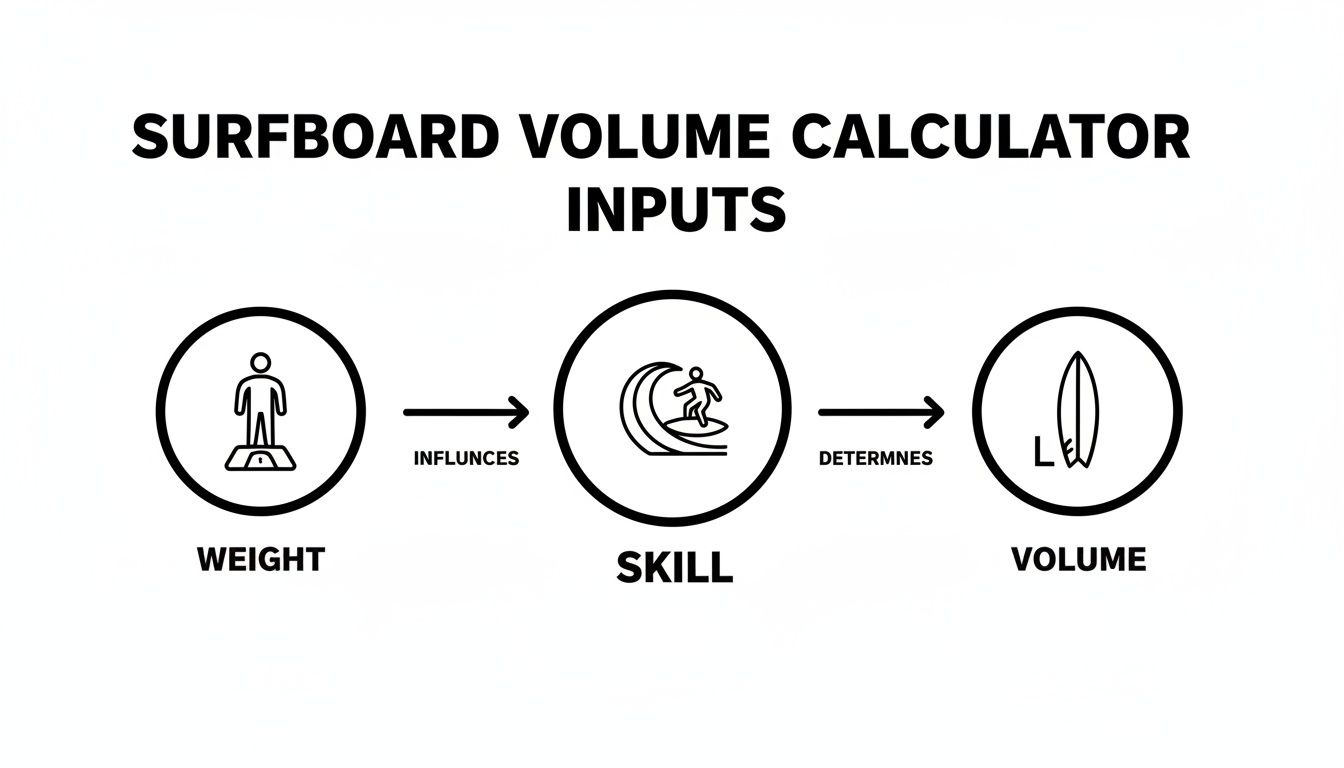
This simple flow shows how your personal stats are the baseline for figuring out the right amount of flotation. Now, let’s look at how to apply that flotation across the different board shapes you'll find here at Blitz Surf Shop.
Shortboards and Performance Hybrids
Best for: Intermediate to expert surfers in decent waves.
Performance shortboards are the Ferarris of the surfing world. They pack their volume into a refined, narrow outline with a pulled-in nose and tail, all designed for high-speed turns and critical manoeuvres. When you match your volume to a shortboard, you’re picking a board that puts responsiveness way ahead of stability.
Performance hybrids, like many of the models from Firewire Surfboards, offer a slightly more forgiving middle ground. They often have a touch more width and foam under the chest, making them easier to paddle while still giving you that high-performance feel. If your volume calculation puts you in the lower range for your weight, a shortboard or hybrid is probably the right call for pushing your surfing.
Fish and Funboards
Best for: Beginners to advanced surfers in small to medium waves.
Fish surfboards are the absolute masters of making everyday and softer conditions fun. They’re typically shorter, wider, and flatter than shortboards, carrying their volume generously through the whole shape. This design gives them incredible paddle speed and lets them glide effortlessly through weaker, mushier sections.
The beauty of a fish is how it makes average conditions feel amazing. That extra volume, spread out over a wider template, gives you a feeling of speed and flow that's hard to beat on smaller days.
Funboards and mid-lengths take this idea even further, offering more stability and making it even easier to catch waves. They bridge the gap between shortboards and longboards, giving you a smooth, cruisy ride that’s perfect for intermediates looking to progress or anyone just wanting to max out their wave count. If you want to get to know these super versatile shapes a bit better, check out our ultimate guide to fish surfboards.
Longboards and Soft-tops
Best for: All skill levels, especially beginners or anyone in small, gentle waves.
Longboards are the original wave-riding machines, and their design is all about maximising volume for flotation and glide. A longboard will have way more volume than any other board type, making it the easiest to paddle and catch waves on. This makes them the ultimate tool for learning or just for enjoying small, peeling waves with a bit of style.
Soft-tops are pretty similar, specifically designed with high volume to provide a safe, stable platform for beginners. If your surfboard volume calculator result is at the highest end of the scale for your weight, a longboard or soft-top is the perfect board to get you started and build that confidence. Brands like Softech are even making high-performance soft-tops that mix user-friendly volume with more progressive shapes. Your calculated volume is your guide to choosing the perfect board from our collections.
Tuning Your Volume for New Zealand Waves
The number a surfboard volume calculator spits out is a brilliant starting point, but it's not the final word. To really nail your board choice, you need to think about where you'll be surfing. New Zealand's coastline is a magnificent beast, serving up a massive variety of waves that ask different things of your board.
Think of your perfect volume not as a single number, but as a range you can play with depending on the day's conditions. A board that feels magic on a clean, peeling point break might feel sluggish and underpowered in sloppy beach break mush. Learning how to tweak your volume for your local spot is the secret to a good session, no matter what the ocean throws at you.
This is about looking past the calculator and understanding how wave power, shape, and even the time of year should shape your decision. Making small adjustments up or down within your recommended range will make sure your board is perfectly suited to the waves you ride the most.
West Coast Power vs East Coast Peelers
New Zealand's two coasts are worlds apart in their surfing experiences, and your board's volume needs to match. The West Coast, open to the raw energy of the Tasman Sea, is famous for its powerful, often hollow beach breaks like you'll find at Piha.
These waves pack a serious punch, but the paddle out can be a battle, and getting in early is everything. For these conditions and for lower skilled surfers, you should think about adding a litre or two to your calculated volume. That extra foam gives you a massive boost in paddle power, helping you get through the whitewater and onto steep waves before they get too critical.
On the other hand, the East Coast, especially around Gisborne and the legendary Wainui Beach, is known for its cleaner, more organised point and beach breaks. Spots like Manu Bay in Raglan serve up long, peeling waves that are often way easier to read and catch.
For these kinds of waves (for a lower skilled surfer), you can comfortably stick to the lower end of your volume range. The wave itself is doing more of the work, so you can focus on manoeuvrability and feeling connected to the board. This is where a slightly lower volume board feels quick, responsive, and alive under your feet. A more advanced surfer is more likely to have a range of boards to choose from depending on the conditions
Adapting to Seasonal Swells
The personality of our waves changes big time with the seasons, and your volume needs can shift right along with them. Summer and winter surfing in New Zealand are two completely different games.
-
Summer Surf: This usually means weaker, smaller, and often mushier waves. In these conditions, volume is your best friend. Choosing a board at the top end of your range, or even a touch above it, will give you the glide you need to catch weak swells and keep your speed through the flat sections. A board from our Fish & Funboards collection is ideal here.
-
Winter Swells: This is when the coast lights up with powerful, clean groundswells. In these stronger waves, too much volume can actually be a problem, making the board feel corky and hard to control. Here, a board in the mid-to-low end of your range gives you the control and rail engagement you need to handle more powerful surf.
Fine-tuning your volume for local conditions is about finding the perfect balance. You're aiming for enough paddle power to get you into the waves you want to ride, without sacrificing the control you need to surf them well.
Ultimately, the best surfboard volume calculator is the one you combine with your own local knowledge. To get a better handle on what makes our waves tick, check out our detailed guide on how waves form. This knowledge will empower you to see your calculator result not as a strict rule, but as an expert suggestion you can smartly adapt to score the best waves at your home break.
Avoiding Common Mistakes with Your Board Volume
A surfboard volume calculator is a brilliant tool. It gives you an incredible starting point, a number that’s grounded in your height, weight, and ability. But it’s critical to remember that this number is a guide, not gospel. The most common pitfall we see is surfers treating this figure as the absolute final word, completely ignoring the subtle, real-world factors that can make or break a board choice.
This is where a bit of human experience comes in. Let's bridge that gap between the number on the screen and the perfect board under your feet, highlighting the classic mistakes and how to sidestep them.
Rushing to Drop Volume Too Quickly
One of the biggest temptations for any improving surfer is the race to drop volume. You see the pros on their wafer-thin blades and think that’s the secret sauce for better surfing. While progression does eventually mean you can handle less foam, dropping too much, too soon is a classic error that will stall your improvement dead in its tracks.
Think of it this way: say you’re catching ten waves a session on your 38-litre board. Dropping to 32 litres might seem like the next logical step up the performance ladder. But if that huge drop in volume means you now struggle to paddle and only catch three waves, you’ve just slashed your practice time by a massive 70%. You're not actually progressing; you’re just spending a lot more time getting frustrated.
A core piece of advice we give everyone at the Blitz Surf Shop is simple but effective: "When in doubt, add a litre or two." A little extra foam is almost always more helpful than not having enough. It keeps your wave count high, and that's the single most important factor for getting better.
To avoid this trap, just be patient. When you feel ready to downsize, do it in small, controlled steps—maybe two or three litres at a time, not six or seven. This gradual approach allows your skills and paddle fitness to catch up to the new board, ensuring you keep catching waves and, most importantly, having fun.
Ignoring the Impact of Your Wetsuit
In New Zealand, wearing a thick wetsuit is common for much of the year. Surfers often overlook that neoprene, when wet, adds significant weight and drag. A full 5/4mm winter steamer with a hood, boots, and gloves can noticeably increase the load on you and your board.
This added weight from your gear means you might need more volume in your board. If your calculator suggests 34 litres, you might find that a 35-litre board works better in your winter kit as the wetsuit adds buoyancy.
Conversely, when you switch to a 2mm spring suit or just boardshorts in summer, you lose that extra weight. The same 35-litre board may suddenly feel more responsive and easier to paddle. It’s important to consider this seasonal change. Many experienced Kiwi surfers use a higher-volume board during winter sessions and a more streamlined one for summer to adjust for their gear.
Forgetting Your Personal Surfing Goals
Finally, a calculator has no idea what you actually want to do on a wave. Your personal goals should play a huge role in your final board choice. Are you dreaming of perfecting your cross-step on a longboard, or are you trying to stomp your first air reverse on a shortboard?
These two goals demand completely different tools, even if the rider's weight and skill level are identical.
-
For Cruising and Style: If your focus is on flow, glide, and style—think nose-riding or smooth, drawn-out cutbacks—then a bit of extra volume is your best friend. It provides the stability and trim speed you need for those kinds of manoeuvres. You'll likely find your perfect board in our Longboards collection.
-
For Progressive Surfing: If you're chasing high-performance airs, sharp snaps, and radical turns, you'll naturally gravitate towards a board at the lower end of your volume range. Less foam makes a board lighter and more responsive under your feet, allowing for the quick, explosive movements that modern surfing demands. Our range of Shortboards has exactly what you need.
Being honest about the kind of surfing you want to do right now is essential. Don’t buy a board for the surfer you hope to be in five years; buy a board that will help you have more fun and achieve your goals for the next six months. Misjudging your equipment is one of the most common issues we see, and you can learn more about how to sidestep these traps in our guide on the common mistakes new surfers make with their gear. Combining the calculator's data with your own ambitions is the key to finding a board you'll truly connect with.
Some Helpful Surf Volume Calculators By Surfboard Brands
JS Industries surfboard volume calculator
Firewire Surfboard volume calculator
Global Surf Industries volume calculator
Your Surfboard Volume Questions Answered
Working out your surfboard volume can feel like a bit of a dark art, but once you get your head around it, it becomes the single best tool for picking a new board. To wrap things up, we've pulled together the most common questions we get asked at the shop about using a surfboard volume calculator. Hopefully, these answers will clear up any confusion and get you amped to find that perfect board.
How Accurate Is a Surfboard Volume Calculator?
A surfboard volume calculator is a fantastic starting point. Shapers and surfers have dialled in the formulas over years, so it gives you a really solid recommendation based on your key stats. Think of it as getting a personalised volume range from an expert who knows their stuff.
But it’s not gospel. The calculator has no idea about your local break, whether you're squeezing into a thick winter wettie, or if you surf more off the back foot. That’s why you should treat the number as your baseline—a solid foundation to build on. You add the final touches based on your own experience and where you surf.
What if I Am Between Two Recommended Volumes?
This happens all the time, and it's a great question. If the calculator spits out a number that puts you between two board sizes you're looking at, our advice is nearly always the same: go with the one that has a little more volume.
The best advice we give out at Blitz Surf Shop is this: when in doubt, add a litre or two. That tiny bit of extra foam is rarely going to hold back the average surfer, but it almost always helps with paddling and catching more waves. More waves equals more fun and faster improvement. Simple as that.
The only time you might ignore this is if you're an advanced surfer chasing a board specifically for powerful, perfect waves, where a lower volume can give you a bit more knife-like control. For the rest of us, that extra float is a massive plus.
Does My Age Really Affect My Volume Needs?
Yep, it absolutely does. It might feel like just another number to punch in, but your age is a super important factor for any good surfboard volume calculator. As we get older, our bodies change—that's just life. Paddle power, flexibility, and how fast you can pop to your feet might not be quite what they were a decade ago.
Adding a few extra litres of volume is an easy and seriously effective way to balance things out. It just means you can still paddle strong, get into waves early, and keep your wave count high. It’s not about surfing "less"; it's about surfing smarter by choosing gear that helps you stay out there and have a blast for years to come.
Should My Next Board Have the Same Volume?
Not always. Your ideal volume should change as your surfing changes. You always want to be on a board that feels right for your current skill, fitness, and the waves you're actually riding.
Here’s a quick way to think about it:
-
If You're Progressing Quickly: You might be ready to drop a litre or two. If your current board feels a bit chunky or slow through turns, stepping down a touch can make your next board feel way more responsive.
-
If You're Surfing Less Often: Your paddle fitness might have dropped off a bit. In that case, adding a litre or two will help you make the most of your sessions and keep that wave count up.
-
If You're Targeting Different Waves: Moving from a mushy beachie to a firing point break might mean you can handle less volume. On the other hand, if you're mostly surfing weak summer slop, a board with more volume is going to be your best friend.
The main thing is to be honest with yourself about where you're at right now. Don't buy a board for the surfer you hope to be in a year; buy the board that’s going to help you have the most fun today.
Where Can I Find Boards in My Volume Range?
Once you’ve got your target volume, the fun part starts—shopping! You can start looking at all the different shapes that will give you that magic number. At Blitz, we make it dead easy to find what you're after.
-
For high-performance surfing, check out our collection of Shortboards.
-
If you need a great all-rounder for everyday Kiwi conditions, our Fish & Funboards are spot on.
-
For maximum wave-catching and smooth cruising, explore our range of Longboards.
Using your volume to filter through these boards will quickly narrow down the options and help you find something perfectly suited to you.
Still got questions? The best surfboard volume calculator is a chat with someone who knows boards. The team at Blitz Surf Shop has been matching Kiwi surfers with the right boards for decades. Swing by the shop or hit us up online—we’re here to help you find your magic board. https://blitzsurf.co.nz


