

When people ask, "what size surfboard do I need," the answer always comes back to two things: your weight and your skill level. If you’re just starting out, remember this golden rule: more foam is your friend. That means a bigger, thicker, and wider board is going to give you the stability and paddling power you need to get going. As you get better, you can start riding smaller, less buoyant boards for more performance and tighter turns.
If you want to head straight to surfboards for sale:
Your Direct Answer To Choosing A Surfboard
Walking into a surf shop for the first time can be a bit much. You’re hit with a wall of shiny boards in every shape and size imaginable, and all the technical talk can make your head spin. But don't worry, the core idea is actually pretty straightforward.
Finding the right board starts with being honest about your current ability and your weight. Forget what the pros are riding on Instagram for a minute. Your only goal right now should be to catch as many waves as possible and have a blast doing it.
This is where that old surfer’s mantra, "more foam is your friend," really rings true. "Foam" is just the stuff inside the board, and more of it equals more volume. It's volume that gives a board its float and stability, making it way easier to paddle, catch waves, and get to your feet.
Once you’ve got the basics dialled, you can start thinking about boards with less foam. They’re not as stable, but they’re faster and way more responsive, letting you pull off the sharper turns and advanced moves you've been dreaming of. This trade-off between stability for beginners and performance for advanced riders is the key to picking the right board at every stage of your surfing journey.
This chart breaks down that fundamental choice.
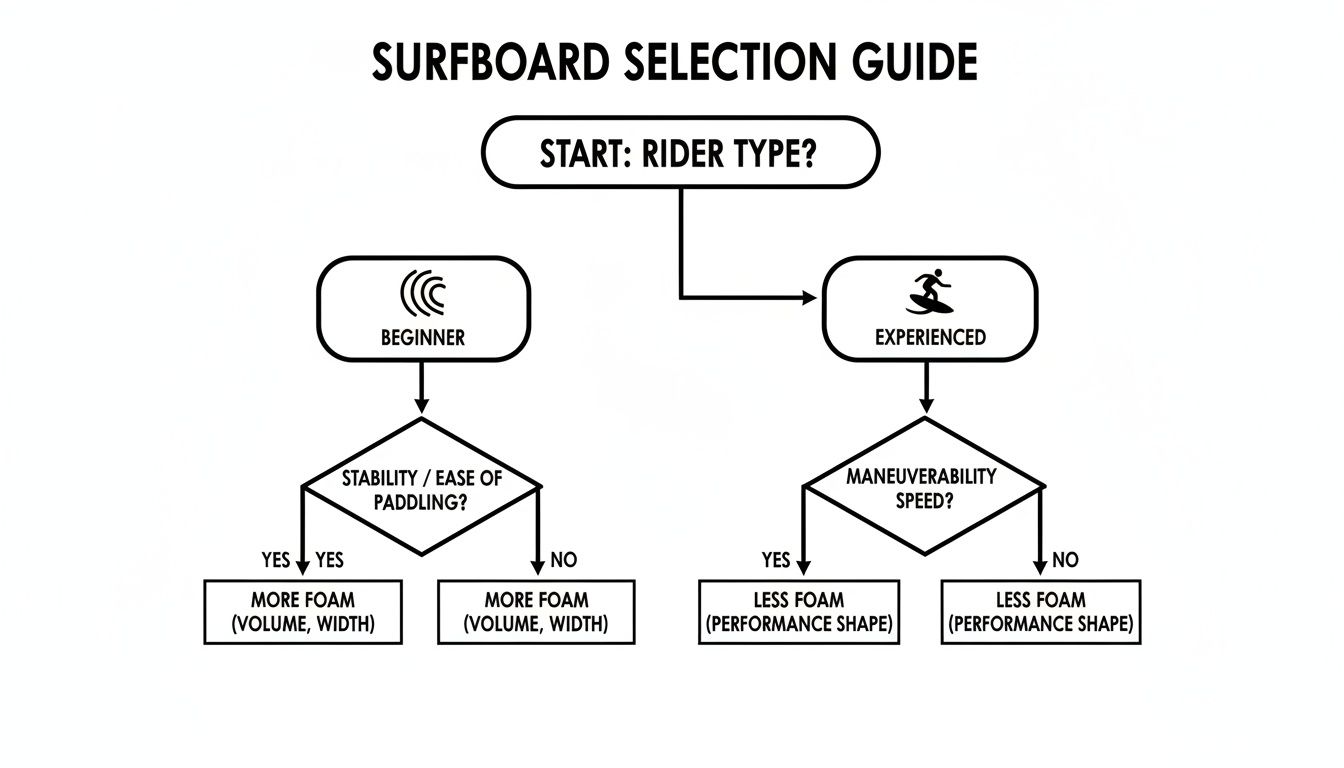
As you can see, it's a clear path: new surfers need more foam to build confidence, while experienced surfers can sacrifice that foam for pure performance.
Matching Size To Your Experience
So, what does this look like in the real world? A beginner weighing 80 kg is going to have a much better time on a stable, high-volume softboard or longboard, probably somewhere in the 8'0" to 9'0" range. An advanced surfer of the same weight, on the other hand, could be ripping on a zippy 6'0" shortboard with way less volume.
The number one mistake we see new surfers make is buying a board that's way too small. They see experienced riders on these sleek shortboards and want to jump straight to that, but it almost always ends in frustration and super slow progress.
The history of surfing here in New Zealand tells a similar story of progression. Back in 1963, the scene was tiny, with maybe 300 riders in the whole country. By 1967, that number exploded to 15,000. Today, there are an estimated 240,000 of us enjoying our incredible 15,000 km coastline—from gentle rollers perfect for learning to heavy breaks that test the best. Our legendary 90 Mile Beach alone serves up 88 km of waves for every kind of board you can think of. You can read more about the incredible rise of surfing in Aotearoa on the NZ History site.
Quick-Look Surfboard Size Guide
To give you a solid starting point, we've put together a simple chart. Just find your skill level and weight to get a feel for the right board type and volume for you.
| Rider Skill Level | Rider Weight (kg) | Recommended Board Type | Target Volume (Litres) |
|---|---|---|---|
| Beginner | 50–70 kg | Softboard / Longboard | 60–80 L |
| Beginner | 70–90 kg | Softboard / Longboard | 75–100 L |
| Intermediate | 60–80 kg | Funboard / Mid-Length | 40–55 L |
| Intermediate | 80–100 kg | Funboard / Mid-Length | 50–65 L |
| Advanced | 65–85 kg | Shortboard / Fish | 28–38 L |
Think of this table as your launching pad. It's not a set of rigid rules, but it’s a brilliant guide to get you looking in the right direction. From here, you can start to fine-tune your choice based on the other factors we’ll dive into next.
Understanding The True Meaning Of Surfboard Size
When you first ask "what size surfboard do I need?", it's easy to just think about length. A 6'2" shortboard or a 9'0" longboard. But that’s like judging a book by its cover—you're missing the most important parts of the story.
A surfboard's true size is a tale told in three dimensions, and getting your head around all three is the secret to unlocking better performance and way more fun in the water. The three core measurements that really define a board's personality are Volume, Width, and Thickness. These numbers work together to dictate how stable a board is, how fast it paddles, and how it responds under your feet. Learning to read them will turn you from a confused beginner into a savvy board buyer.
Volume: The Ultimate Measure Of Float
If there’s one number to rule them all, it’s volume. Measured in litres (L), volume is the single most accurate gauge of a board's buoyancy—basically, how well it floats you in the water.
Think of it like a boat. A massive cruise ship displaces a heap of water and sits high on the surface, making it super stable. A tiny dinghy, on the other hand, sits lower and feels much tippier. A board with more volume will float you better, which makes paddling and catching waves a whole lot easier. This is precisely why beginners thrive on high-volume boards.
In contrast, a low-volume board sits deeper in the water. This gives you less float but allows for quicker, more sensitive turns—something experienced surfers need. For a deeper dive into this critical concept, check out our detailed guide on how to choose the right volume for your surfboard.
Width: Your Platform For Stability
Width is your board's side-to-side measurement, usually taken at its widest point. The easiest way to get it is to picture a raft versus a canoe. A wide raft is incredibly stable and almost impossible to tip over, perfect for a lazy float. A narrow canoe is much less stable but can turn on a dime and slice through the water with speed.
This applies directly to surfboards:
-
Wider Boards (21"+): These offer a stable platform that’s super forgiving when you're learning to pop up. They’re also brilliant for gliding over flat, weak sections of a wave.
-
Narrower Boards (under 20"): These allow for lightning-fast rail-to-rail transitions, which is essential for performance surfing and sharp, snappy turns. They're less forgiving but far more nimble.
A wider outline provides a solid, dependable base, which is why you'll see generous widths on beginner-friendly options.
Thickness: The Engine For Paddling Power
Thickness is the final piece of the puzzle, measuring the board's depth from the deck to the bottom. This dimension is the engine behind your paddling power. A thicker board simply packs more foam, which translates directly into more buoyancy and forward momentum with every single stroke.
A common mistake is overlooking how thickness is distributed. A board might be thick down the centre to help you paddle, but have thinner, more tapered rails (the edges) to help it bite into the wave face during turns.
This combination of a strong "engine" in the middle and sensitive controls on the edges is the hallmark of a great surfboard design. For a beginner, a board that is consistently thick from nose to tail provides the most straightforward paddling advantage, helping you get into waves earlier and more often.
Mastering these three elements—volume, width, and thickness—moves you beyond just looking at length. It empowers you to truly understand what size surfboard you need for your journey.
How Skill And Fitness Influence Your Board Choice
The board a pro rides in a competition would be a frustrating, wobbly nightmare for someone just starting out. That’s because the single most important factor in finding the right surfboard isn’t the board—it’s you. An honest look at where you're at with your ability and physical fitness is the key to choosing a board that helps you get better, not one that holds you back.
It’s tempting to buy a board for the surfer you want to be, but the secret to improving is to pick the board that matches the surfer you are today. For beginners, this means more volume and stability. For seasoned surfers, it means trimming down the foam to get that high-performance feel.
Honestly Assessing Your Skill Level
To find your perfect match, you first need to figure out where you are on your surfing journey. Let’s break down what each stage actually looks like in the water.
-
Beginner: You're new to the game, still getting the hang of paddling, and dialling in your pop-up. You’re probably catching waves in the whitewater or just starting to paddle for small, unbroken green waves. The main goal? Just getting to your feet and riding straight to the shore.
-
Intermediate: You can consistently paddle out, catch green waves, and pull off basic turns like a bottom turn and a cutback. You're comfortable riding along the face of the wave and are starting to figure out how to generate your own speed.
-
Advanced: You've got your board on lock in all sorts of conditions, from small peelers to powerful, overhead waves. You can throw down critical manoeuvres like snaps, floaters, and maybe even get yourself barrelled.
Being truthful here is everything. Grabbing a board that’s too advanced for your skill level is the fastest way to stall your progress and suck all the fun out of surfing.
The Impact Of Fitness And Age
Your physical condition plays a huge role in what board you should be riding. Surfing is a seriously demanding sport that requires a tonne of paddling strength, core stability, and general endurance. A fit teenager can paddle a low-volume shortboard around for hours, catching waves without breaking a sweat.
But for the weekend warrior who doesn't get in the water as often, more foam is your friend. A board with extra volume makes paddling easier, saves your energy, and helps you catch more waves per session—which is what it's all about, right? Beyond just being fit, developing a solid core through dedicated core stability exercises is crucial for managing different board sizes and powerful conditions.
Here in New Zealand, surfing brings everyone together. Demographically, 34.2% of Kiwi surfers are aged 40-54, with the 25-39 group right behind at 32.3%. We’ve been helping generations of surfers here at Blitz Surf Shop in Gisborne since 1983, and we’ve seen that mid-lengths in the 7'0"-8'0" range are spot-on for handling our classic East Coast swells, especially for surfers in these age brackets.
If you want to boost your paddle fitness, our guide on cross-training for surfing has some practical tips to get you started.
Matching Your Surfboard To New Zealand Waves
Ever tried taking a board that absolutely flies at Raglan to a softer beach break near Auckland, only to feel like you’re surfing through honey? It’s a classic reminder of a fundamental truth: the perfect surfboard is a partnership between you, your board, and the waves you actually ride.
Getting a handle on the personality of your local break is the final, crucial piece of the puzzle. A board's design can either groove with a wave's power and shape, or it can fight you every step of the way, turning a fun session into a frustrating battle. This is where we need to talk about a key design element: rocker.
Understanding Rocker: The Curve That Counts
If you lay a surfboard on its side and look at its profile, the rocker is that gentle (or not-so-gentle) upward curve from nose to tail. It might seem subtle, but it completely dictates how a board feels and performs in the water.
Let’s break it down. A board with very little curve (a flat rocker) is like a speedboat. It has a long, straight waterline that lets it skim across the surface with minimal drag. This makes it seriously fast in weaker, mushier waves like those you might find at Waikanae Beach/Roberts Road, helping you glide through gutless sections with ease.
On the flip side, a board with a tonne of curve (a high rocker) is more like a jetski. It's not built for straight-line speed; it’s all about agility and whipping into tight turns. That pronounced curve fits perfectly into the steep, pocket of a powerful wave, stopping the nose from digging in (what surfers call "pearling") and letting you pivot on a dime. Great for heaving Wainui waves.
Think of it this way: a flat rocker is for generating speed on flatter waves, while a high rocker is for controlling speed on steeper, more powerful waves. Your local break dictates which you'll need more of.
Matching Your Board To Your Break
So, what does this mean for you as a Kiwi surfer? Aotearoa’s coastline dishes up every kind of wave you can imagine, and your board choice needs to reflect that.
Let’s put this into a real-world context:
-
Gentle Beach Breaks: If you spend most of your time at mellow, rolling beachies, a board with a flatter rocker will be your best mate. It’ll help you paddle faster, get into waves earlier, and make the most out of less powerful conditions.
-
Powerful, Hollow Breaks: For anyone charging the hollow, fast-peeling waves at spots like Gisborne’s Wainui beachbreaks or Raglan, you’ll want more rocker. That curve helps the board fit into those critical, steep sections and gives you the responsiveness you need to stay in the sweet spot.
Understanding how waves get their grunt and shape is key to getting this right. For a deeper dive, check out our guide on how waves form in New Zealand. It’s packed with local insights that will help you read the ocean better and choose a board that’s perfectly suited to your home break's unique character.
Surfboard Recommendations By Type And Size
Alright, let's put it all together. You've got the theory down—volume, how your ability changes the game, and why your local break is so important. Now it’s time for the fun part: matching all that knowledge to the actual boards you’ll see on the racks at Blitz Surf Shop.
We'll run through the main styles, from the super-forgiving softboards right up to the high-octane shortboards. Every board has its own personality, and this is your cheat sheet to finding the one that lines up with your surfing goals.
Softboards: The Ultimate Learning Tool
Often called "foamies," these are the undisputed champions for anyone starting out. Their soft foam construction makes them incredibly safe and forgiving (for you and others in the water), while their massive volume provides all the stability you need to get your confidence up.
-
Best For: Absolute beginners and kids.
-
Ideal Waves: Small, gentle whitewater and cruisy, rolling green waves.
-
The Vibe: Maximum fun, zero frustration. These boards are all about catching heaps of waves and getting to your feet without a struggle.
When you're picking a softboard, go big. Seriously. More length and volume directly translate to a better time in the water for your first few sessions. Have a look at our great range of surfboard options for beginner and progressing surfers for some solid choices.
Longboards: Classic Style And Glide
Longboards are all about flow, glide, and that timeless soul-surfer style. Traditionally 9'0" and longer, these boards are absolute wave magnets, perfect for those small, weak days when nothing else seems to work. Their huge surface area gets you into waves earlier than everyone else.
But they're not just for beginners. In the right hands, a longboarder can perform elegant cross-steps, stylish nose rides, and graceful, carving turns.
-
Best For: Beginners wanting ultimate stability, or experienced surfers after that classic, cruisy feeling.
-
Ideal Waves: Small to medium-sized, gently peeling waves. Think long, cruisy lines.
-
The Vibe: Smooth, graceful, and squeezing the fun out of every single ripple.
Mid-lengths: The Versatile All-Rounder
Sitting right in that sweet spot between a longboard and a shortboard, mid-lengths (or funboards) are arguably the most versatile boards you can own. Ranging from around 6'8" to 8'6", they perfectly blend the paddle power of a longer board with some of the flick-of-the-wrist manoeuvrability of a shorter one.
This makes them the perfect board for an intermediate surfer stepping down from a longboard, or a fantastic "one-board quiver" for someone who just wants to handle the huge variety of waves we get here in NZ.
-
Best For: Progressing intermediates or anyone who wants one board that can do it all.
-
Ideal Waves: Just about anything, from knee-high slop to fun, overhead peelers.
-
The Vibe: The ultimate compromise. It's dependable, fun, and always ready for a session, no matter what the forecast says.
A Sport NZ report found that 34.2% of surfers here are in the 40-54 age bracket. A lot of those surfers are choosing forgiving mid-lengths from 7'6" to 8'6" to balance performance with paddle power—essential for making the most of a long session out at spots like Wainui.
Shortboards: High-Performance Surfing
Shortboards are the pinnacle of surfboard design, built for one thing: high-performance surfing. They exist for speed, power, and radical manoeuvres in the most critical, powerful part of the wave. With the least volume and the most rocker, they're incredibly responsive but also extremely challenging to ride.
Let's be clear: these boards are strictly for experienced surfers who can already generate their own speed and link turns together with confidence.
Choosing a shortboard is a deeply personal thing. A quarter of an inch in length or a single litre of volume makes a massive difference. It's the final step in a long journey of progression, not the first.
-
Best For: Advanced surfers only.
-
Ideal Waves: Good quality, powerful, and steep waves that offer a canvas for performance surfing.
-
The Vibe: Fast, aggressive, and pushing the limits.
Board Type Sizing Guide For NZ Surfers
To make things even clearer, here’s a handy table breaking down the general size and volume recommendations for each board type. Use it as a starting point, but remember to factor in your fitness and the specific waves you'll be riding.
| Board Type | Best For (Skill Level) | Ideal Wave Type | Rider Weight (kg) | Recommended Size Range |
|---|---|---|---|---|
| Softboard | Beginner | Small, weak waves (0-2 ft) | Under 60 | 7'0" – 8'0" (60–80 L) |
| 60–85 | 8'0" – 9'0" (75–95 L) | |||
| Over 85 | 9'0"+ (90–110 L) | |||
| Longboard | Beginner to Expert | Small to medium peelers (1-4 ft) | Under 70 | 9'0" – 9'2" (65–75 L) |
| 70–90 | 9'2" – 9'6" (70–85 L) | |||
| Over 90 | 9'6"+ (80–100+ L) | |||
| Mid-length | Intermediate+ | All-round conditions (2-6 ft) | Under 65 | 6'8" – 7'2" (40–48 L) |
| 65–85 | 7'2" – 7'10" (45–55 L) | |||
| Over 85 | 7'10" – 8'6" (52–65 L) | |||
| Shortboard | Advanced | Good, powerful waves (3-8 ft) | Under 65 | 5'6" – 5'10" (24–28 L) |
| 65–80 | 5'10" – 6'2" (27–34 L) | |||
| Over 80 | 6'1" – 6'6" (32–40 L) |
Think of this table as a solid guide, not a strict set of rules. Your perfect board might sit just outside these ranges, and that’s totally fine! The best way to know for sure is to get in the water and feel it out.
Finding Your Perfect Board At Blitz Surf Shop
Alright, you’ve got the theory down, but nothing beats talking it over with someone who lives and breathes surfing. This is where we bring all that knowledge home to Blitz Surf Shop. Nailing the answer to "what size surfboard do I need?" is a journey, and we’re here to be your guide—not just a checkout counter.
Our team in Gisborne doesn't just sell boards; we surf them. We know the ins and outs of our local breaks and exactly how a board's design translates to performance in real New Zealand waves. We can take everything we’ve talked about—your skill, weight, fitness, and the waves you want to ride—and help you find that perfect match from world-class brands like Firewire and Slater Designs.
Your Local Experts In Gisborne
Popping into our store means getting proper, personalised advice. We can walk you through the subtle differences between models, let you feel the rails, and make sure the board under your arm just feels right. It’s a hands-on process that takes the guesswork out of the equation and makes sure you leave with a board that’ll genuinely help you progress and have more fun.
At Blitz, we're more than just a store; we’re your partners in surfing. Our goal is to see you out in the water, stoked on your gear and catching the best waves of your life. That commitment has been the heart of our family-owned shop since 1983.
Before you even head out, you can scope the conditions with our live Wainui Beach surf cam right on our website. See what the waves are doing in real-time, then swing by the shop for a chat. We’ll get you sorted.
Supporting Surfers Across New Zealand
Not in Gisborne? No worries. We’re proud to be one of New Zealand’s go-to online surf stores, and we give our customers nationwide the same expert advice you'd get standing in the shop. Just give us a call or flick us an email with your questions, and our team will give you the same detailed guidance.
We’ve made our online shopping experience as straightforward as possible:
-
Expert Online Support: Our crew is on standby to answer your calls and emails to help you find the right size and model.
-
NZ-Wide Delivery: We ship boards and gear safely to your door, anywhere in the country.
-
Subsidised Shipping: We offer part subidised shipping on surfboards.
We get that buying a board online can feel like a big call, which is why we're committed to giving you all the info and confidence you need. You can learn more about what sets us apart in our guide to why Blitz Surf Shop is New Zealand's go-to online surf store.
Here in New Zealand, we’re seeing more people from all walks of life getting into the water. Women, who make up 2.5% of the surfing population, often find their groove starting on forgiving softboards or longboards in the 8'0"-9'6" range—perfect for our punchy winter swells. With the NZ surf apparel market hitting $621M in 2022, investing in quality gear like a solid O'Neill wetsuit alongside the right-sized board is key to staying warm and safe in the lineup. As you can discover in more detail from Sport NZ, having the right equipment makes all the difference.
Common Questions About Surfboard Sizing
Alright, let's tackle a few of the most common questions we hear in the shop. Getting these sorted will help you feel a whole lot more confident when you finally get out in the water.
Should I Start on a Shorter Board to Learn Faster?
This is a classic myth, and honestly, it's the fastest way to get frustrated and give up. It might seem like a good idea to start on something small and zippy, but a board that's too short and lacks volume will sink, wobble, and feel impossible to paddle.
The right move? Go for a longer, wider, and thicker board like a soft-top or a mini-mal. They give you the stability you desperately need at the start, make paddling a breeze, and help you catch almost any wave that comes your way. More waves mean more time on your feet practising your pop-up, and that's the real key to getting better.
"A 2021 NZ injury study identified 502 reported injuries in one survey period. Stats prove bigger boards with more volume cut wipeouts for novices, keeping you paddling longer and reducing risk amid NZ's diverse conditions."
Choosing a stable, high-volume board isn’t just about making things easier—it's a smart safety call. You'll wipe out less, which means you're less likely to get hurt while you're still figuring things out. To get a better feel for the scene here, you can read the full overview of surfing in New Zealand.
Can One Surfboard Work for All New Zealand Waves?
Every surfer dreams of that one 'magic board' that can do it all, but the reality is, it doesn't really exist. New Zealand's coastline throws everything at you, from gentle peelers to heavy, powerful beach breaks.
If you're set on a 'one-board quiver', your best bet is probably a mid-length or a funboard for the average surfer. These shapes are incredibly versatile; they have enough paddle power for the small, mushy days but can still hold their own when the surf gets a bit bigger and cleaner.
But a high-performance shortboard will just sink and struggle (for intermediate and beginner surfers) in weak summer surf, and a big, heavy longboard can become a real handful in powerful, hollow waves. Competemnt surfers will be fine with the right stick for a larger range of conditions
The golden rule is to buy a board for the waves you surf 90% of the time, not the perfect waves you dream about surfing once a year.
Ready to find your perfect match? The expert crew at Blitz Surf Shop is here to give you personalised advice and get you on the best board for your ability and local break. Browse our full range of surfboards today and start your next adventure.


