

You're paddling hard on a borrowed shortboard, watching another wave roll underneath you. When you finally catch one, the take-off feels rushed and the board wobbles before you've found your feet. Back on the beach, a longer board looks tempting, but you don't want to buy something you'll immediately outgrow.
A useful surfboard length guide should help you solve that problem, not match your height to a number. Choose for your current ability, your paddling fitness and the waves you surf. For New Zealand riders, especially around Gisborne and the East Coast, those details matter more than copying someone else's dimensions.
Why Surfboard Length Matters
Put a learner on a narrow, unfamiliar shortboard and they can spend the session fighting the equipment. Give that same rider a forgiving midlength and they may finally have enough time to organise their paddle strokes, settle their balance and approach the take-off without rushing. That's a better starting point for learning than a board chosen for its appearance.
The contrast is easy to recognise when you compare the boards underfoot.
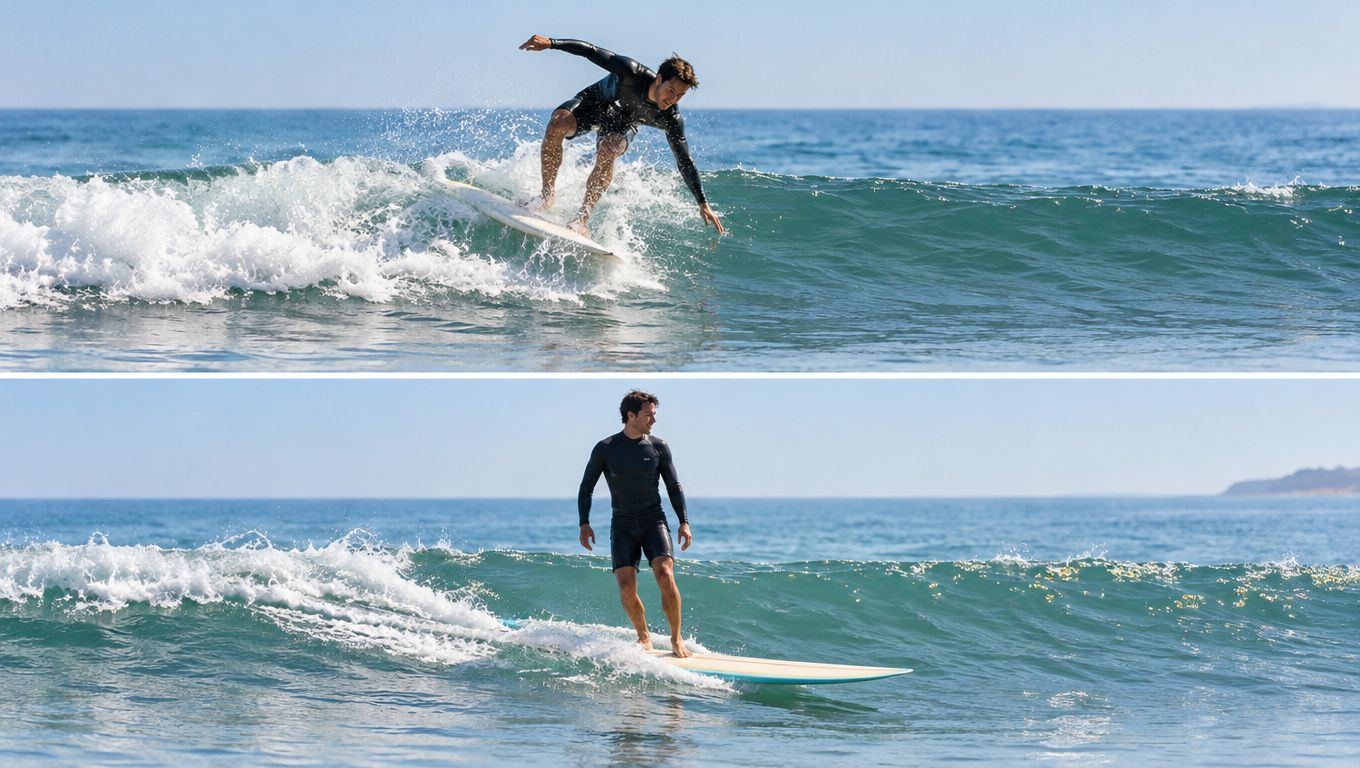
Length affects more than how much board sits in front of you. It changes the paddling platform, the rail line you're trying to turn and the amount of equipment you have to manage between the car and the water. A board that feels reassuring while lying down can still feel cumbersome once you're standing.
Choose the job before the dimensions
New Zealand's relationship with shorter boards developed alongside a change in surfing technique. In 1958, visiting American lifeguards Bing Copeland and Rick Stoner introduced Piha surfers to smaller boards suited to surfing across the wave face, as recorded in Te Ara's history of lifesaving and surfing. That history matters because different board categories answer different surfing ambitions, not different stages of competence.
A longboard isn't a failed attempt at shortboarding. Equally, buying a shortboard doesn't make a rider more advanced. Your equipment should support the surfing you want to do, while leaving enough margin for the ability and fitness you have today.
Start with the job: What does this rider need to do most often in the conditions they actually surf?
For a beginner, that might mean getting stable and catching waves independently. A returning surfer may need easier wave entry without giving up the turns they already know. Someone leaving a generic softboard might want a more responsive shape, rather than a dramatic reduction in length.
Volume, width, thickness, rocker and outline belong in that conversation from the start. Length is an important choice, but it's never the whole choice.
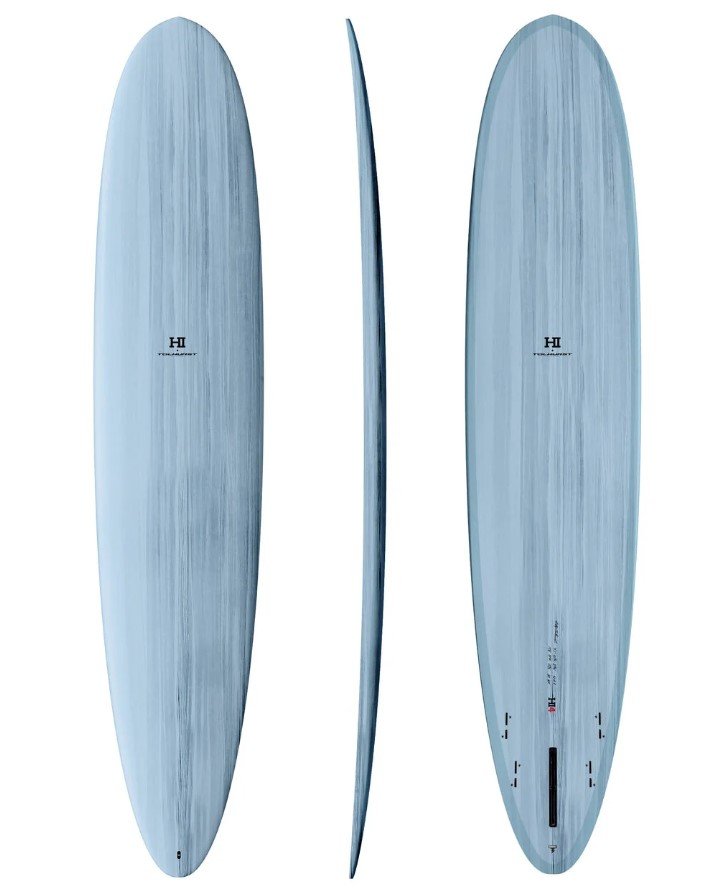
How Length Shapes Your Surfing
Length and volume solve related but different problems. Extra waterline length generally helps a board travel efficiently while paddling. Additional volume provides flotation, but it doesn't tell you how that flotation is distributed or how the board will behave once it's moving.
The practical relationship between glide, flotation and stability looks like this.
Think about moving a long toothbrush through water compared with a compact travel toothbrush. The longer shape encourages a straighter movement, while the compact shape is easier to redirect. It's only an analogy, but it captures the trade-off: the length that helps you hold a line also has to come around when you change direction.
Separate glide from float
When a surfer complains that a board won't paddle, I'd ask what happens. Does the board feel submerged and unstable, or does it float comfortably but lose momentum between strokes? Those experiences call for different conversations.
Adding width can provide a broader platform, and adding thickness can put more flotation into the existing footprint. Adding length spreads the shape farther along the water. None of those changes guarantees a good board if the rest of the design doesn't suit the rider.
The practical beginner recommendations in this Gisborne longboarding guide connect greater waterline length and volume with easier paddling and wave entry. The useful lesson isn't to maximise both indefinitely. It's to identify whether the rider needs support, forward travel or a different balance between them.
- More length: Consider it when maintaining paddle momentum and entering waves are the main difficulties.
- More width: Consider it when the rider needs a more manageable balance platform without an unwieldy overall length.
- More thickness: Check where the added foam sits, rather than assuming extra litres will improve every part of the ride.
- A different outline: Consider whether the nose, tail and rail shape suit the intended turns and wave shape.
Don't confuse paddling ability with surfing ability
A competent surfer can have poor current paddling fitness. A strong swimmer can still struggle with take-off timing and foot placement. Choosing equipment on either fitness or surfing experience alone misses half the problem.
Rocker, the board's curve from nose to tail, also changes how the shape fits the wave. Fin setup and outline affect the turning feel, so a longer board with an appropriate design can be more useful than a compact board with the wrong proportions.
If positioning and timing remain the main difficulties, work on those alongside equipment selection using this beginner surfing guide. Don't expect a purchase to replace practice.
Add length when you need glide. Explore a shorter, wider shape when handling is the constraint. If neither change addresses the actual difficulty, reconsider the whole design rather than adding more foam by default.
Compare Shortboards Midlengths and Longboards
Choose a board family before arguing over small differences in length. A performance shortboard, a forgiving midlength and a traditional longboard can all be appropriate, but they encourage different ways of riding.
This comparison provides a starting point, not a ranking of good and bad boards.
Pick the category that matches your intention
Shortboards make sense for experienced riders who can catch waves reliably and want quick responses and tighter direction changes. The mistake is treating their compact size as an advantage regardless of ability. A responsive board isn't much help if you can't get into a wave with control.
A midlength is a sensible candidate when you want a practical balance between wave access and manoeuvrability. Don't assume every midlength is a learner board, though. A refined shape can ask more of its rider than a broad, forgiving outline with the same stated length.
Longboards suit surfers who value glide, relaxed wave entry and a substantial platform. They also support a distinct style of surfing that experienced riders can keep developing. Before buying, consider the practical work of carrying, storing and controlling the board, not just how it feels on an open face.
Choose the category for the ride you want, then choose the dimensions for the rider you are.
Within longboards, construction and intended use still matter. This comparison of high-performance, all-rounder and traditional longboards is useful when the category appeals but the different shapes are hard to distinguish.
Use the video below as another reference when comparing board styles.
Softboards and SUPs need separate consideration
A softboard describes construction rather than a single length category. For learners, I'd consider a forgiving softboard before a hard, performance-oriented shape chosen only because it fits neatly in the car. Its flex and feel also mean that copying its dimensions into a different construction won't necessarily reproduce the same experience.
Stand-up paddleboards, or SUPs, belong in a different buying conversation. If your main intention is calm-water paddling, fitness or coastal exploration, assess those uses directly. Don't buy a SUP as an exceptionally large substitute for a beginner surfboard.
- For learning: Prioritise a manageable platform and appropriate construction.
- For linking turns: Compare midlength outlines and responsive shapes without sacrificing necessary support.
- For compact performance: Assess whether your technique and usual waves justify a shortboard.
- For paddle-first use: Discuss SUP suitability separately from prone surfing.
Transport matters across every category. The right board must work at the beach, but you also need to get it there safely and regularly. A theoretical match that's miserable to carry is a poor everyday choice.
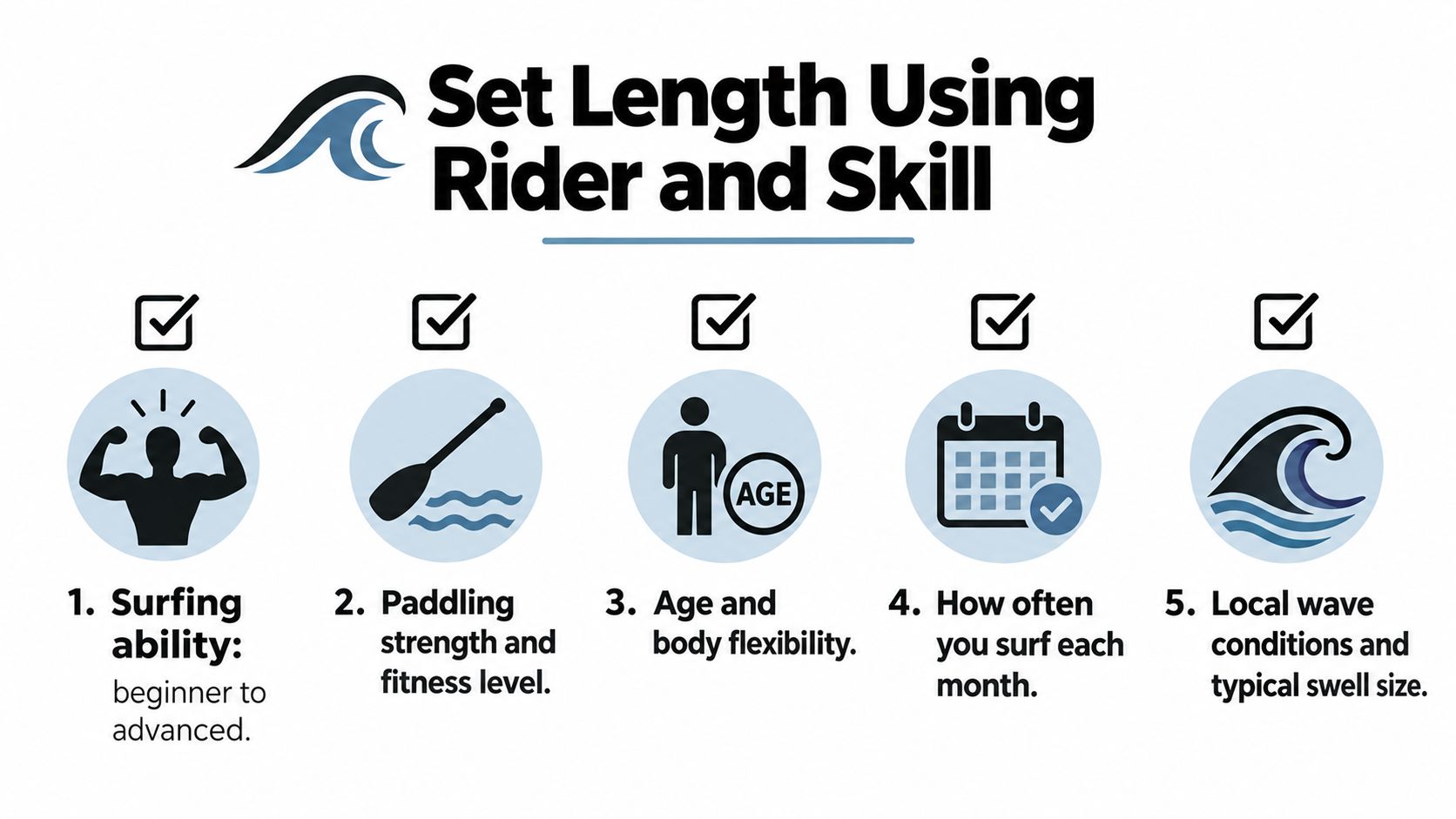
Set Length Using Rider and Skill
There's no reliable universal height-and-weight rule. Height and weight help describe the rider, but they don't tell you whether that person catches unbroken waves, paddles efficiently or surfs often enough to maintain fitness.
Start with what happens during a normal session. Ask where the rider struggles, what they can already do without assistance and what they want to improve next. Only then should the conversation turn to dimensions.
Use body size without letting it make the whole decision
For heavier riders, sufficient flotation belongs near the top of the discussion. But a competent heavier surfer and a heavier beginner shouldn't automatically receive the same recommendation. One may have the technique to use a compact design, while the other needs a more forgiving platform and easier wave access.
A taller rider may need additional volume without needing a particularly long board. A smaller adult may find a shorter, wider, flounder-like outline more manageable than a long shape that's awkward to carry or redirect. Check reach, handling and confidence rather than making assumptions from body size alone.
Use the surfboard volume calculator to inform the discussion, not finish it. A volume estimate can help narrow the search, but it can't assess take-off timing, shoulder comfort or how a particular outline feels underfoot.
- Children: Check whether they can carry, position and control the board, rather than scaling down an adult recommendation mechanically.
- Smaller adults: Look closely at width and manageable handling, not just the shortest available length.
- Women: Choose around individual dimensions, strength, experience and intended use, not a gender-based size label.
- Returning surfers: Assess current fitness separately from remembered ability.
- Surfers returning after injury: Respect any clinical restrictions and discuss movement limitations before choosing equipment.
Age belongs in the conversation because recovery, mobility and priorities can change. It shouldn't become an automatic instruction to ride a bigger board. Ask the person what feels difficult now.
Decide whether to stay longer or go shorter
A beginner's useful targets are independent wave catching, controlled take-offs and reliable direction. A progressing rider should be able to explain what the present board prevents them from doing. Wanting a more fashionable shape isn't the same as having reached a functional limit.
Stay with the more supportive option when:
- Wave catching is inconsistent: You still miss suitable waves or need repeated help with positioning.
- Take-offs feel rushed: You're regularly arriving too late to organise the pop-up.
- Fitness limits the session: You lose paddling effectiveness before you've had useful practice.
- Control remains uncertain: You can stand, but can't reliably choose and maintain a direction.
Test a shorter or more refined option when:
- Wave entry is dependable: You catch suitable unbroken waves without relying on luck.
- Your intention is clear: You want a specific response, such as a tighter turn, rather than less board.
- The current shape is the restriction: You can identify a handling problem instead of assuming every difficult turn is an equipment issue.
- Your usual conditions support it: You'll have appropriate waves in which to use the new design.
Downsizing should preserve useful surfing time. If the change leaves you paddling unsuccessfully through the session, it hasn't achieved the purpose, regardless of how advanced the board looks.
Match Length to NZ Waves
A board recommendation should name the break, not just the country. Even along the East Coast, similar-looking forecast labels can hide quite different sessions. Wave period matters, but it needs to be considered alongside height, take-off shape, wind and what the wave does over the local seabed.
NIWA explains that the northeast coast from North Cape to East Cape is sheltered from Southern Ocean swell by the North Island, with generally smaller waves than the south and west coasts, while cyclone conditions can still produce unusually large surf in its overview of New Zealand wave action. Don't stretch that regional description into a guarantee about every Gisborne session. Use it as context, then inspect the actual break.
Read period alongside wave quality
Environment Canterbury reports that more than half of its measured waves fall within 1.0–2.0 metres, another 32% within 2.0–3.0 metres, with a long-term average period of about 6.5 seconds, in its regional wave-data overview. Those observations aren't a board chart. They show why a national recommendation based on wave height alone is too crude.
Long-period swell can bring a different level of power from shorter-period local wind swell. But don't turn that into another simplistic rule that powerful surf always requires a shorter board. An experienced surfer may need a specialised shape with additional length, while a beginner may need to choose a different break altogether.
MetService has also recommended a “longer more floaty board” for smaller East Coast surf when easterly swell is less common in its El Niño surfing guidance. That's a useful conditions-based recommendation, not an instruction to take the same board into every swell.
Use this guide to New Zealand surf spots to help define your likely locations. Then choose for the waves you'll regularly ride, with enough flexibility for the better days you can safely handle.
Work Through Two Sizing Examples
Local customer experience is useful when it explains a decision. It becomes misleading when someone else's successful dimensions turn into a prescription for everyone.
These Gisborne examples show why the right change isn't always shorter, and why adding volume isn't always the answer.
A beginner moves away from an softboard
For average-sized adult beginners in Gisborne who are coming off softboards, a 7'6 midlength is the most popular length in the shop's experience. Although that transition is sometimes described as moving down from a softboard, it means stepping away from an unsuitable board, not reducing physical length.
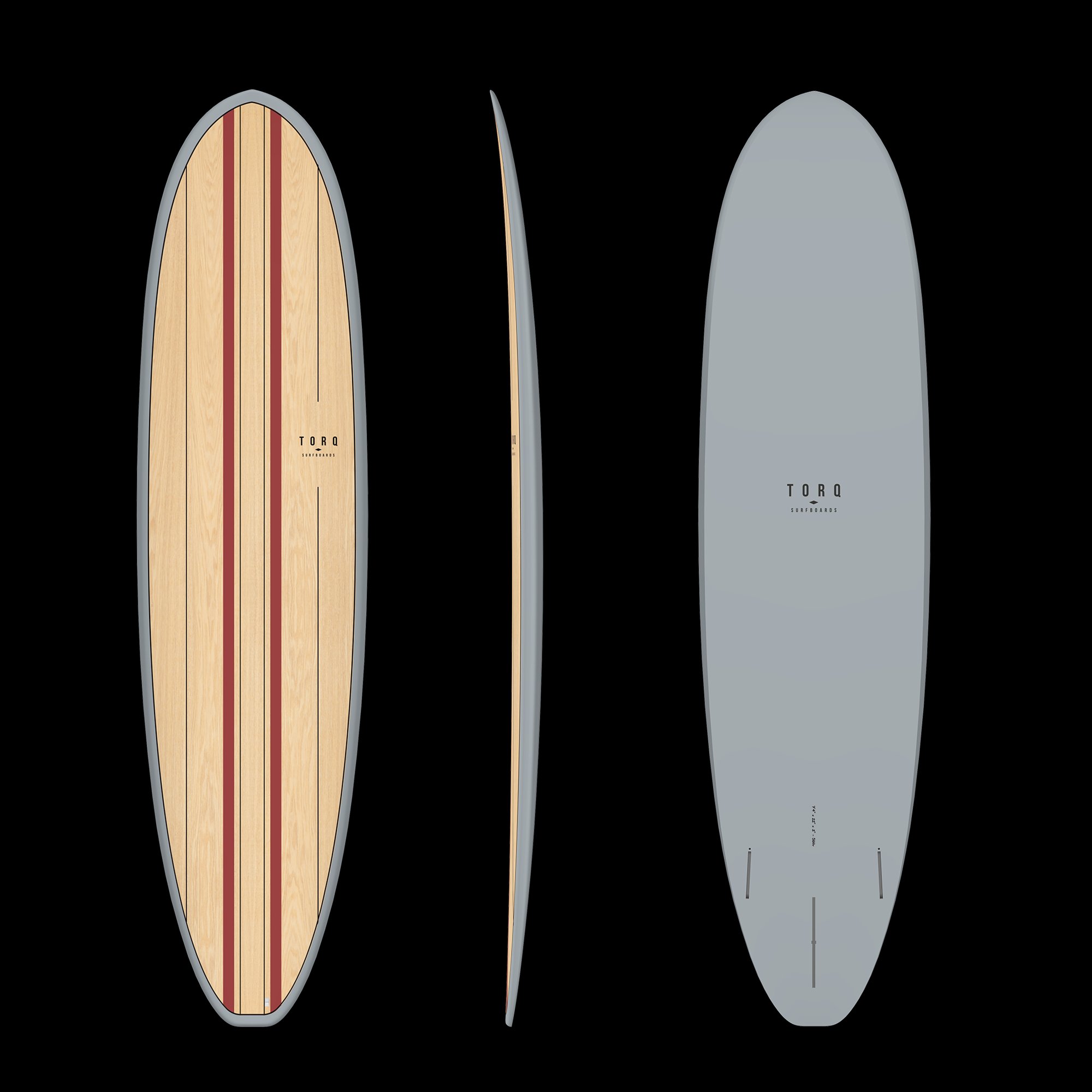
The attraction is the combination of a forgiving shape, buoyancy, width and stability, with a more refined outline that leaves room to progress and link turns. It gives the rider something useful now without requiring them to abandon their turning ambitions.
That recommendation applies to this particular progression problem. It doesn't mean a complete beginner should skip a suitable softboard, or that every midlength with the same length will feel equally forgiving. Check the actual shape and the rider's present control.
A successful change makes the next useful skill more accessible. It doesn't just make the board look more advanced.
A competent heavier surfer changes the approach
Another local customer was a 50-year-old competent surfer who was heavier and wasn't surfing as often as usual. He'd been adding volume to his shortboards to compensate, even though he could still surf well.
When he tried longer boards at around the same volume, he found he caught considerably more waves without compromising the performance he wanted. This is an individual customer observation, not a measured trial or a promise that the same change will suit everyone.
The distinction matters: he didn't need to relearn surfing, and the answer wasn't to keep adding foam. Changing the board's proportions better matched his current use.
- What changed: He tried more length rather than continuing to increase shortboard volume.
- What stayed relevant: His existing ability still informed the performance he wanted.
- What the experience doesn't establish: It doesn't prove that extra length suits every heavier or less-frequent surfer.
Contrast him with a rider who already catches waves comfortably and wants tighter direction changes in steep, well-shaped surf. That surfer may have a good reason to test less length or a more refined outline. Copy the reasoning from these examples, not the dimensions.
Buy or Borrow With Better Expectations
Write down your usual session before choosing a board. Name the break, describe the waves you normally catch and be honest about how often you surf. Add the equipment difficulties you want to solve.
If you'll own a single board, choose something suited to your regular waves that can also handle the better conditions you realistically intend to surf. If you already have a useful everyday board, a second shape can serve a narrower purpose. Don't make your only board a specialist for rare days.
Borrow to compare, not just to confirm
Borrowing a contrasting shape can expose what your current board isn't doing for you. Compare boards in reasonably similar conditions and pay attention to the whole session, not just the best ride.
An unfamiliar board may feel awkward initially because the balance point and take-off position have changed. Give yourself time to adapt, without dismissing obvious control problems. Don't use a trial as a reason to paddle into conditions beyond your ability.
- Before entering: Check whether you can carry the board comfortably and manage it on the beach.
- While paddling: Notice whether positioning and wave approach feel more manageable.
- During take-off: Assess whether you can settle your feet without hurried corrections.
- While riding: Decide whether the board supports the turns and lines you intended.
- Afterwards: Separate equipment problems from unfamiliarity, fatigue and unsuitable conditions.
The surfboard hire guide is a practical place to start when considering a trial before buying. A useful comparison should answer a question, such as whether extra length helps more than a compact, wider shape.
Buy the actual design, not the label
When you're ready to buy, compare the stated length, width, thickness and volume together. Ask about outline, rocker, construction and intended use. Category names such as midlength or all-rounder don't replace those details.
Bring your current board information into the conversation. Explain what works, what doesn't and whether you're changing your surfing style or making the same style more accessible. An experienced local surfer or in-store advisor can give more relevant guidance when they know the problem.
Check the practical fit too: storage, vehicle space, boardbag suitability and the walk to your usual access point. Don't choose a board you'll avoid using because getting it to the water is a nuisance.
For a new learner, I'd prioritise appropriate support and construction. For a progressing rider, I'd protect reliable wave access while refining handling. For an experienced surfer, I'd choose around the intended conditions and response.
Buy for realistic use, not an arbitrary length milestone. The right choice is the board you can control, paddle and enjoy in the waves you surf.
Blitz Surf Shop offers shortboards, midlengths, longboards, softboards and SUPs, with local advice in Gisborne and online shopping across New Zealand. Bring your current board dimensions, describe your usual break and ask for a comparison of length, volume and shape before you choose your next board.


