

81% of respondents identified street skateboarding as their discipline in New Zealand's 2023 national survey, according to Skateboarding New Zealand's 2023 participation report. That's a useful starting point, but it doesn't mean a street popsicle suits everyone looking at skateboard decks for sale. A bowl rider, a kid riding to school, and a surfer practising cutbacks on flat days need different widths, shapes and trucks.
Start with a simpler rule than shoe size or graphics. Match the new deck width to the truck axle you already own, then check wheel clearance, wheelbase and concave. If you're buying used, treat it as a saving only if the wood still has pop and no structural cracks. No single deck does street, park and surfskate well, and pretending otherwise usually ends in a second purchase.
Deck Specs by How You Ride
Use this shortlist first, then narrow it down by your trucks and terrain. These are common retail bands, not one brand's mould.
| Riding style | Wheelbase | Concave and shape | Best for |
|---|---|---|---|
| Technical street, 7.75 to 8.0 inches | 14 to 14.25 inches | Mellow to medium; symmetrical popsicle | Flip tricks and ledges |
| All-round street, 8.0 to 8.25 inches | 14 to 14.5 inches | Medium concave; standard nose and tail | Mixed street and small park |
| Park and bowl, 8.25 to 8.75 inches | 14.25 to 15 inches | Medium to steep; slightly longer shape | Transition, vert and larger riders |
| Cruiser, 8.25 inches and wider | Short and stable | Flat to mellow; little or no kick | Pavement and short transport |
| Longboard, mid-30s to 40 inches long and beyond | Long | Camber, drop or flat; minimal kick | Distance, carving and commuting |
| Surfskate, 29 to 34 inches long, 9 to 10.5 inches wide | Surf-style, not a street wheelbase | Wide nose, mellow concave | Surf practice and tight carves |
Street and Small Park Setups
Say you're learning ollies at a street spot and starting to try ledges. Pick a standard 7-ply popsicle near 8.0 inches with medium concave. It's light enough to flick, wide enough to land on, and the symmetrical nose and tail help when you ride switch or land backwards by accident. Skip a longboard or surfskate for this job. Neither pops or flips like a street deck.
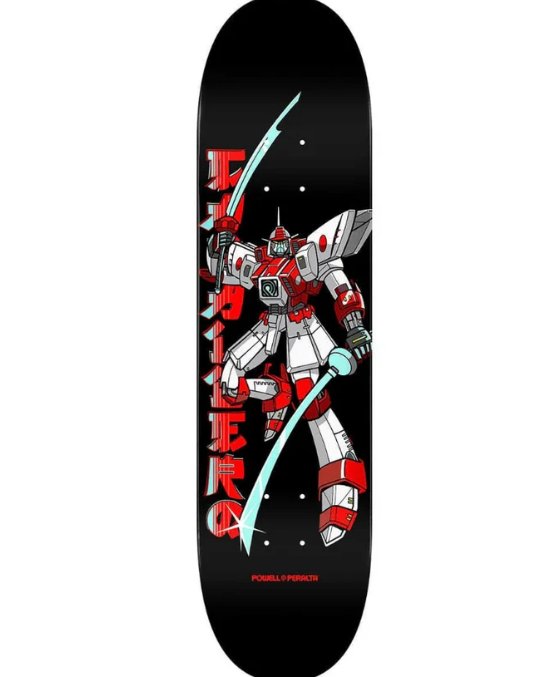
Technical riders who live on flip tricks often stay at 7.75 to 8.0 inches because the board rotates faster. The trade-off is a smaller landing platform. If you're missing landings by a toe or heel, the all-round 8.0 to 8.25 inch band is usually the calmer choice.
Wheel choice matters here too, because a hard street wheel that slides predictably on smooth concrete can feel harsh on rough pavement. If you're unsure, read up on skateboard wheel durometer and hardness before you blame the deck for a rough ride.
Park, Bowl and Transition
A rider who spends most sessions in a flow bowl needs the wider park row. 8.25 to 8.75 inches, medium to steep concave, and a 14.25 to 15 inch wheelbase keep the board steadier at speed and give your feet more to lock into on the wall. A narrow street deck can feel nervous and twitchy on transition, especially for heavier riders.
A wider deck won't make you drop in. It just stops the board feeling like it's trying to leave before you do.
That stability point isn't just comfort. Safekids NZ's child skateboard injury factsheet recorded 725 child hospitalisations associated with skateboarding injuries during 2007–2011, with falls the most common mechanism and fractures the principal injury type. Those figures are historical, but the advice still holds. Pair a stable, correctly sized deck with a correctly fitted approved helmet, elbow and knee pads, and wrist guards.
Cruisers, Longboards and Surfskates
Commuters riding along the beachfront or to school want a different tool. A cruiser trades pop for a flatter, wider platform that clears larger wheels. A modest longboard adds length and stability for distance. Both roll over chips and cracks better than a trick deck on small, hard wheels, which tends to chatter and stop dead on stones.
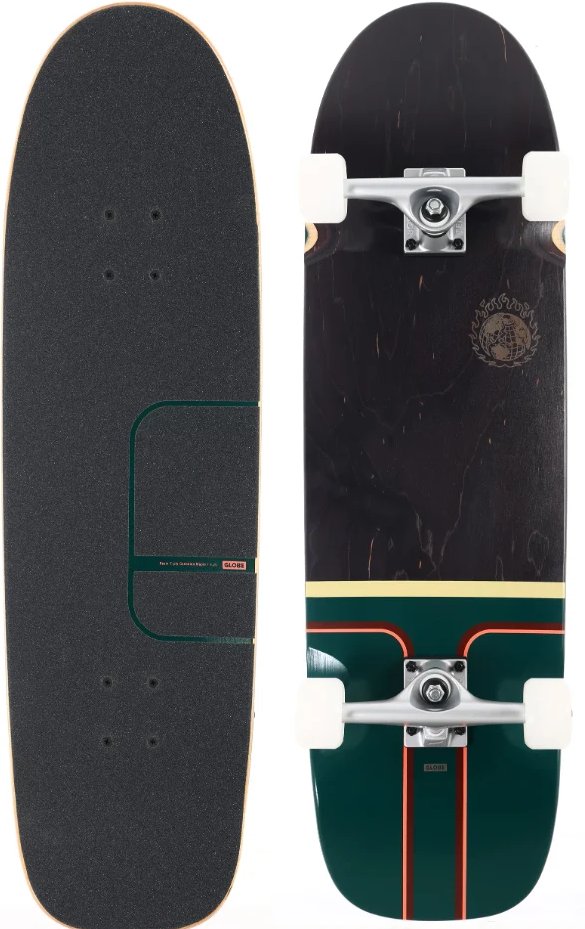
Surf practice is its own category again. A surfskate at 29 to 34 inches long and 9 to 10.5 inches wide needs a surf-adapter truck, not a standard street truck. That front truck is what lets you pump and carve tightly. Bolt a surfskate deck onto normal trucks and you've built an awkward cruiser, not a surf trainer.
Skill Level Picks for Every Rider
Start with skill, not the graphic. The right width for learning is the one your feet can find without looking down.
Beginners and groms should stay on a normal 7-ply maple popsicle near 8.0 inches with medium concave. Don't start on a steep pro shape. A predictable width lets your feet learn where the pockets are, and medium concave gives you lock without feeling like you're standing in a canoe. If you're buying for a child, this guide to skateboards for kids covers sizing and safety basics in more detail.
Intermediate street riders can move to 8.0 to 8.25 inches as ollies get higher and flip tricks enter the picture. That small jump adds landing room without making the board feel slow to flick. Change one thing at a time. If you go wider and steeper and longer all at once, you won't know what helped.
When to Size Up
- Heavier riders: Move toward 8.25 to 8.75 inches for a sturdier platform.
- Bowl and transition riders: Size up for stability on walls and at speed.
- Frequent breakers: Consider an 8-ply layup if you're snapping standard decks quickly.
- Experienced riders replacing a broken deck: Copy the width and wheelbase that already works, unless new terrain is the reason for change.
New Zealand has plenty of both ends of that market. The national community includes first-timers and a large group of long-term, frequent riders who skate right through the year. That mix is why a shop wall carries everything from a grom's first popsicle to wide bowl shapes. One recommendation can't cover all of them.
Whatever the level, budget for protection alongside a first deck. Falls are part of learning, especially on concrete. A helmet and pads don't make a deck choice wrong or right, but they reduce the cost of the mistakes every new rider makes.
How to Measure Width Concave Wheelbase and Shape
You don't need new gear to start. You need a tape measure and the board already in your garage.
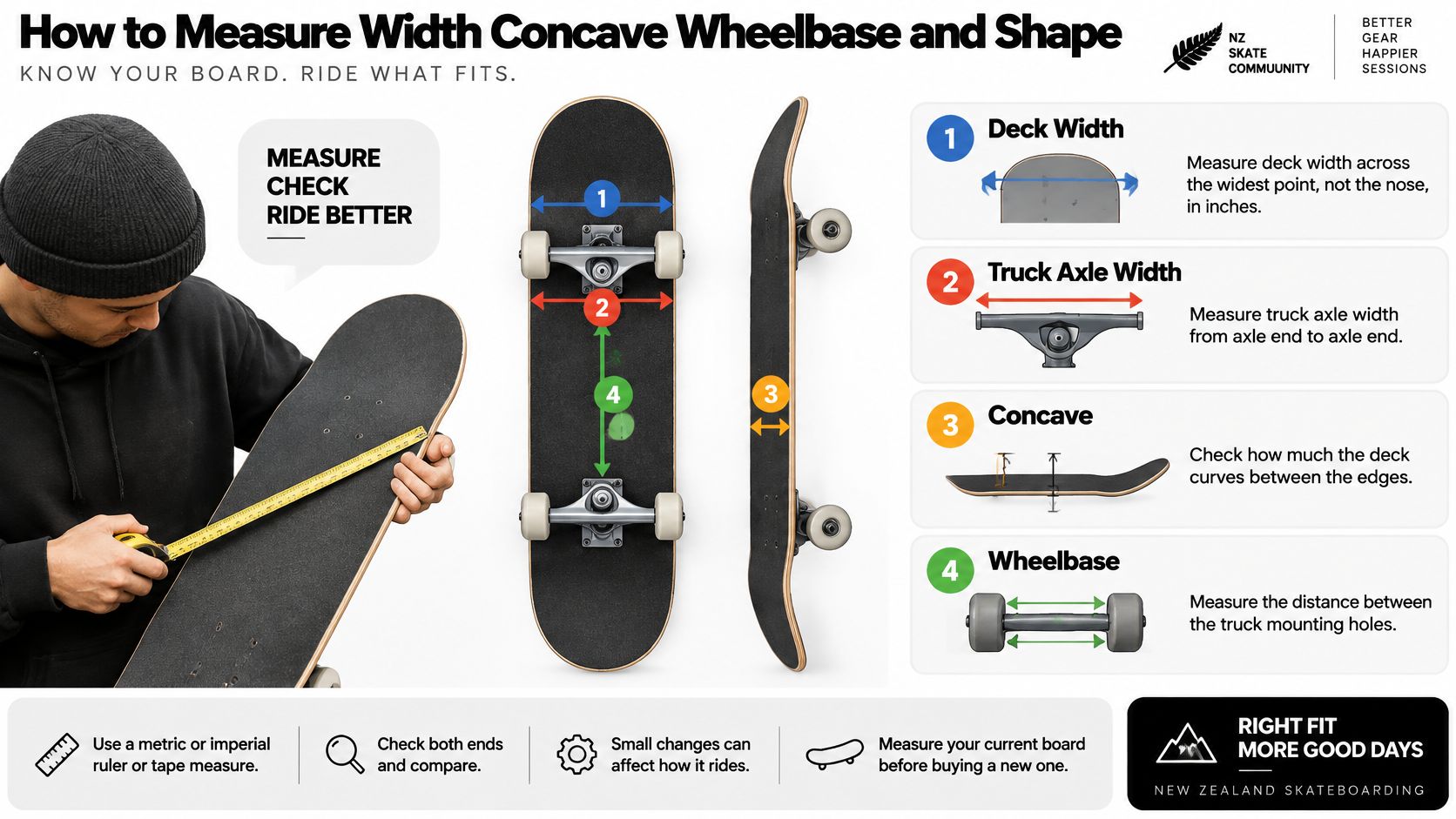
The diagram below shows where each measurement sits on the deck.
Measure in This Order
- Deck width: Measure across the widest point, not the nose, in inches. Write it down.
- Truck axle width: Measure from axle end to axle end. Keep it within about a quarter inch of the new deck width so the wheels sit under the board, not tucked in or poking out.
- Wheel diameter: Check the number printed on the wheel. Wheels over about 54 mm often need a riser pad or a setup that clears wheel bite, where the wheel rubs the deck mid-turn and stops you suddenly.
- Wheelbase: Measure from inner mounting hole to inner mounting hole. A shorter wheelbase flicks faster. A longer one stays steadier on transition.
- Mounting holes: Most street decks use the standard pattern. Some old-school and longboard decks don't, so check before you assume your trucks will bolt straight on.
- Concave: Stand on the deck. Mellow is easier to learn on, medium locks your feet for flips, and steep can feel harsh if you're new.
- Nose, tail and shape: Check the length of each end and whether you've got a symmetrical popsicle, a squared shovel, a shaped cruiser, or a wide surf nose.
If truck sizing still feels murky, compare your numbers against a skateboard truck size chart before you order anything.
The short video below walks through checking a setup visually, which helps if concave and shape are hard to picture from numbers alone.
The Width Jump Mistake
Moving from 8.0 to 8.5 inches without wider trucks leaves your wheels tucked under the deck. The board turns differently and can feel tippy at the edges, because you're leaning out over air instead of over a wheel. That's the most common reason a new deck feels wrong even though nothing looks broken.
Shoe size is a weak rule on its own. A size 9 rider who skates bowls may want 8.5 inches. A technical skater in the same shoe may stay at 8.0. Stance, confidence, terrain and your existing components matter more than footwear size.
Order rule: Only order when width, axle, holes and wheel clearance all agree.
Maple Plies and Other Deck Constructions
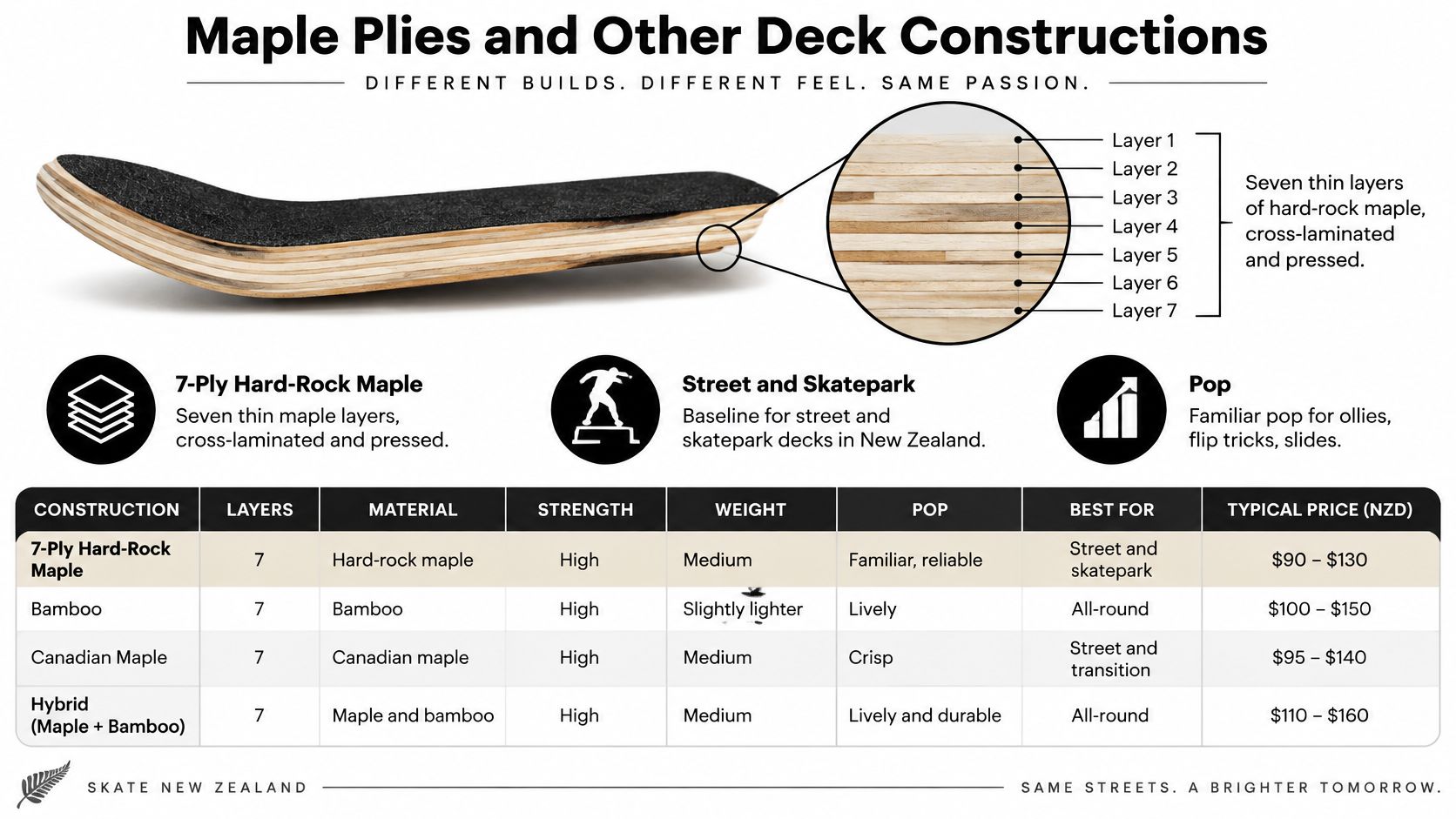
Seven-ply maple is the most common construction for street and park decks. Each thin layer is pressed across the next, making a strong, familiar board with enough pop for ollies, flip tricks, slides and park landings. For most riders, it is a sensible starting point. Lighter builds can reduce swing weight, but consider how the deck will handle your riding before choosing one.
The comparison below shows how common constructions differ in feel and purpose.
| Construction | Feel | Durability | Choose it when |
|---|---|---|---|
| 7-ply maple | Balanced pop and weight | Common choice for street and park | Most trick and park riding |
| 8-ply maple | Stiffer and heavier | Built for harder impacts | You are heavier or break 7-ply decks often |
| Maple with carbon or fibreglass | Snappier or stiffer | Can resist some flex and breakage | You want less flex, not a board that cannot break |
| Bamboo or mixed layup | Lighter, with a different flex | Less consistent than maple | You want to carve more than skate hard street |
| Plastic or resin cruiser | Little trick pop | Handles wet conditions and kerbs | You want a transport board |
When Each Alternative Makes Sense
An 8-ply deck is stiffer and slower to snap. It can suit heavier riders, hard bowl impacts, or riders who break 7-ply boards quickly. The trade-off is extra weight, which can make flick tricks feel slower. If you mainly skate technical street, that difference may matter more than the extra stiffness.
Some decks add carbon or fibreglass to change stiffness or reduce certain kinds of breakage. They can still chip and develop razor tail, just like other decks. The extra material changes how the board feels, but it does not make the deck unbreakable.
Bamboo and mixed layups are lighter and can feel lively for carving. Their pop and feel can be less predictable than maple, so they are a less straightforward choice for technical street. Moulded plastic or resin cruiser decks handle water and kerbs well, but offer little pop for tricks. They suit rolling to the dairy, not learning kickflips.
For more detail on how presses and materials affect a deck, read this guide to skateboard construction and deck materials.
Water Is the Quiet Killer
A wet deck can swell, soften, or separate along its glue lines. Those changes can make the board feel vague underfoot even when the graphic still looks fine. Surface grip and foot lock matter on local concrete, so a water-damaged deck is more than a cosmetic problem.
Cold storage can also make a deck feel less lively until it warms up. Roll around for a while before judging its pop on a frosty morning.
Buying rule: Start with sound 7-ply maple for street and park. Choose 8-ply or a reinforced layup when your weight or riding puts more stress on the deck. For carving or commuting, a cruiser construction may suit better. Match the deck to your trucks first, then decide whether its construction fits the way you ride. No single deck does every job equally well.
Price Durability and When a Used Deck Fails
Budget pressure is real, and there's no point pretending otherwise. The IAB New Zealand summary of the 2025 Pureprofile commerce report found 46% of New Zealanders surveyed in 2025 said they had increased second-hand purchasing, with saving money the main motivation for 90% of those shoppers. So let's talk lifespan and avoiding a second failed purchase, not eco slogans.
A new 7-ply maple deck is the predictable cost. It has full pop, square edges and no hidden cracks. Your trucks, wheels and bearings move across to the next deck, so a replacement deck isn't the price of a whole new board. That's the bit families often miss when comparing a new deck with a cheap complete.
Cosmetic Wear Versus Structural Failure
| What you see | Still reasonable | Replace it |
|---|---|---|
| Scratched graphic or light shoe rash | Yes, if the wood is solid | No |
| Mildly rounded tail on a cruiser | Yes for rolling around | When the tail is square-edged and pop is gone |
| Razor tail on a trick deck | Only as a spare cruiser | Yes if you still want ollies |
| Cracks or oval holes around the trucks | No | Yes |
| Delamination, soft spots or water swell | No | Yes |
| Visible warp on flat ground | Poor for tricks | Yes for street and park |
A used deck can be fine when the only wear is a scratched graphic, light shoe rash, or a slightly rounded tail on a board used for cruising. It's poor value when pop is gone, the tail is razor-flat, the board rocks on flat concrete from a warp, truck holes are cracked or elongated, plies are splitting, or the wood is swollen from rain.
Those faults make tricks unpredictable. A deck that flexes unevenly or might snap at the truck holes isn't a cheap starter for a grom, it's a fall waiting for a landing. Check pop by pressing the tail down on concrete. A live deck snaps back with a sharp crack. A dead one thuds.
What Repair Can and Cannot Fix
- Fresh griptape: Fixes slick, worn grip.
- New hardware: Fixes stripped or rusted bolts.
- Glue failure and cracks: Not a home fix worth chasing. Clamping a delaminated deck rarely restores pop or strength.
Compare cost as decks per year of hard skating, not the sticker alone. A rider who snaps boards may spend less on a slightly stronger layup than on two bargain decks. Don't overclaim recycling either. A dead deck can become a shelf or a balance board project, but it shouldn't go back under a learner.
Buy used only after the wood checks pass. Otherwise buy a new deck and keep your old components.
Order a Deck That Fits Your Setup
You've measured. Now order against those numbers, not against a photo.
Five Checks Before You Pay
- Write it down: Deck width, truck axle width, wheel size, mounting pattern and nose shape, all in one list.
- Match the listing: Compare those numbers plus ply count. Ignore a listing photo that hides the dimensions.
- Check stock, delivery cost and timeframe: Confirm all three before paying, not after.
- Use retailer-arranged delivery where you can: It's the cleaner path if a deck arrives lost, late or crushed.
- Inspect on arrival: Check the nose, tail and edges before you grip it. Fresh grip hides damage and makes disputes harder, so look first and read a guide to applying skateboard grip tape before you stick anything down.
Know where you stand legally. Consumer Protection's online shopping guidance explains that under the Consumer Guarantees Act a deck bought from a business trading in New Zealand must be of acceptable quality, match its description, be fit for its normal or stated purpose, and arrive within an agreed or otherwise reasonable timeframe. If it fails those guarantees, you may request a repair, replacement or refund depending on the seriousness of the problem.
Those protections generally don't apply in the same way to private marketplace sellers. A change of mind about a graphic also isn't the same as a deck that arrives cracked. One is preference, the other is a legal remedy. Keep your order confirmation and photos of any damage.
Matching a Deck to Trucks You Own
We stock completes, longboards, cruisers, decks, trucks, wheels, bearings, griptape, hardware and protective gear, including decks from Almost, Blind, Chocolate, Darkstar, Deco, Enjoi, Girl, Powell Peralta, Santa Cruz and Wreck, plus Carver surfskates. That range matters for one practical reason. You can check a deck listing against truck and wheel listings in the same place, so the numbers either agree or they don't.
Bring your old trucks into the Gisborne shop if you're local and we'll set the new deck against them before you commit. Ordering from further away, use NZ-wide delivery and the measurements from your list. We've sold surf and skate gear since 1983, and the deck mistakes we can help you avoid are almost always measurement mistakes, not brand mistakes.
If the numbers and the listing disagree, don't order yet. A deck that doesn't fit your trucks is the wrong deck, however good the graphic looks.
Bring your width, axle and wheelbase numbers to Blitz Surf Shop and we'll help you match a deck from our street, park, cruiser and surfskate range to the trucks you already own. Shop online for NZ-wide delivery, with free shipping over $150 on eligible items, or call into our Gisborne store and stand on a few shapes before you choose.


