

You've got the softboard pop-up sorted, and now you're eyeing a shorter board that'll fit into steeper turns. The hard part isn't choosing the shortest shape in the rack. It's finding a board that still lets you paddle into waves, practise often and stay in control when Gisborne's beach breaks get bumpy.
Shortboard surfing rewards good timing and precise movement, but a board that's too low in volume can turn every session into a struggle for position. Match the shape to your current surfing, the waves you ride and the fitness you can bring to the water.
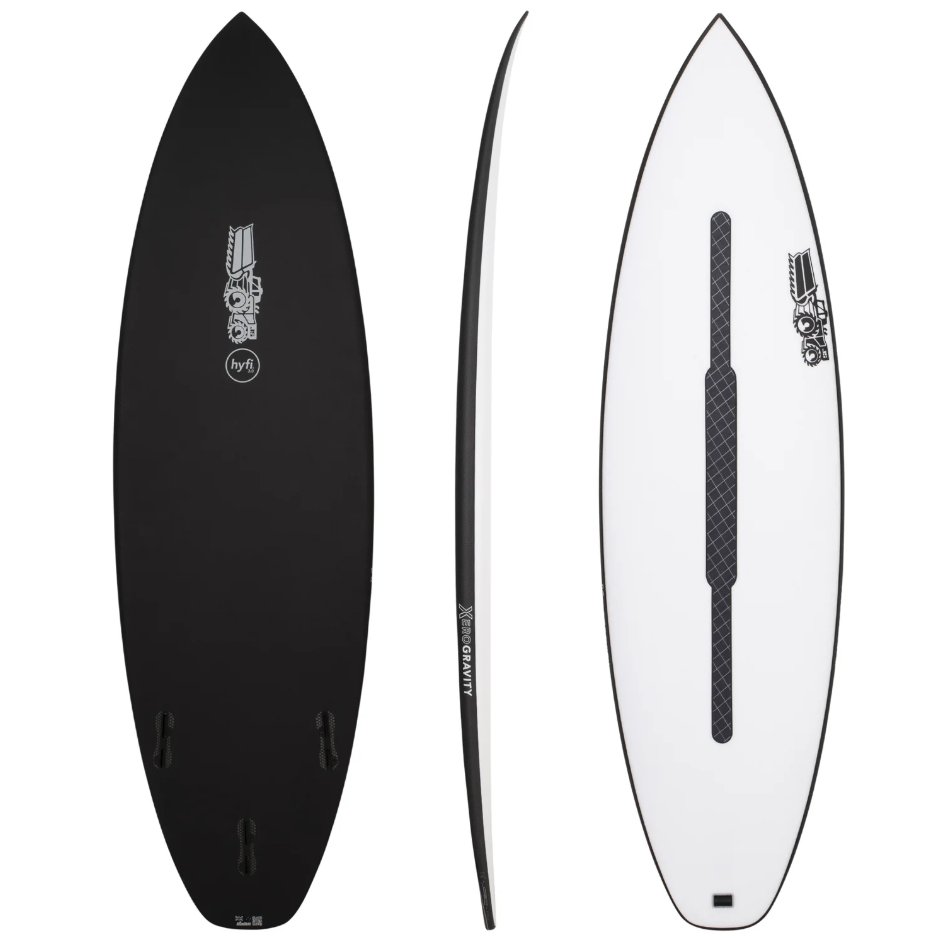
Shortboard Sizes and Volumes at a Glance
A shortboard is a compact, performance-focused board designed for quick turns and steeper parts of a wave. Its flotation comes from volume, width and outline, not length alone. Use this table to compare the main shortboard families with a funboard as a step-down reference.
| Board type | Typical length | Volume guide | Best rider |
|---|---|---|---|
| Performance shortboard | 5ft 6in to 6ft 4in+ | Lower volume for the rider's weight and ability | Advanced riders in steep, powerful surf |
| Hybrid shortboard | 5ft 6in to 6ft 4in+ | Moderate volume with a more forgiving outline | Intermediates stepping down from a funboard |
| High-volume shortboard | 5'6ft to 6ft 6in+ | Fuller outline and extra flotation | Intermediates in weak or inconsistent beach breaks |
| Fish | 5ft 2in to 6ft 2in | Wide, buoyant shape for its length | Riders wanting speed and flotation in small waves |
| Funboard, step-down reference | 6ft 8in to 8ft | More flotation and stability than a shortboard | Beginners and riders moving down from a softboard |
Read volume before chasing length
Litres of volume affect how easily you paddle, catch waves and recover after a fall. Two boards with the same length can feel quite different because one may be wider through the chest or thicker under the front foot. Start with the volume your paddling needs, then look at the other design features to work out how it will perform.
These are typical ranges, not fixed rules. Shapers vary their outlines and thickness, so compare actual boards rather than assuming two models with the same length will ride alike. A size guide can help you narrow the options, but your weight, fitness, experience and local waves still matter. Use this surfboard size guide as a reference, then find your bodyweight and current board in the table and compare the rows above and below it. Those two likely options are a useful starting point for the fitting conversation at the end.
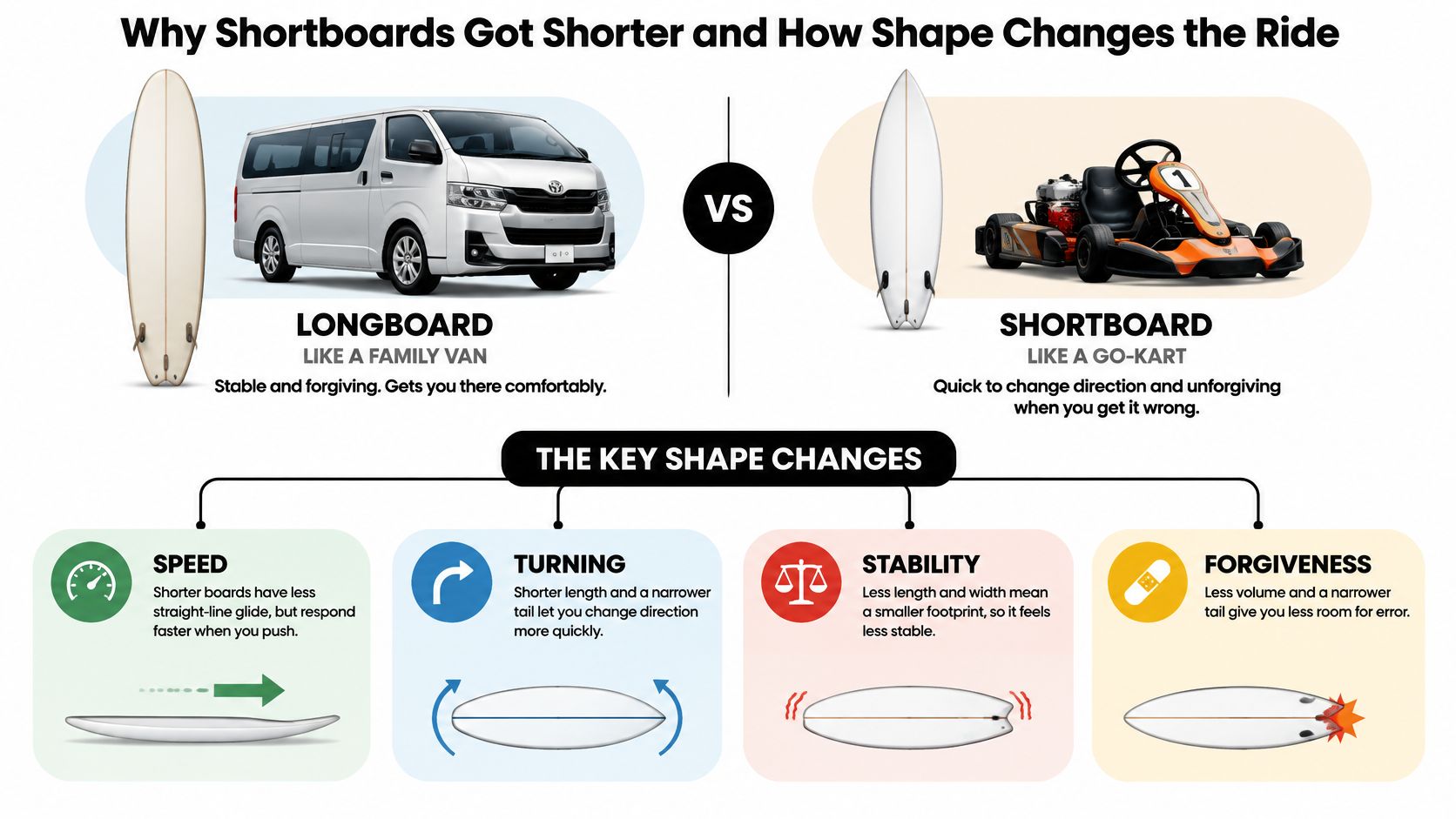
Why Shortboards Got Shorter and How Shape Changes the Ride
A longboard is like a family van: stable, forgiving and happy to carry you through a slow turn. A shortboard is more like a go-kart. It changes direction quickly, but a late movement or poor line choice can cost you the ride.
Four design features explain most of that difference.
Four levers that change the feel
Rocker is the curve from nose to tail. More curve can make a board easier to turn and help the nose clear a steep drop, but too much can slow it down across a flatter section. A flatter rocker carries speed and drives across a steeper face, though it can feel less forgiving when the wave is soft.
Rails are the board's edges. Thin rails sink and hold through a turn, giving a skilled rider a precise feel. Fuller rails offer more flotation and can be easier to manage, but they may feel less responsive when pushed hard.
Tail shape changes how the board holds and releases. A squash tail gives a familiar, versatile platform. A swallow tail is common on fish shapes and suits speed and flow, while a round pin can hold a line in powerful surf. Volume supplies flotation and paddle power, so removing too much can make a board harder to catch waves on even if it feels lively underfoot.
Shop-floor rule: Choose the shape for the waves you surf most, not for the best wave you hope to find.
Why the shorter design took hold
New Zealand's shortboard era developed during the 1960s, as board design moved away from traditional longboards. Te Ara's history of lifesaving and surfing records that boards commonly measured more than 10 feet before the shortboard revolution, but had fallen below 7 feet by 1969. Better board-building technology and local manufacturing helped make the change possible, with shapers including Bob Davie, Alan Mitchell, Peter Way and Ted Davidson contributing to the domestic scene.
Shorter boards made it easier to turn across the wave face and attempt more dynamic manoeuvres. That trade-off still defines shortboard design: each choice of rocker, rail, tail and volume shifts the balance between speed, turning response and forgiveness. There isn't one shape that wins in every wave.
Matching a Shortboard to NZ Wave Conditions
At Gisborne's Makorori Beach, the surf can change character during a session. A Surfing New Zealand report describes national-level surfing in waves of about 1.0 m, with a clean swell and light winds later affected by moderate sea breezes that degraded the surface. A board that feels lively in a clean morning face may become harder to paddle and control once the wind roughens the water.
| Conditions | Wave face | Board to try | Why it works |
|---|---|---|---|
| Knee to waist-high | Soft, mushy shoulders | High-volume shortboard or fish | Extra volume helps you paddle and catch waves |
| Waist to chest-high | Punchy beach break | Hybrid or performance shortboard | Balances paddle power with turning speed |
| Head-high and above | Steep, hollow faces | Performance shortboard with rocker dependent on ability to stay in the pocket | Holds a line on steep faces and drives off the bottom |
| Any height, onshore sea breeze | Choppy, bumpy faces | Slightly fuller hybrid | Adds stability and paddle power in messy water |
Match the board to the face, not just the forecast
A steep, fast section gives a shortboard the energy it needs to engage its rail and drive through a turn. In soft, mushy surf, that same board may lack the glide to enter waves early, leaving you paddling harder for fewer chances. In those conditions, a fuller board can help you get into waves and practise your positioning instead of forcing late take-offs.
Onshore chop also changes the equation. A narrower board with less flotation can feel unsettled while you paddle, so a slightly fuller hybrid may give you more useful stability. For a broader look at local options, compare the conditions at New Zealand's surf spots, then choose the break you'll surf.
Don't judge safety from the swell forecast alone. A 2025 University of Otago-related report found that about half of New Zealand beach users struggled to identify a rip current in photographs or videos (Phys.org's report on beach safety). Pick a board you can paddle back out on after a fall, and leave the water if the conditions exceed your ability to manage the rip or the paddle back. Check the forecast and local beach flags before paddling out.
Fins and Stance Setups That Change Your Turns
Fins affect how a board holds a line, accelerates and releases through a turn. The same shortboard can feel markedly different when you change the fin setup, so match the configuration to both the shape and the waves.
| Fin setup | Fin count and layout | Feel | Best for |
|---|---|---|---|
| Thruster | 3 fins, centre plus two side | Hold and drive, versatile | Most performance shortboards in beach breaks |
| Twin fin | 2 fins, wide base | Loose, fast, surf-skate feel | Fish and fun waves in small, clean surf |
| Quad | 4 fins, two per rail | Fast, drives off the bottom, looser hold | Fast, powerful waves and fish |
| Five-fin option | 5 fin positions, centre plus four side positions | Lets you choose a thruster or quad feel | Steep, powerful surf and advanced riders |
Set up and test with purpose
A thruster is the straightforward starting point for many performance shortboards because its centre fin adds hold while the side fins help create drive. A twin fin can feel quicker and looser, particularly on a fish in clean small surf. Quads can carry speed and drive off the bottom, while five-fin boxes give you the option to run either a thruster or quad configuration. You generally ride three or four fins at a time, not all five together.
Fin size matters too. Larger fins tend to offer more hold, while a smaller fin can feel easier to release. Check the fin-box system before buying, and make sure the fins fit the board's boxes. Side fins usually point slightly inward, a design called toe-in that helps the board respond as you turn. For a clearer comparison of fin shapes and systems, use this surfboard fins guide.
Your stance changes the result. Regular means the left foot leads; goofy means the right foot leads. A wider stance can feel steadier, while a narrower one makes it easier to turn quickly, but either can limit control if it doesn't suit your balance.
Make one change at a time. Keep the board and stance familiar while you test a different fin setup over several sessions, so you can tell what actually changed.
How to Pop Up and Make Your First Turns
A clean pop-up links your paddle to the ride. Shortboards give you less room to shuffle into place, so practise making the movement committed and centred rather than trying to correct your feet after you stand.
Run through the movement
- Paddle with the wave. Build speed as the wave approaches and feel the tail lift. If you stop paddling too early, the wave can pass under you; if you hesitate too long, the drop gets harder.
- Set your hands. Put your palms flat beside your ribs at chest height, with elbows bent. Hands too far forward can press the nose down; hands spread wide can slow the push.
- Push up and bring your back foot through first. Keep your head down as your back foot comes under the rail, then slide your front foot forward. A slow, hesitant movement can stall the board before you're standing.
- Land with your front foot just behind the centre line. Keep it over the stringer, with knees bent. Feet too far forward can make the nose dive.
- Stand tall enough to balance, with arms out and eyes on the wave. Looking down at your feet pulls your attention away from your line and makes it harder to stay centred.
- Drop low into a bottom turn. Bend through your knees and use the rail to set your speed and direction. Standing stiffly makes it harder to control the board through the first turn.
Practise the sequence before chasing turns
Practise the foot placement on sand with a steady count of one-two-three: hands set, feet through, eyes up. Keep your practice controlled and repeat the same movement until your feet land consistently. This beginner's guide to learning how to surf can help you revisit the fundamentals if your take-off still feels rushed.
Learn your turns in order. Start with the bottom turn, which sets your line and speed after take-off. Build into a cutback to redirect towards the breaking part of the wave, then work on the off-the-lip, which asks for timing and control at the top of the face. Each move depends on the balance and board control you've developed in the one before it.
Progressing Without Injury From Softboard to Shortboard
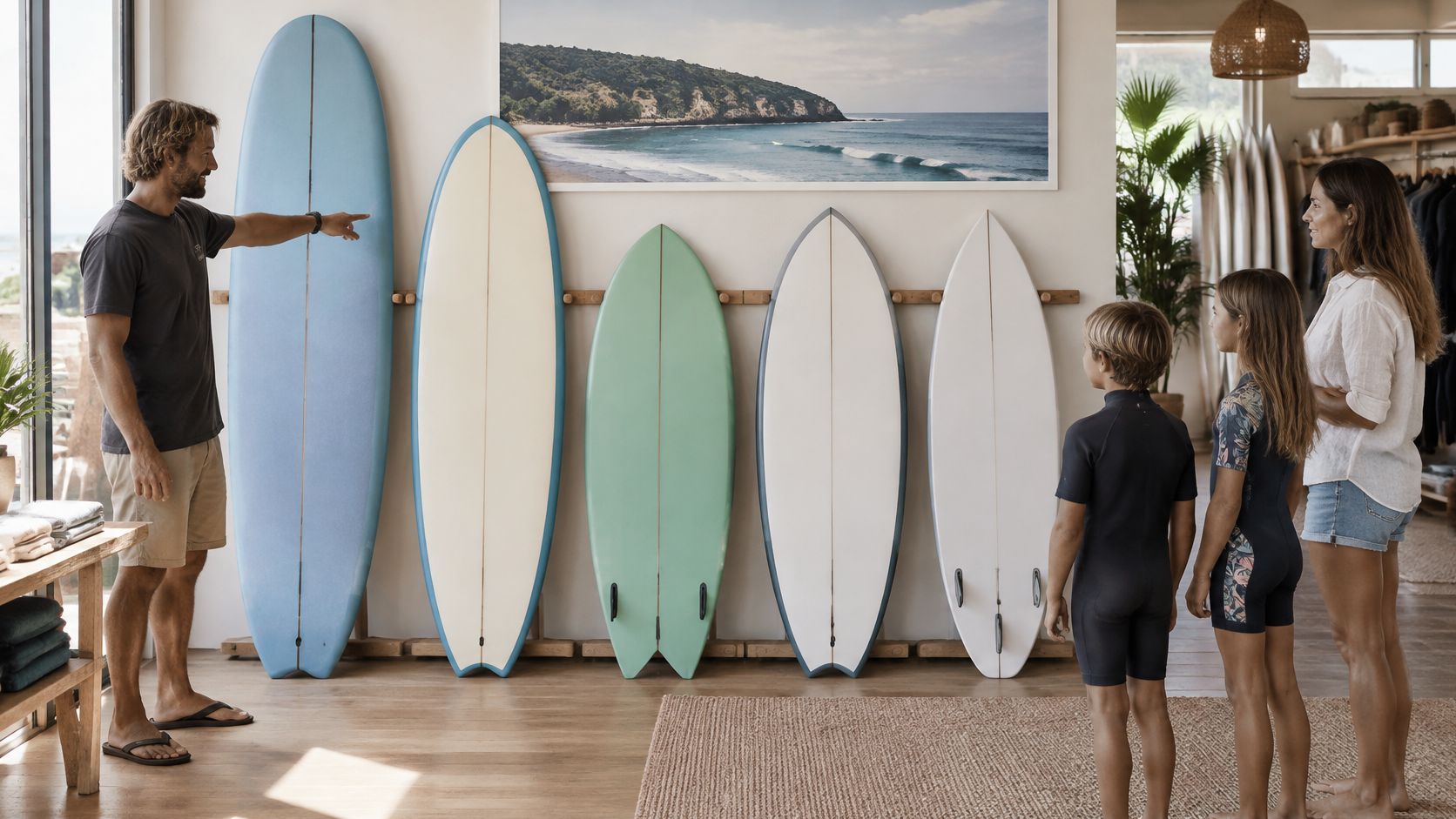
A sensible progression usually goes from a softboard to a funboard for adults and larger teens. Kids may move to a fish or high-volume shortboard, then step down towards a hybrid or performance shortboard once their paddling and wave-reading are reliable.
A shorter board isn't automatically faster progress
A New Zealand survey of 1,473 surfers found that 34.1% reported at least one major traumatic injury. Intermediate-or-more-skilled surfers reported injuries more often than beginners, at 35.8% versus 22.7%, and competitive surfers had a rate of 41.0% (the University of Waikato's injury study). Skill progression can increase exposure to difficult waves and manoeuvres, so a shorter board isn't automatically a safer or more effective next step.
In a separate New Zealand survey of 1,341 surfers, predominantly shortboard riders reported traumatic injuries more often than predominantly longboard riders, 35.4% versus 29.6%. The difference narrowly missed conventional statistical significance, so it's a risk signal, not proof that shortboards independently cause more injuries (the PeerJ study on surfing injuries). Surfers able to complete aerial manoeuvres had a higher injury proportion than other ability groups, 49.0% versus 32.6%.
Reduce the workload as well as the impact risk
Paddling fitness is part of board fit. In a New Zealand study of 1,473 surfers, prolonged paddling was identified as the mechanism for 40% of gradual-onset injuries; the shoulder, low back and neck were the most common locations (the University of Waikato study of gradual-onset injuries). Choose enough volume to paddle efficiently, build shoulder endurance and thoracic mobility, and increase your surf hours gradually rather than making a sudden jump in workload.
Acute contact needs its own precautions. Direct contact accounted for 58.1% of injury mechanisms, and being struck by the surfer's own board made up 44.6% of direct-contact injuries, according to the New Zealand traumatic-injury survey. Use a correctly fitted leash, protect your head and face when you fall, and don't dive headfirst in shallow or crowded water. If pain persists or affects how you surf, get appropriate advice; this resource explains when athletes should seek professional help.
A steady progression gives your body time to adapt. If you're still working on basic wave entry or your shoulders are tiring early, keep the more forgiving board in the rotation rather than treating it as a step backwards.
Here's a short visual guide to the transition from softboard to shortboard:
Choose Your First Shortboard and Your Next Step
A useful fitting starts with your surfing, not a target length. Work through these points before choosing:
- Current board: Note what you're moving down from and what feels limiting about it.
- Water time: Be honest about how often you'll surf. Regular sessions help you adapt to lower volume; intermittent surfing favours a more forgiving option.
- Fitness and age: Consider how comfortably you can paddle and recover during a session.
- Weight and local waves: Match the board's flotation and outline to your build and the breaks you're most likely to surf.
Use the size table to shortlist two boards, then compare their rocker, rails, tail and fin options side by side. For steep Gisborne beach breaks, a flatter rocker can help the board drive across the face. If you mostly surf smaller, softer waves, more curve and extra volume can make wave entry easier. For a general primer before you compare specific shapes, PADL's guide to choosing your first surfboard offers useful context for the move from a beginner board.
Compare construction as well as shape
Construction changes how a board responds. A cheaper glassflex fin can feel softer, while a more premium Performance Core fin can give a sharper response. That upgrade won't fix a board that's too small or poorly matched to the waves, so get the fit right first and treat construction as a tuning choice.
For a short list, compare a hybrid or performance board from brands such as Firewire, JS Industries, Slater Designs or Surftech. Blitz Surf Shop stocks new surfboards including high-performance shortboards and fish, and sells fins from Endorfins, FCS and Futures Fins. Match the fin system to the board and include a leash in the setup. If you're still weighing up two shapes, a trial in the water is more useful than choosing by appearance alone.
The practical next step is to compare your two shortlisted options in person or through surf hire before you buy. Bring your current board details and be clear about the waves you usually surf, so the choice reflects your real sessions rather than an idealised one.
Blitz Surf Shop offers surf hire and stocks shortboards, fish, fins and leashes for riders working out their next setup. Visit Blitz Surf Shop to compare options, or come into the Gisborne store to talk through a board that suits your surfing and the East Coast waves.


