

Without a doubt, the best surfboards for beginners are large, high-volume foam boards. You'll hear them called "soft tops" or "foamies," and for good reason. Their stability, buoyancy, and forgiving nature make catching waves and figuring out how to stand up so much easier and safer. This is absolutely crucial for building confidence when you're just starting out.
Your First Wave Awaits: Finding the Right Beginner Board
Starting your surfing journey is an awesome experience, but your progress—and how much fun you have—really hinges on that first piece of gear: your surfboard. Choosing the wrong board can quickly turn an exciting new adventure into a frustrating struggle, leaving you wondering why you can't seem to catch anything.
This guide is here to cut through all the noise and focus on what actually matters for your first board. The main idea is simple: a bigger, more buoyant board is your best mate in the water. Think of it like learning to ride a bike with training wheels; it gives you the stability you need to nail the basics without constantly wobbling and falling off.
Why Stability and Volume Matter Most
One of the most common mistakes we see is someone picking a board that looks cool but is way too small and performance-focused. Those boards are less stable and require some serious skill just to paddle in a straight line. For a beginner, that’s a recipe for a very short, frustrating session. This could put you of surfing for good.
Instead, your first board should be all about making the learning process fun and effective.
Here’s why starting on the right board makes all the difference:
- More Stability: A wider, thicker board gives you a solid platform. This makes it way easier to balance when you're paddling and trying to pop up.
- Easier Paddling: High buoyancy, or volume, means the board floats you higher out of the water. This cuts down on drag, letting you paddle faster and with less effort, so you can save your energy for catching waves.
- Catch More Waves: Since you can paddle faster and stay stable, you'll catch a lot more waves. And your "wave count" is the single biggest factor in getting better, fast.
- Safer and More Forgiving: The softer materials are a lot kinder during wipeouts—for both you (and anyone else in the water).
The right beginner board isn't about looking like a pro from day one. It's about giving yourself the best tool to actually become one. It should feel less like a tightrope act and more like a stable raft that helps you tap into the ocean's energy.
Before we dive into the specific types, here's a quick rundown of the boards we recommend for anyone starting out.
Beginner Surfboard Quick Comparison
This table gives you a quick look at the top surfboard types for beginners, highlighting their key features and what conditions they're best for.
| Board Type | Best For | Key Benefit | Typical Size Range |
|---|---|---|---|
| Soft Top | Absolute beginners of all ages; learning in small, gentle waves | Maximum safety, stability, and ease of use | 7'0" - 9'0" |
| Longboard | Catching the smallest waves; learning footwork and balance | Unbeatable wave-catching ability and glide | 8'6" - 10'0" |
| Midlength | Beginners who are progressing quickly; versatile conditions | A good balance of stability and manoeuvrability | 6'6" - 8'0" |
Each of these boards offers a unique blend of features that can help you get the most out of your time in the water.
Getting the relationship between your body weight and the board's size right is critical. To figure out the perfect match for you, check out our detailed guide on what size surfboard you need for some personalised advice. Once you're kitted out, you can start dreaming about where to paddle out. Spots like the best beginner surf spots on the Big Island offer the kind of gentle waves that are perfect for learning.
Why a Soft Top Should Be Your First Surfboard
If you're asking what board to start on, the answer from just about any experienced surfer is going to be the same: a soft top. Often called a "foamie," this is the board purpose-built to make your first forays into surfing as fun, safe, and successful as possible.

Think of it like learning to ride a bike. You wouldn't jump straight onto a feather-light carbon fibre racing bike; you'd start with something stable and forgiving, maybe even with training wheels. A soft top surfboard is your set of training wheels for the ocean, giving you the perfect platform to build your confidence and nail the basics.
Built for Bumps, Bruises, and Building Confidence
The name really says it all. A soft top has a deck made of a soft, forgiving foam—much like a bodyboard—wrapped around a tough inner core. This design is a game-changer for a couple of big reasons: your safety and your confidence. Let's be real, you're going to fall. A lot. Wipeouts are just part of the deal when you're learning, and falling onto a soft surface is a whole lot nicer than copping a hard fibreglass board to the head or ribs.
This forgiving nature isn't just about avoiding a few bumps. It actually helps you learn faster. When you're less worried about getting smacked by your board, you're more likely to commit to paddling for a wave and giving that pop-up a proper go. That commitment is where the real progress happens.
Buoyancy: Your Wave-Catching Superpower
Beyond safety, the single biggest advantage of a foamie is its insane buoyancy. These boards are much thicker and wider than their traditional counterparts, which means they float incredibly well. This high volume is your secret weapon out there.
A soft top’s buoyancy is your ticket to a higher wave count. It helps you paddle easier, get into waves earlier, and feel stable once you’re up. More waves equals faster progression and, most importantly, more fun.
All that float makes paddling way less of a grind, so you can save your energy and stay in the water longer. It also helps you catch waves much, much earlier, often when they're still just gentle, rolling walls of water. Nailing this part of the process is absolutely key to getting the momentum you need to stand up.
Here in New Zealand, soft tops have become the standard-issue board for anyone starting out. The NZ surfing equipment market hit USD 176.7 million back in 2020, and the numbers tell a clear story: a massive 65% of new surfers in 2023 got started on soft tops. This isn't a coincidence; choosing the right gear massively boosts the chances of you sticking with the sport. You can read more about the growth of the surfing market in New Zealand to see the trend.
The Good, The Bad, and The Foamie
Like anything, soft tops have their pros and cons. It’s good to have the full picture so you know why they’re the best choice to start with, but also what to expect as you get better.
Key Advantages for Beginners:
- Ultimate Safety: That soft deck seriously reduces the risk of injury to you and anyone else in the water around you.
- Superior Stability: They’re wide and packed with volume, giving you a steady platform that makes finding your balance a whole lot easier.
- Durability: Soft tops are built like tanks. They can handle the knocks, drops, and dings that come with learning, so they’ll last you. Just keep them away from sharp objects!
- Affordability: They’re generally way more budget-friendly than a traditional fibreglass board, which is great when you're just starting out.
- Wave-Catching Ease: All that buoyancy means you can paddle efficiently and catch waves with way less effort.
Now, while they're fantastic learning tools, foamies do have their limits. Their softer rails and more flexible construction mean they don't turn as sharply or generate the same kind of speed as a hardboard. As your skills progress, you will eventually want to move on to a board that offers more performance and responsiveness.
But for getting the fundamentals dialled, their benefits are impossible to beat. Even the smallest groms can get started on the right gear, like the Gnaraloo Dune Buggy Soft Surfboard which is designed just for kids.
Understanding Surfboard Volume and Sizing
Walk into any surf shop, and you'll see boards measured by length, width, and thickness. These dimensions are part of the story, but the single most important number for a beginner is volume. Honestly, it's the secret ingredient that decides whether you'll have an amazing time or a frustrating one.
Think of volume, measured in litres, as your board’s flotation power. It’s a simple trade-off: more volume means more buoyancy. A high-volume board sits higher on the water, making it feel way more stable and so much easier to paddle.
That extra float also cuts down on drag. This means you can paddle faster with less effort, which helps you catch waves earlier and more often. Catching waves is the name of the game, and that's what makes surfing fun right from day one.
What Is Surfboard Volume?
So, what exactly is volume? It’s the total amount of space a surfboard takes up, calculated from its length, width, and thickness across the entire shape. It makes sense that a longer, wider, and thicker board will have more volume.
But it's not just about the raw numbers; how that volume is spread out is also crucial. You could have two boards of the same length, but if one is thicker through the nose and tail, it’ll pack more volume and feel more stable under your feet. For beginners, the goal is a board with generous, evenly distributed volume.
This is why just looking at the length of a board can be a trap. A long, thin, high-performance longboard might actually have less volume than a shorter, wider, and much thicker soft top. Getting the volume right ensures your board works with you, not against you.
Matching Volume to Your Body Weight
Your body weight is the number one thing that determines how much volume you need. A heavier surfer needs more volume to get the same float and stability as a lighter surfer. Your fitness and age also come into play—if you're not super athletic or are a bit older, adding a few extra litres makes a world of difference to your wave count and how much fun you have.
The biggest mistake we see new surfers make is choosing a board with too little volume because it looks "cooler" or seems easier to carry. This is a recipe for a bad time. Always, always prioritise volume over looks for your first board—it's the single best decision you can make for your surfing journey.
This chart explains why a soft top, known for its high volume and safety, is the perfect starting point for pretty much every new surfer.
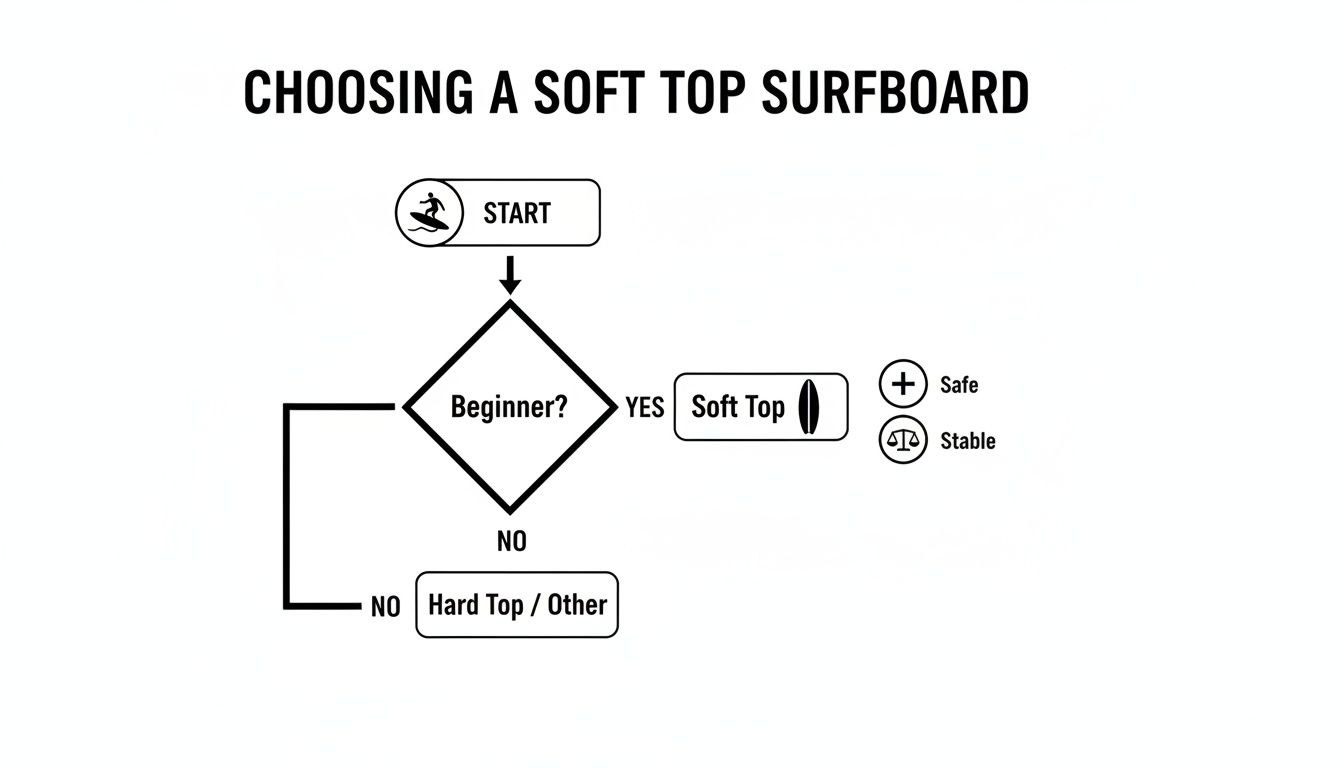
The flowchart just reinforces what we always tell people: starting on a safe, stable, high-volume soft top is the best foundation you can build for learning to surf.
A Simple Guide to Beginner Volume
To take the guesswork out of it, we've put together a quick reference table. It’s a simple guide that matches your body weight to a recommended volume range, giving you a solid starting point. If you're completely new to board sports or your fitness is just average, aim for the higher end of the range.
For a more precise recommendation that factors in your exact weight, age, and fitness level, jump on our detailed surfboard volume calculator. It will give you a personalised number to work with.
But for a quick look, here’s a simple chart to get you started:
Recommended Beginner Surfboard Volume by Weight
This table offers a simplified starting point for beginners. Finding a board within these volume ranges will give you the stability and paddle power needed to catch heaps of waves and build your confidence.
| Your Weight (kg) | Recommended Volume (Litres) | Example Board Size |
|---|---|---|
| Under 55 kg | 55 - 65 L | 7'0" Soft Top |
| 55 - 70 kg | 65 - 80 L | 7'6" - 8'0" Soft Top |
| 70 - 85 kg | 80 - 95 L | 8'0" - 9'0" Soft Top |
| Over 85 kg | 95 L + | 9'0" Soft Top |
Remember, these are guidelines. The key is to be honest about your ability and fitness to make sure you end up with a board that helps you succeed. Sometimes you may be limited by things like mode of transport, you'd be able to fit a 7' or maybe even a 7'6 softboard into most cars but anything larger will definitely be going on the roof!
By understanding and prioritising volume, you’re setting yourself up for a much more successful and enjoyable start to your surfing life.
Exploring Other Great Board Options for Beginners
While a soft top is the undisputed champ for your first few surfs, it's not the only way to get started. Once you get the hang of things, or if you're already pretty sporty, you might feel ready for a board with a bit more spark. This is where other awesome beginner-friendly options, like mid-lengths and longboards, come into the picture.
These boards swap the super-safe, full-foam construction for a more responsive feel under your feet. This is exactly what you need to start learning the next set of skills, like turning and trimming down the line. They’re still built with plenty of stability and paddle power in mind, making them a natural next step—or even a starting point for the right person.
Deciding between them really comes down to what you want to get out of surfing. Are you looking for a versatile board that’ll bridge the gap to something smaller later on? Or do you want to dive straight into that classic, cruisy style of wave riding?
Mid-Lengths: The Perfect All-Rounder
Often called "mini-mals" or "funboards," mid-length surfboards are the ultimate jack-of-all-trades. They sit in that perfect sweet spot, usually between 6'6" and 8'0", giving you more manoeuvrability than a big longboard but way more stability and paddle power than a shortboard. Think of them as the Swiss Army knife of your quiver; they handle a massive range of conditions, from small, friendly peelers to days with a bit more punch.
This versatility makes them one of the best choices for beginners who are picking things up quickly. If you've nailed your pop-up on a soft top and are starting to think about steering the board, a mid-length is your ideal next partner. The slightly shorter length makes it easier to manage in the water, while the generous volume makes sure you're still catching heaps of waves.
Who Should Consider a Mid-Length?
- Confident Beginners: If you've done other board sports before (like skateboarding or snowboarding) and you're reasonably fit, you could definitely start on a mid-length.
- Progressing Surfers: For anyone moving on from a foamie, this is the logical next board to really start learning proper turning technique.
- Versatility Seekers: If you want one board that can handle almost anything the East Coast throws at you, a mid-length is a solid bet.
A mid-length gives you a clear pathway to getting better. It has just enough performance to let you feel the board react under your feet, encouraging you to use your rails to turn, but without yanking away the stability you need to build a solid foundation.
Have a look at our collection of versatile mid-length surfboards to see the different shapes and sizes we carry. These are the boards designed to keep your surfing journey moving forward with confidence.
Longboards: The Classic Wave-Catching Machine
If your idea of surfing involves gracefully gliding down a long, peeling wave with a relaxed style, then a longboard has your name written all over it. These boards, typically 8'6" and longer, are the original wave-riding tools. They are absolute wave-catching machines, thanks to their huge volume and surface area, letting you paddle into even the smallest, weakest waves with barely any effort.
This makes them an incredible board for learning on. The pure stability of a longboard gives you so much time to get to your feet, get your stance sorted, and just enjoy the feeling of gliding on water. They're at their best on those small, clean days when everyone on a shortboard is struggling, which means more water time and more waves for you.
Of course, their size can be a bit of a handful. They’re heavier to carry to the beach and can be tricky to control in crowded line-ups or bigger surf. But for anyone who loves that cruisy, soulful approach to surfing, there's just no substitute. It's worth knowing the difference between the styles, and you can get the full rundown in our guide comparing high-performance vs all-rounder vs traditional longboards.
For a great selection of classic cruisers, check out our range of longboard surfboards that are perfect for beginners and seasoned gliders alike.
Gearing Up With Surfing Essentials
While your board is the star of the show, a few key accessories are totally non-negotiable for a safe and fun session out in the water.
Think of these bits of gear as your essential support crew. They handle the crucial jobs behind the scenes so you can focus on the main event: catching waves. Going out without them isn't just being unprepared—it's putting yourself and others at risk.
From staying warm in our chilly New Zealand waters to actually staying on your board, here’s the full checklist of what you'll need.
Your Lifeline: The Leash
A surfboard leash is easily the single most important piece of safety gear you'll own. This tough cord tethers your ankle to your board, making sure it doesn't get swept away after a wipeout. It stops your board from becoming a runaway hazard to other surfers and, more importantly, saves you a long, tiring swim back to the beach.

Choosing the right length is simple: your leash should be roughly the same length as your board, or just a fraction longer. Got an 8-foot beginner board? An 8-foot leash is the perfect match.
Grip and Go With Surf Wax
Surf wax is what gives you grip. Without a good coat of wax, your board's deck is like a wet bar of soap, and you'll be slipping off the moment you try to pop up. Applying it properly creates sticky, textured bumps that help lock your feet in place.

You’ll see different wax for different water temperatures. Here in New Zealand, you'll almost certainly be using a 'cool' or 'cold' water wax for most of the year. Not sure where to start? Check out our complete guide on how to properly wax a surfboard for all the steps.
Fins for Control and Direction
Fins are basically the rudders for your surfboard. They give you stability and control, helping the board paddle straight and allowing you to actually steer it once you're up and riding a wave. Most beginner soft tops come with a simple three-fin 'thruster' setup, which is all you need to get going.

Your fins channel water under the board, turning a slippery, uncontrollable plank into something you can actually direct. For a beginner, they are fundamental for getting the feel of how a board moves and responds on a wave face.
Before every session, give your fins a quick wiggle to make sure they're securely installed. A loose fin will mess with your board's performance and is easily lost to the ocean.
The Essential Wetsuit for NZ Waters
Let's be honest, New Zealand's water can be "refreshing" even in summer. A good wetsuit is essential for staying warm and comfortable, letting you stay out for longer and actually focus on learning. Wetsuits work by trapping a thin layer of water between your skin and the suit, which your body then heats up, keeping you insulated.
Choosing the right thickness, measured in millimetres (mm), is vital.
- Summer (3/2mm): A '3/2' means the torso panels are 3mm thick while the arms and legs are 2mm for flexibility. This is your go-to for the warmer months.
- Winter (4/3mm or 5/4mm): When it gets properly cold, a '4/3' or even a '5/4' provides the extra insulation you need to stay comfortable and avoid hypothermia.
It's also a good idea to have some basic safety knowledge. For more general info, you might want to look into watersports first aid guidance.
Protecting Your Investment
Finally, a board bag is a very smart purchase. It protects your board from dings, scratches, and sun damage when you're chucking it in the car or storing it at home. This not only extends its life but also helps keep its resale value up when you're ready to upgrade. Plus, it makes lugging your board, wetsuit, and wax down to the beach a whole lot easier.

Making a Smart Purchase at a Local Surf Shop
All the theory in the world is great, but nothing really beats holding a board under your arm and getting advice from someone who actually surfs your local breaks every day. This is where buying from a proper surf shop like Blitz really makes a difference. We can help you take all this info and apply it in a practical, hands-on way.
Walking into the shop lets you get a real feel for the gear. You can feel the weight, see the curve of the rocker, and get a sense of the volume that numbers on a screen just can't convey. This in-person experience is a huge part of finding the right first board.
The Importance of the 'Under-the-Arm' Test
There’s an old-school method for sizing up a board that you just can't do online: the ‘under-the-arm’ test. Tucking a board under your arm gives you an immediate, gut feeling for its size and volume. Does it feel like a manageable plank or an unwieldy log you’ll be wrestling with?
That physical connection really matters. It helps you picture yourself carrying it down to the beach, paddling it out through the whitewash, and actually trying to turn it on a wave. Our team can walk you through this, explaining how different shapes and sizes will feel once you hit the water. It’s all about translating specs into a real-world feel.
The right board should feel like a natural extension of you, not something you have to fight. Getting hands-on advice from experienced surfers means you leave with a board that just feels right, which is a massive confidence boost before you even get wet.
This personalised fitting is something we really pride ourselves on here at Blitz. We’re not just moving boxes; we’re helping you kick off your surfing journey on the right foot.
Should You Rent Before You Buy?
The rent vs. buy question comes up all the time with newcomers. Renting is an excellent, low-commitment way to test the waters—literally. If you’re only planning to surf once or twice a year, or you’re still not 100% sure if surfing is for you, renting is a smart move.
It also gives you a chance to try a few different sizes and shapes. You might rent an 8'0" soft top one day and a 9'0" the next, giving you a proper feel for how that extra volume changes the whole experience.
However, the moment you decide to commit, buying your own board is the fastest path to getting better. Owning your board means you get consistent practice on the exact same piece of equipment. You’ll learn all its little quirks, which really speeds up your learning curve.
Here at Blitz, we can help you make that call. We have some boards for rent of various sizes and when you’re ready to take the plunge, we’ll help you find a board that matches your commitment and budget. We’re here to help you get started, no matter what stage you're at.
Got Questions? We've Got Answers.
Stepping into the world of surfing kicks up a lot of questions, and that's completely normal. Getting the right answers helps you move forward with confidence and make choices that lead to way more fun in the water. To wrap things up, we've put together some of the most common questions we hear from new surfers here at the shop.
Think of it as a final checklist to make sure you’re on the right track.
Can I learn on a shortboard?
Look, we get the temptation. You see the pros ripping on these sleek, pointy boards and think, "That's what I want to ride!" But trying to learn on a shortboard is a classic beginner mistake, and honestly, a recipe for frustration.
Shortboards have very little volume, which makes them unstable and incredibly difficult to paddle. It’s a bit like trying to learn to drive in a Formula 1 car—it’s just not the right tool for the job. You'll spend your whole session just trying to stay balanced instead of actually surfing.
Start on something stable and floaty, like a soft-top or a longboard, and you'll catch 10 times more waves. That's how you build muscle memory, learn the fundamentals, and most importantly, have a blast doing it. You can always jump on a smaller board once you've got the basics dialled.
How long will I use a beginner board for?
That's a great question, and the answer is probably a lot longer than you think! A good quality beginner board, especially something versatile like a mid-length or a fun longboard, can stay in your quiver forever. It'll become your go-to for those small, cruisy days when the waves just aren't punchy enough for a shortboard.
Most surfers hang onto their first board for at least a full year or two before they even start thinking about something more performance-focused. Don't rush it. The skills you master on that first board are the foundation for your entire surfing life.
What’s the difference between a soft top and a hard board?
The main difference really comes down to what they're made of and what they're made for. Soft tops, or "foamies" as we often call them, have a forgiving foam deck that makes them safer and way more durable when you're just starting out. Hard boards are generally built with fibreglass or epoxy resin over a foam core.
Think of it this way: a soft top is designed for learning. It offers maximum stability and forgiveness, making it safe and easy to get the hang of things. A hard board is designed for performance, giving you more speed, responsiveness, and control once you've got the fundamentals sorted. Both are awesome, but they serve different purposes.
When should I upgrade my board?
You'll know. Seriously, there will come a point where you feel like the board is holding you back. This usually happens once you can consistently:
- Catch waves all by yourself.
- Pop up to your feet smoothly without thinking too much.
- Ride along the green face of the wave (not just going straight to the beach).
- Start trying to do basic turns.
When you start wishing your board could turn sharper or generate a bit more speed down the line, that's your cue. It’s a huge sign of progress, and that's the perfect time to pop back into the shop and have a chat with us about what's next.
Ready to find that perfect first board and kick off your surfing journey? The team here at Blitz Surf Shop has your back with expert advice and the best range of beginner surfboards in New Zealand. Check out our collection online or, even better, come see us in-store to get properly kitted out.


