

Measure your longer bare foot in centimetres, choose the smallest listed fin size that comfortably fits it, then allow for your socks or booties: the NZ/Australian and US men's chart bands below list Small 6–7, Medium 8–9, Medium-Large 9–10, Large 10–11 and Extra-Large 12–13. Don't buy your usual shoe size on autopilot, because those matching numbers aren't a universal conversion between sizing systems.
The popular advice to buy fins as snug as possible misses the point. You need secure retention without pressure, wearing the exact footwear you'll use in the surf. A tight barefoot fit can become the wrong fit once you add neoprene for a cold Gisborne dawn session.
Bodyboard Fin Size Chart by Shoe Size
There is no reliable shoe-size chart that converts every bodyboard fin brand and sizing system. Treat shoe sizes as a rough shortlist, then check the exact model's guide and your foot measurement. A snug label match alone does not confirm a good fit.
| Fin size | Shoe-size guidance |
|---|---|
| Small | Check the manufacturer's range |
| Medium | Check the manufacturer's range |
| Medium-Large | Check the manufacturer's range |
| Large | Check the manufacturer's range |
| Extra-Large | Check the manufacturer's range |
The New Zealand product sizing guide is a fin-tethers product page, not a shoe-size chart. The Hydro Tech 2 size guide, published by NZ Board Store in 2025 links to a flippers category page, so it does not establish a specific size conversion either. Use the size chart supplied for the fin you are considering rather than treating these pages as evidence for shoe-size bands.
All of our shoe and fin sizes are listed in US sizing (not UK).
Check the sizing system before choosing
Check whether the manufacturer labels its chart US men's, UK, NZ/Australian or European. A product page that gives a shoe-size range without naming the system leaves room for error. Do not assume it matches the label inside your trainers.
Standards New Zealand's footwear sizing guidance explains that international size conversions are guidelines, since sizing systems developed differently. Use the fin maker's centimetre range when available. It gives you a more direct comparison than a generic conversion.
Foot-pocket shape matters too. A fin can suit your foot length and still press across a wide forefoot or high instep. Choosing a longer size may leave space at the heel without easing that pressure.
Chart rule: Check the fin model, sizing system and manufacturer's range. A familiar shoe-size label is only a starting point.
If your measurement falls between sizes, keep both options open. Your foot volume and the socks or booties you plan to wear should help settle the choice. Those factors can change the fit as much as the number on your shoe.
When changing brands, use your previous fin size as a reference, not a guarantee. Compare the new model's own chart with your measurement before buying.
How to Measure Your Feet for Bodyboard Fins
Measure both feet barefoot, then use the longer measurement to find the right starting size. The article's chart lists shoe-size bands, not centimetre ranges, so compare your measurement with the specific fin model's manufacturer sizing chart. A snug fit is not automatically a better fit: pressure across your toes or instep can make a fin uncomfortable, even when its length seems right.
Get a usable measurement
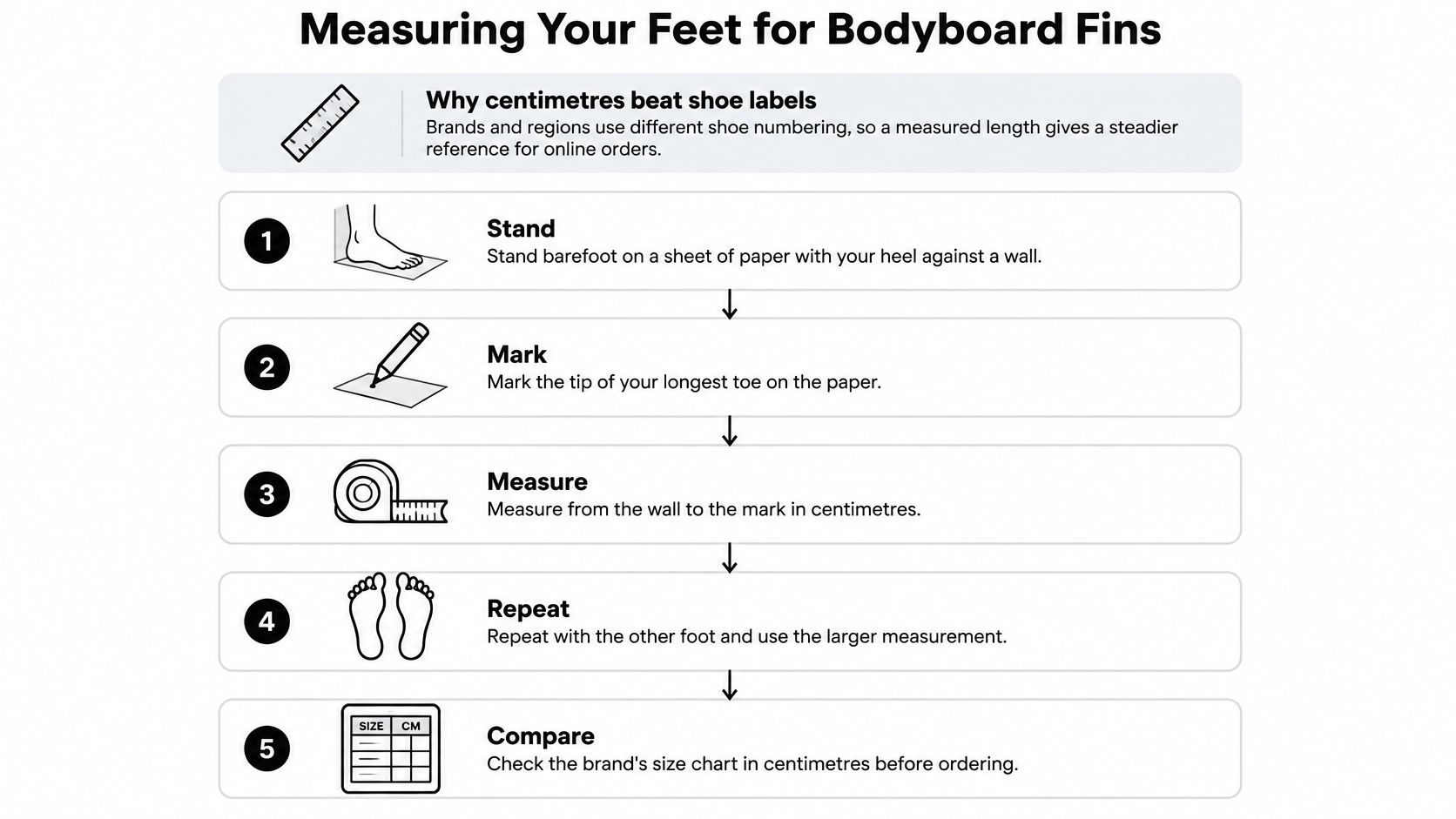
- Stand barefoot on paper or a hard floor. Measure while standing so your weight is on your feet. Measuring in the evening can account for the way feet may swell during the day.
- Mark the heel and longest toe. Measure between the marks in centimetres with a ruler or tape measure. Check which toe extends furthest instead of assuming it is the big toe.
- Repeat on the other foot. Record both lengths and use the larger one as your baseline. A size based on the shorter foot can leave the larger foot squeezed.
- Check the fin model's centimetre range. The shoe-size chart in this guide cannot convert centimetres directly into a fin size. Look up the manufacturer's range for the exact model, then use your longer-foot measurement to identify the candidate size.
- Check the pocket shape. Length alone won't show whether the fin suits your forefoot width or instep. If the sides pinch, try a different model rather than automatically sizing up.
- Compare neighbouring sizes at a boundary. Keep both options in mind if your measurement sits at the edge of a range. Judge the fit with the socks or booties you plan to wear, since they take up space inside the pocket.
Use this visual guide to measure accurately.
Read the result without forcing it
Your foot should sit comfortably within the manufacturer's stated range. Don't add an allowance to the measurement or force your foot against the top of a range. Use the chart to choose a starting size, then check the fit in the actual fin.
Write down foot length, any width or instep concerns, and the footwear you intend to use. That record makes it easier to compare models without treating a different blade style as a change in foot size.
For broader advice on comparing fin types, see our New Zealand swim-fin guide. Keep the measurement as your baseline, then assess each model's shape and fit.
Allowing for Booties and Fin Socks
A fin that fits barefoot may not fit with neoprene. Choose the size around the footwear you'll wear in the water, and don't assume a tighter pocket is automatically better.
| Setup | Sizing action | Warning sign |
|---|---|---|
| Bare feet in warm water | Fit the pocket to your bare foot | Heel lifts on a strong kick |
| Thin fin socks | Try the fins on with socks | Heel gap appears after repeated kicks |
| Thick neoprene booties in cold water | If between sizes, test the larger candidate | Toes feel compressed or numb |
| Thick socks, between sizes | Try the larger candidate and check retention | Heel moves inside the pocket |
| Fin loose without socks | Choose a better-fitting model rather than adding socks | Water floods the pocket and the fin slips |
Match the setup to the session
Fit the fin with the footwear you'll really wear. Barefoot riders should check the pocket directly against their foot. Thin socks also take up room around the toes and instep, so put them on for the fitting. With thick booties, test the larger candidate if you fall between sizes, then reject it if your heel shifts.
Water temperature varies by location and session. NIWA's coastal monitoring framework covers coastal monitoring from northern beaches to southern waters. Use local conditions to decide what footwear you need, rather than assuming New Zealand's water is uniformly warm.
East Coast and South Island winter sessions, as well as dawn and offshore sessions, can call for neoprene protection. Stats NZ's coastal-temperature reporting gives wider temperature context. A warming trend doesn't remove the need to fit fins around footwear for cold conditions.
Fit for the session you're planning, not the warmest session you can imagine.
Check for pressure after putting on the full sock-and-fin combination. If your foot becomes numb, stop forcing the fit and try a roomier model or the next size. If the pocket feels loose, don't disguise the problem with thicker socks. Choose a fin that holds your foot securely with the footwear you intend to wear.
Our wetsuit boots guide covers the footwear side of the choice. Choose the smallest size that fits your intended socks comfortably and keeps the heel secure during repeated kicks.
Matching Fin Size to Skill, Weight and Riding Style
A snug fin is not automatically a better fin. Start with a correctly fitted pocket, then choose blade stiffness and length to suit your kicking strength, bodyweight and the session. A stiffer blade can provide more push, but it also asks more of your legs. Foot fit sets the pocket size; strength, bodyweight and riding style guide the blade choice.
Keep those decisions separate. Don't choose an oversized pocket to gain propulsion.
| Rider or condition | Lean towards | Why |
|---|---|---|
| Children or groms | Smaller, softer, shorter blade, with a correctly fitted pocket | Easier control and less demand on the ankles |
| Beginner with limited ankle strength | Softer, shorter blade | More forgiving and less demanding on the calves |
| Lighter rider with a moderate kick | Mid-range stiffness, true measured size | Balances thrust against effort |
| Heavier rider who kicks strongly | Stiffer blade, same fit rule | More thrust potential, but monitor fatigue |
| Long paddle to the break | Comfort-first fit, moderate stiffness | Prioritises endurance for the return |
| Powerful East Coast shorebreak | Secure retention, not an oversized fin | Reduces the chance of the fin shifting during wave encounters |
Choose for the return journey
Prioritise control and endurance over maximum propulsion. A strong, heavier rider may suit a firmer blade, but bodyweight alone doesn't determine the right choice. You also need the ankle strength and conditioning to kick with it comfortably.
Children, beginners and riders with limited ankle strength should start with a more forgiving blade. A softer blade can work with a secure pocket; choosing a loose fin is not a comfort fix.
Long paddles make blade choice matter. A fin you can drive hard in a short burst may tire your legs over a full session. In powerful shorebreak, secure retention helps keep the fin in place, but it doesn't justify crushing your toes.
Use this video alongside your fit checks, not as a substitute for trying fins yourself.
Bring useful details to the fitting
Decide in this order: foot fit, sock use, kicking strength, session length and break conditions. Your blade preference should never override a pocket that fits properly. Footwear and conditions affect the right choice as much as your foot measurement, so don't treat a shoe-size conversion as the whole answer.
Bring your measured length, intended socks and an honest description of your ability. Blitz Surf Shop's team offers expert advice and personalised recommendations to help you choose suitable gear.
If you're also choosing a board, the bodyboard construction and sizing guide covers that decision separately from fin sizing.
Open-Heeled Fins, Tethers and Fin Savers
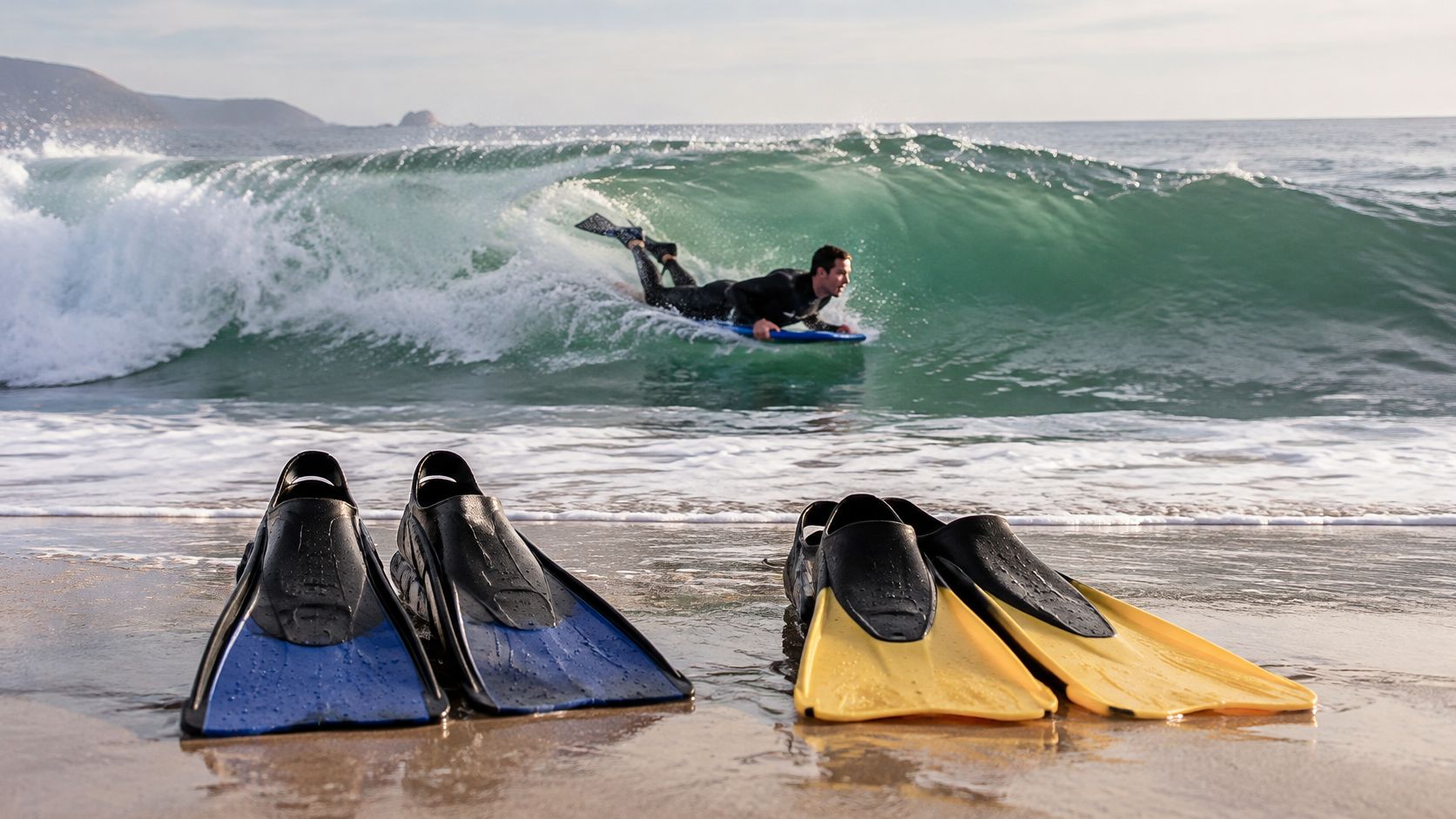
Choose open-heeled bodyboarding fins for surf use. A New Zealand guide recommends this style for bodyboarding and notes that fins help with paddling longer distances to waves. An open heel also lets you check how the strap holds with the socks you plan to wear. Pool-training fins serve a different purpose, so don't use their fit as your guide for surf fins.
Check the pocket and blade together
- Blade alignment. Consider whether the fin's shape and angle work with your legs and ankles. Appearance alone is a poor reason to choose a model.
- Drainage. Check that the openings can release water and sand. Trapped sand can cause pressure, while a pocket that shifts sideways makes each kick less direct.
- Heel hold. Try the fin with your intended socks. The strap should keep your foot in place without causing a painful pressure point.
Another NZ Guide explains how blade shape, drainage and the difference between surf fins and pool-training equipment affect your choice. Check these features after settling on the right length, not as a substitute for it.
Plan for loss without confusing it with fit
Fin tethers and fin savers are retention accessories. They help keep a dislodged fin attached to you. They cannot correct an oversized pocket or protect fins from rocks and shorebreak damage.
Don't assume a fin floats. Check the specific model's information and use suitable retention rather than relying on finding a loose fin in moving water. Fit the accessory according to its instructions, and check that it doesn't create another pressure point.
A tether is backup retention, not permission to accept a slipping heel.
The bodyboard accessories guide explains how fins, leashes and fin savers work within a bodyboarding setup. Choose a properly fitted open-heeled fin first, then use accessories for their intended purpose.
Test the Fit in the Water and Confirm Your Size
A snug fin is not automatically the right fin. Your bodyboard fins should stay aligned when you kick, without making your toes curl, compressing your instep or rubbing your heel. Check the fit in the water with the socks or booties you'll wear in practice, because footwear and riding conditions can change how a size feels.
Start with a dry fitting. Before wet-testing a new purchase, check whether doing so affects your ability to return it. Choose safe, suitable water for the test, and don't use challenging surf to find out whether the fit works.
Run a controlled fit check
- Put on your complete setup. Let the pocket settle around your foot, then check for heel movement. Your toes should lie comfortably without curling to compensate for excess length.
- Move briefly in the shallows. Keep walking controlled and minimal. Fins are designed for kicking, so judge heel movement rather than trying to stride normally.
- Flex your ankles and kick. In safe water, make repeated, firm kicks. The heel should stay seated, and the pocket should not twist around your foot.
- Check again after wearing them. Reassess your toes, instep and heel. Stop if you feel numbness or significant pressure. A fit that becomes painful is a poor fit, even if the fin initially felt secure.
| Symptom | Likely cause | Fix |
|---|---|---|
| Heel lifts on each kick | Fin is too big or its shape doesn't suit your foot | Try the next size down or another model |
| Toes or instep go numb | Pocket is too tight over your socks | Try the next size up or a roomier model |
| Water floods the pocket | Loose fit and heel movement | Recheck the fit with your socks on, then resize |
| Blisters or rubbing at the heel | Foot moves inside the pocket | Compare the smaller candidate using the same socks |
| Pocket twists sideways on kicks | Pocket shape doesn't match your foot | Try another model and retest with your socks on |
These are likely causes, not automatic diagnoses. If sizing down stops heel lift but crushes your forefoot, the model's shape is the problem. Try a different pocket instead of forcing a size that creates a new pressure point.
Confirm the purchase and keep safety separate
Before ordering, make sure you have the key checks covered:
- Measurement recorded. Use the longer bare-foot length in centimetres.
- Chart checked. Match that measurement to the manufacturer's sizing system and range.
- Footwear included. Confirm the size with the socks or booties you plan to wear.
- Movement tested. Your heel stays seated without toe or instep compression.
- Boundary resolved. Compare the neighbouring size rather than accepting a painful, overly tight fit.
Fins aren't rescue equipment. Choose a setup you can kick comfortably for the whole return journey, and avoid solo sessions. Water Safety NZ recorded 78 drowning fatalities in 2025, including 43 people who were alone. That figure is not about fin sizing, but it reinforces that equipment cannot replace safer decisions.
Blitz Surf Shop sells bodyboards and bodyboard fins, and its team offers personalised recommendations to help you find suitable gear. Bring your foot measurements and actual footwear so advice can account for your setup, not just your shoe label.


