

Picking out the right surfboard in New Zealand is all about matching the board to your skill level and, just as importantly, our unique local waves. Whether you're a total beginner needing something stable or a seasoned pro hunting for a high-performance blade, there’s a board out there perfectly suited for Kiwi conditions, from Raglan's long, peeling points to Piha's powerful beach breaks.
Your Guide to Buying Surfboards in New Zealand
Choosing your next surfboard can feel like a massive task, but it doesn't have to be. Think of this guide as your personal shop talk session, designed to help you cut through the noise and navigate the sea of options with confidence. Honestly, the right board is the single most important bit of gear you'll own—it dictates how many waves you catch, how quickly you progress, and ultimately, how much fun you have out there.
New Zealand’s coastline is famously diverse. We've got everything from gentle, rolling waves perfect for learning, to hollow, heavy barrels for the experienced. A board that absolutely rips at Sumner Beach in Christchurch might feel completely wrong at Shipwreck Bay. This is exactly why getting your head around the fundamentals is so critical.
What This Guide Covers
Our goal here is to break down the essentials into simple, practical advice. We’re drawing on decades of hands-on experience from our team at Blitz Surf Shop—a family-owned surfing institution since 1983—to give you insights that actually work in the real world.
This guide will walk you through:
-
Board Types and Shapes: We’ll explain which designs work best for the kinds of waves we get here in NZ.
-
Sizing and Volume: You’ll get the lowdown on the secret sauce to stability and paddle power. Our comprehensive guide on what size surfboard you need goes even deeper on this.
-
Materials and Construction: We'll compare the different builds so you can figure out what’s right for your surfing and your wallet.
-
Budgeting and Value: We'll cover how to find a quality board that’ll last, without having to remortgage the house.
By the end of this, you won’t just be buying a surfboard; you'll be making a smart investment in your surfing journey. One that makes sure every session is better than the last. Let's dive in and find your perfect ride.
Matching Your Board to New Zealand Waves
Choosing a surfboard in New Zealand isn't about finding the 'best' board; it's about finding the right board for the waves you want to ride. Our coastline serves up an incredible variety of conditions, and the shape under your feet is your direct connection to all that energy. Think of a surfboard like a key—the right one unlocks the full potential of a specific wave.
We're going to break down the main surfboard categories you’ll find across Aotearoa. This will help you understand why certain shapes excel at specific breaks, so you can pick a board that works with our waves, not against them.
Shortboards: The High-Performance Choice
When you picture professional surfing, you're almost certainly thinking of a shortboard. These boards are defined by their sharp noses, thinner rails, and aggressive rocker (the curve from nose to tail). They're the sports cars of the surfing world—fast, incredibly responsive, and built for sharp, powerful turns right in the pocket.
But that performance comes at a cost. Shortboards have less volume, making them less stable and harder to paddle. They really need speed and power from the wave itself to get going, which is why they feel most at home in punchy, steep, and hollow waves.
-
Ideal NZ Waves: Perfect for the powerful beach breaks of Piha or Muriwai, the hollow reef breaks around Taranaki, or a firing day at Wainui Beach in Gisborne.
-
Surfer Level: Best for intermediate to advanced surfers who have already locked in the fundamentals.
-
Explore Our Collection: Check out our range of high-performance Shortboards, featuring top-tier designs from shapers like Firewire and Slater Designs.
Surfing participation has seen a massive surge in Aotearoa recently. Surfing New Zealand's 2023 report noted 180,000 registered surfers, a 35% increase from 2015, establishing it as the nation's fastest-growing water sport. This growth heavily influences demand, with 68% of Kiwi surfers aged 15-35 preferring shortboards, which hold a dominant 49.1% regional market share, perfectly suited for the powerful waves at places like Raglan. Discover more about the growth of the surfing market.
Midlengths and Funboards: The Versatile All-Rounders
Sitting comfortably between a shortboard and a longboard, midlengths and funboards are the ultimate utility players. Ranging from roughly 6'6" to 8'0", they blend the paddle power and stability of a longer board with some of the manoeuvrability of a shortboard. This makes them a fantastic choice for anyone stepping down from a softboard or for experienced riders who just want a reliable board for those average, everyday sessions.
Their whole design philosophy is about versatility. They have enough volume to help you catch waves early and flow through weaker sections, but they're still responsive enough to let you lay down proper turns.
Think of a midlength as the perfect road trip board for exploring New Zealand. It can handle the gentle peelers at Mount Maunganui, the mushier days at Sumner Beach, and even some of the more mellow point breaks, making it a true one-board quiver for many.
For a deeper dive into wave types, check out our guide on the best surf spots in New Zealand.
Longboards: Classic Style and Glide
Longboarding is less about aggressive manoeuvres and more about graceful flow and timeless style. These boards, typically 9'0" and over, are built for one thing: glide. Their immense volume and surface area mean they can catch the smallest ripples, making them the perfect tool for those small summer days when everyone else is stuck on the beach.
In New Zealand, Longboards truly shine at the classic point breaks that offer long, uninterrupted rides. They allow you to trim, cross-step, and connect with the wave in a more relaxed, soulful way.
-
Ideal NZ Waves: Unbeatable for the long, peeling lines at Mangawhai Heads, the gentle waves of Te Arai Point, or a small, clean day at Manu Bay in Raglan.
-
Surfer Level: Great for all levels, from beginners who need that extra stability to advanced surfers perfecting their noseriding.
-
Find Your Glide: Browse our selection of classic and modern Longboards to find the perfect board for cruising.
Softboards: The Ultimate Starting Point
For anyone new to surfing, the softboard (or 'foamie') is non-negotiable. Their design is all about safety, stability, and catching as many waves as possible. The soft foam construction minimises the risk of injury to yourself and others, while their high volume makes them incredibly stable and easy to paddle.
These boards are designed to make learning as easy and fun as it can be. They give you a forgiving platform to practice your pop-up and get comfortable in the whitewater, building the essential skills you'll need to progress. Every Kiwi surfer's journey should start right here.
Understanding Surfboard Volume and Materials
Beyond the basic shape, two things really dictate how a board will feel under your feet: its volume and the materials it’s made from. Nailing these is key to finding a board that clicks with you and works in our unique New Zealand waves. Let's translate some of that board-talk into practical knowledge you can actually use.
Cracking the Code on Surfboard Volume
Years ago, surfers would only talk about a board’s length, width, and thickness. Nowadays, volume – measured in litres (L) – is the most important number to get your head around. Think of volume as your board's personal buoyancy engine. It’s the truest measure of how well a board will float you, which directly impacts how easily you can paddle and catch waves.
A board with more volume sits higher in the water, creating less drag when you paddle. Simple physics, really. This means you’ll get into waves earlier and with less effort. On the flip side, a board with too little volume will feel sluggish and tippy, a bit like trying to ride a bike with flat tyres. You'll waste a ton of energy just staying balanced, which is a one-way ticket to a frustrating session.
The image below gives you a quick visual on how board types progress, from high-volume longboards that are perfect for learning, down to the sleek, low-volume shortboards built for high-performance turns.
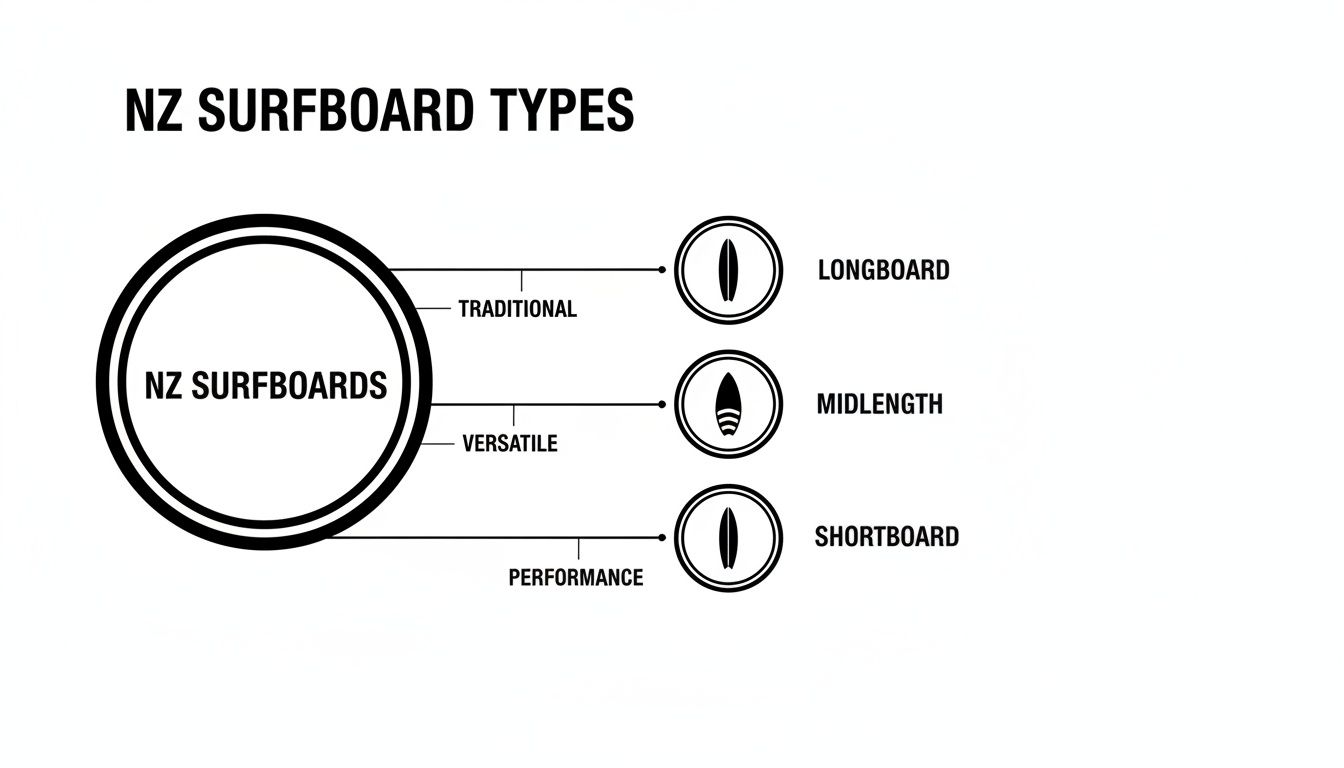
As you can see, as the boards get shorter, the volume generally drops, shifting the focus from stability and glide to speed and pure responsiveness.
So, how do you figure out your magic number? It’s all about balancing your body weight, fitness, and current skill level.
-
Beginners: You need all the help you can get. A great starting point is a volume that’s at least 100% of your body weight in kilograms. For an 80kg surfer, that means looking for a board with 80 litres or more.
-
Intermediates: You’ve got the basics sorted and are starting to generate your own speed. You can comfortably drop down to a volume that’s around 40-60% of your body weight.
-
Advanced Surfers: Your technique is sharp, so you don't need as much foam to do the work for you. These surfers often ride boards with a volume around 35-40% of their body weight.
Just remember, these are starting points, not hard-and-fast rules. If you only surf on the weekends or your paddle fitness isn't what it used to be, grabbing a board with a little extra foam is always a smart move. More volume means more waves, and more waves mean more fun.
Surfboard Volume Guide for NZ Surfers
To make it even easier, here’s a quick-glance table to help you find a solid volume range based on your weight and where you're at with your surfing.
| Surfer Weight (kg) | Beginner Volume (Litres) | Intermediate Volume (Litres) | Advanced Volume (Litres) |
|---|---|---|---|
| 50-60 | 55-70+ L | 28-36 L | 22-26 L |
| 60-70 | 65-80+ L | 32-42 L | 25-29 L |
| 70-80 | 75-90+ L | 38-48 L | 28-33 L |
| 80-90 | 85-100+ L | 44-54 L | 32-37 L |
| 90-100+ | 95-110+ L | 50-60+ L | 36-42+ L |
This should give you a solid ballpark figure to start with. If you're still scratching your head, check out our in-depth guide on how to choose the right volume for your surfboard.
Exploring Surfboard Construction Materials
The stuff a board is made of has a huge say in its weight, flex, toughness, and, of course, price tag. Here in New Zealand, you’ll mainly come across three types of construction. Each one has a totally different personality in the water.
Traditional Polyurethane (PU) Boards
This is the classic construction, the tried-and-true method that’s been around for over 50 years. It starts with a polyurethane foam core, has a timber stringer down the middle for strength, and is wrapped in fibreglass cloth and polyester resin.
Surfers love PU boards for their smooth, predictable flex that feels really connected to the wave. They sit a bit lower in the water, which helps them knife through chop and feel solid in more powerful surf. Plus, they’re usually a bit easier on the wallet.
Modern Epoxy (EPS) Boards
Epoxy boards are built around an expanded polystyrene (EPS) foam core, which is way lighter and more buoyant than traditional PU foam. This core gets laminated with fibreglass and epoxy resin—a combination that's much stronger and more durable than the old-school polyester resin.
The end result is a board that's noticeably lighter, feels super lively underfoot, and can take a few knocks. Brands like Firewire have built their name on advanced EPS technologies that deliver incredible performance. That extra buoyancy makes them paddle like a dream and really come alive in smaller, weaker Kiwi waves.
Soft-Top (Foamie) Construction
The go-to choice for learners, kids, and families. Soft-top surfboards (foamies), or 'foamies', use a tough EPS foam core (just like an epoxy board) but are wrapped entirely in a soft, forgiving foam deck. They come with flexible fins to round out the safety-first design.
These boards are built to be super stable, incredibly durable, and take the fear out of learning. They’re pretty much indestructible and give you the confidence you need when you're just starting out on your surfing journey.
How to Budget for Your New Surfboard
Alright, let's talk coin. Figuring out how much to drop on a new board is a massive step, but it gets a whole lot easier once you know what you’re actually paying for. Here in New Zealand, the surfboard market breaks down into some pretty clear price brackets, each with its own level of performance, durability, and craftsmanship.
Our job is to give you the full picture of what a board costs so you can find the absolute best value for your money. Whether you’re hunting for your very first board or a top-tier performance machine, there’s a smart choice out there for you.
Entry-Level Boards: The Perfect Start
If you're just dipping your toes into surfing, this is your territory. Priced from $400 to $600, entry-level boards are all about making those first waves easy, safe, and fun without breaking the bank.
This range is pretty much owned by durable soft-top surfboards (foamies) and some of the more budget-friendly machine-shaped epoxy "pop-outs." These things are built to take a hiding, give you heaps of stability, and offer a forgiving ride while you get the hang of the basics. A good foamie is honestly one of the best investments you can make in your surfing life.
Mid-Range Boards: The Sweet Spot
Once you’re up and riding consistently and starting to link a few turns, you’re ready for the mid-range. Sitting at roughly $700 to $1,100, this is the sweet spot for most intermediate Kiwi surfers. This is where you’ll find quality boards built with traditional polyurethane (PU) or standard epoxy (EPS) from trusted local and international shapers.
These boards are a serious leap in performance from the entry-level stuff. You get more refined shapes, much better responsiveness, and a feel under your feet that really helps you push your surfing forward. It's in this bracket you’ll find those versatile all-rounders that can handle the massive variety of conditions we get here in NZ.
Premium Boards: High-Performance Innovation
Welcome to the top shelf. Premium surfboards, which kick off from $1,200 upwards, are where you find the latest in design and advanced materials. This tier is home to the big global names like Firewire Surfboards, famous for their forward-thinking construction and high-performance shapes.
That bigger price tag comes from superior materials like carbon fibre, advanced EPS foam cores, and precision shaping that delivers incredible speed, lightness, and durability. These boards are for experienced surfers who need a specialised tool to push their limits in specific types of waves.
The economic impact of surfing in our country is massive. A Surfing NZ study revealed that surfboard retail alone contributes NZ$70 million to the economy annually, a significant slice of a NZ$250 million industry footprint. This market is championed by independent shops like Blitz, with local production also on the rise. Learn more about the surfboard market trends.
The Savvy Surfer’s Guide to Second-Hand Boards
Picking up a used surfboard is a brilliant way to save some cash, whether you’re a beginner or just want to try out a few different shapes without the commitment. But you’ve got to know what you’re looking at to avoid ending up with a lemon. A sweet deal can turn sour fast if the board has hidden damage.
Before you hand over your money, give the board a proper once-over.
-
Check for Dings and Cracks: Scan the whole board for any dings, paying close attention to the nose, tail, and rails. If any spots look yellowed or feel soft, it’s a red flag that water might have seeped into the foam core.
-
Inspect for Delamination: Press down gently on the deck and the bottom of the board. If you feel any bubbling or soft spots where the fibreglass has lifted away from the foam, that’s delamination. It’s a major problem that’s often a real mission to fix properly.
-
Examine the Fin Boxes: Make sure the fin boxes are solid and have no cracks. Give them a gentle wiggle to check they aren’t loose. A busted fin box is a serious issue that messes with the board's structural integrity.
-
Sight Down the Stringer: Hold the board up and look right down its length from the nose to the tail. This is the best way to spot any twists or weird rockers, which could mean it’s had a bad break and a dodgy repair job.
Finding a quality second-hand board can feel like striking gold. And if you're on the hunt for value, make sure you check out the huge surfboard sale on now at Blitz Surf Shop.
Choosing Your Essential Surf Gear
A great surfboard is just the beginning of your story. The right hardware is what really brings it to life, protects your investment, and keeps you safe out there. Getting your setup dialled in before you hit the water is a crucial step, turning a good session into a great one. Honestly, it’s the little details that make a massive difference.
Think of your gear as the essential support crew for your board. From giving you grip and control to keeping you and your board connected when you wipe out, each piece plays a vital role. Let's break down the must-have bits and pieces that will complete your kit for surfing in New Zealand.
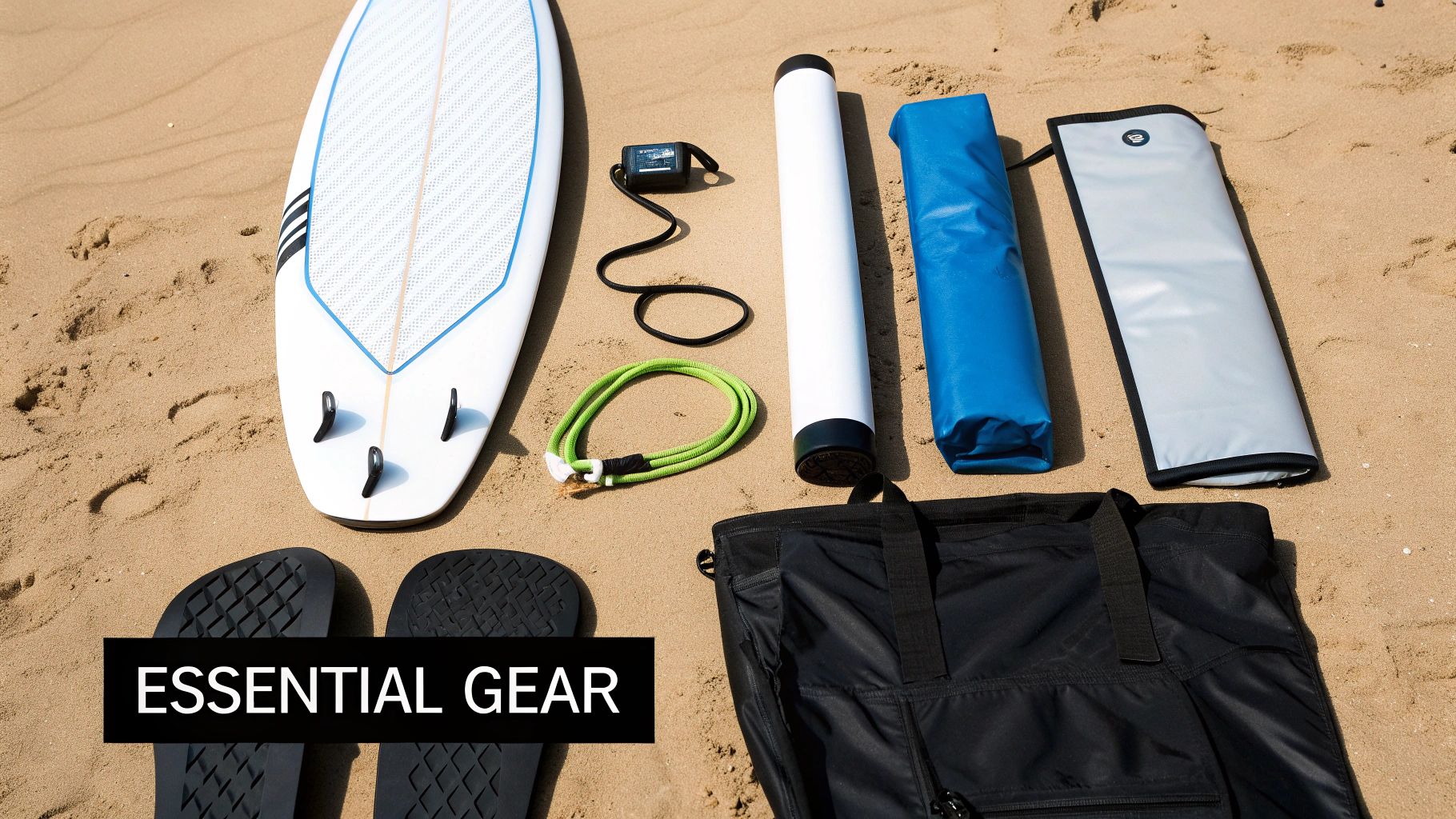
Fins, Leashes, and Bags: The Core Trio
Your board's performance really hinges on a few key pieces of hardware. These aren't just optional extras; they're completely fundamental to your whole surfing experience.
-
Fins: These are your board's steering wheel and engine all rolled into one. The most common setups are the thruster (three fins), which gives a super reliable and controlled ride, and the quad (four fins) for a bit of extra speed and hold in hollower waves. Check out our full range of surfboard fins to find the perfect match for your board and local break.
-
Leash: Your leash is your lifeline, plain and simple. It keeps your board with you after a wipeout. The golden rule here is to pick a leash that’s about the same length as your board, eg 6' leash for boards 6' plus, 7' for 7' plus etc. For a proper deep dive, you can learn more about finding the right one in our complete guide to choosing a surfboard leash.
-
Boardbag: Dings and sun damage are a surfboard's worst enemies. A quality boardbag is non-negotiable for protecting your board during transport, whether you're just driving down to the local beach or heading off on a classic Kiwi roadie.
When you're sorting out your gear for a New Zealand surf adventure, it's also worth considering how exploring eco-friendly travel products can help minimise your footprint on our beautiful coastlines.
Grip and Maintenance Essentials
Once you have the core items sorted, a few more pieces will round out your setup and help you look after your board properly. It's all about maintaining solid grip under your feet and keeping your board in prime condition for years to come.
A traction pad (or deck grip) gives you a reliable, non-slip surface for your back foot, providing the grip you need for powerful turns. Applying it correctly is a one-time job that pays off in every single session.
Surf wax is just as crucial for your front foot. New Zealand's water temperature changes dramatically from north to south and season to season, so using the right temperature-rated wax is key for optimal stickiness.
-
Cold Water Wax: A must for the chilly South Island or a winter session up north.
-
Cool Water Wax: A versatile choice for most of the year in many North Island spots.
-
Warm Water Wax: Perfect for the height of a Northland summer.
Basic Board Care and Ding Repair
Look, dings happen. It's just part of surfing. The good news is that fixing minor ones is pretty straightforward and something every surfer should learn to do. Small cracks or dings that haven't taken on water can be easily patched up at home.
For those small, non-structural dings, a solar resin kit is your best friend. It’s a simple process:
-
Make sure the damaged area is completely dry and clean. No salt, no sand, no water.
-
Carefully apply the resin, making sure to fill the entire crack.
-
Cover it with the clear plastic sheet from the kit to smooth it all out.
-
Leave it in direct sunlight to cure—it seriously only takes a few minutes!
However, for bigger dings, snapped noses, or any damage near the fin boxes, it’s always best to see a professional. A poor home repair on a major issue can cause long-term water damage and ruin your board, so it pays to know when to call in the experts.
Why We're at the Heart of NZ Surfing
Choosing the right surfboard is a massive decision, and honestly, having someone in your corner who gets it can make all the difference. While this guide gives you the technical know-how, the final step is finding a place that truly understands the unique pulse of New Zealand surfing. That’s where we come in.
We’re not just another shopfront. We’re a family-owned, rider-operated shop that’s been part of the Gisborne scene since 1983. Our roots run deep here, right where the heart of Kiwi surfing beats strongest. The advice we give doesn’t come from a sales manual; it comes from our daily surfs at local breaks and decades of matching people with their perfect boards.
More Than Just a Surf Shop
What really sets Blitz apart is our history. New Zealand's surfboard scene properly kicked off back in the 1960s, with the first shapers setting up shop on the rugged East Coast. Gisborne, with its consistent waves, has been a magnet for surfers since the pioneers first rode Wainui Beach in 1961, so it naturally became a hub.
Fast forward to 1983, and our family opened Blitz Surf Shop. We started stocking everything from classic shortboards to cruisers and have been a cornerstone for NZ surfers ever since. If you're interested in the bigger picture, you can learn more about the global surfboard market evolution. This history is what drives us today and lets us offer an expert, personalised service you just won't find anywhere else.
We reckon the best advice comes from people who live and breathe surfing. When you chat with our team, you’re talking to someone who surfs our waves every day. We get the little nuances of finding the right board for our specific conditions.
Your One-Stop Shop for Everything Surf
Our goal is simple: support every surfer in New Zealand. From the first-timer getting pushed into the whitewater to the seasoned local chasing barrels, we've carefully picked a range of gear to cover every need and budget.
We've got you covered with:
-
A Board for Every Rider: From super stable beginner softboards to high-performance sticks from world-class brands like Firewire Surfboards.
-
All the Essentials: A full stock of wetsuits, fins, leashes, and all the bits and pieces you need to get in the water comfortably and safely.
-
Community First: We offer reliable NZ-wide delivery, with free shipping on eligible orders over $150. And if you need to check the conditions, our live Wainui Beach surf cam is always on.
Here at Blitz, we’re more than just a shop; we’re a core part of the surfboards New Zealand family. We're here to share our passion, give you honest advice, and help you find the board that makes you fall in love with surfing all over again.
Got a Few Questions?
Stepping into the world of surfboards can feel a bit overwhelming, especially with all the different shapes, sizes, and tech floating around. Don't worry, it's totally normal. Here are a few of the most common questions we get from Kiwi surfers, answered straight up to get you sorted and out in the water.
What's the Best Surfboard for a Beginner in New Zealand?
For anyone just starting out, a softboard (or 'foamie,' as you'll hear it called) is your best mate, hands down. They're packed with volume, which means they're super stable and forgiving while you're figuring out how to paddle and pop up. Plus, the soft deck is a lifesaver for you—and anyone else nearby!
Look for something in the 7-to-9-foot range. That size has all the float you need to catch the mellow, rolling waves you’ll find at learner-friendly spots like Mount Maunganui or Christchurch's Sumner Beach. It's all about building that confidence early on.
How Do I Figure Out What Size Surfboard to Get?
This is a big one. While length is part of the picture, the most critical number is volume, which is measured in litres. Think of volume as the board's engine—it dictates how well it floats you and how easily it paddles. It’s a balance between your weight, fitness, and where you're at with your surfing.
As a solid starting point, beginners should aim for a volume that’s at least 100% of their body weight in kilograms. So, if you weigh 80kg, you’ll want a board with 80 litres of volume or more. The volume guide table we put together earlier in this article is a great spot to double-check.
Does Blitz Surf Shop Ship Surfboards Around New Zealand?
You bet! We offer reliable NZ-wide delivery on all our surfboards, from the very top of the North Island right down to the bottom of the South. We've been doing this a long time, so we take a lot of pride in packaging our boards properly to make sure they arrive at your door in one piece.
We also offer free shipping on heaps of items for orders over $150. So no matter where your local break is, we can get the right gear to you.
Should I Buy a New or Second-Hand Surfboard?
Both have their pros and cons. A second-hand board can definitely be a good way to get in the water without breaking the bank, but you’ve got to play detective. Look closely for hidden dings, delamination (where the fibreglass peels away from the foam), or signs that the board is waterlogged. A cheap board can quickly become a waterlogged dud.
Buying new gives you that peace of mind. You get the latest designs, guaranteed quality, and a board that's fresh off the rack. Honestly, for most beginners, a durable new softboard is often a much better long-term investment than a battered second-hand stick.
Ready to find your perfect ride? The team at Blitz Surf Shop has been helping Kiwi surfers find the right gear since 1983. Come and see us or explore our full range of boards and accessories online.


