

You're probably here because someone in your house has just started skating, or started again after years off, and the first proper slam has already happened. It's usually the same story. Board shoots forward, feet go one way, hands go out, and the wrist takes the hit.
That's why buying wrist guards properly matters more than many assume. Not all skateboard wrist guards do the same job, and the usual “just get a pair that fits” advice misses the part that changes protection: guard length, splint design, and the kind of skating the rider is doing. In New Zealand, that matters even more, because local injury data and NZ-based review work point to a real issue with wrist and forearm injuries, plus a design problem in some shorter guards sold here.
Why Wrist Guards Matter for Every Skateboarder
A beginner's first few sessions all look similar. Knees stiff, shoulders high, arms out, weight too far back, then one small wobble turns into a reach for the ground. Nobody plans to land on their hands. They just do it.
That instinct is exactly why wrists get hurt so often in skating. A Safekids New Zealand position paper reported 725 children were hospitalised for skateboard-related injuries during 2007 to 2011, with males aged 10 to 14 years the most commonly injured group and falls the leading cause of injury. The same paper says wrist fractures are a common skateboard injury and cites research showing skaters without wrist guards had 10.4 times the risk of wrist injury compared with skaters wearing wrist protection (Safekids NZ position paper).
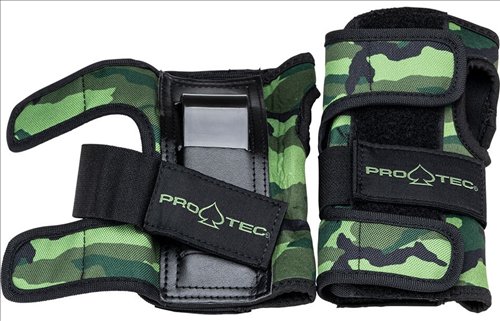
What a wrist guard actually does
A good wrist guard isn't magic. It doesn't make you crash-proof, and it won't stop every injury.
What it does is simpler and more useful than that:
- Limits backward bend: It helps stop the wrist from folding back too far when the hand hits concrete.
- Spreads force: Instead of dumping impact straight into the joint, it distributes load along a bigger area.
- Adds a slide surface: On some designs, the palm section helps the hand skid instead of sticking.
That's the whole point. Reduce the ugly load that turns a basic fall into a fracture.
Practical rule: For low and mid-speed falls, the right wrist guard often turns a harder wrist impact into something far more manageable.
If you've ever looked at rehab supports after a fall, it also helps to understand the difference between injury management and impact protection. Medical supports like browse carpal tunnel wrist braces are built for support during recovery or repetitive strain. Skate wrist guards are built for crashes. They solve different problems.
The buying decision most people miss
Most riders shop by comfort first, then price, then brand. I'd flip that around. Start with three linked decisions:
- Length
- Splint design
- Riding discipline
If one of those is wrong, the rest doesn't matter much. A comfortable guard that's too short or too soft for the way you fall is still the wrong guard.
For broader setup advice around pads, habits, and safer early sessions, Blitz also has 6 skateboarding safety and injury prevention tips worth reading alongside this.
Soft Sleeve vs Hard Splint Wrist Guards
Two guards can look similar on the wall and feel completely different once you skate in them.
The short version is this. Soft sleeve guards are easier to live with. Hard splint guards give you a higher protection ceiling. Neither is automatically right. The right one depends on how hard, how fast, and onto what surface you usually fall.
Where soft sleeve guards work
Soft sleeve designs usually use a stretch or padded fabric body with a more flexible splint built in. They sit closer to the hand, breathe better, and don't feel like you've strapped a small tool box to your wrist.
They suit riders who are:
- Learning basics: Pushing, turning, tic-tacs, gentle kickturns.
- Cruising smooth ground: Bike paths, carparks, flat concrete.
- More likely to skip bulky gear: A guard left at home protects nobody.
For that rider, comfort matters a lot. If a guard is light enough to wear every session, that counts.
Where hard splint guards earn their keep
Hard splint designs are bulkier for a reason. They usually combine a rigid palm plate with a firmer dorsal splint and multiple straps that hold the wrist more neutral on impact.
They make more sense when the falls are nastier:
- Street skating: Ledges, drops, rough concrete, missed landings with hands down.
- Park sessions: Faster approaches, transition falls, coping slams.
- Returning riders: People who still have muscle memory for tricks but not for absorbing falls.
The trade-off is obvious once you put them on. They can feel clunky. Some rub in the thumb web until they break in. Push comfort is lower. But if the rider's falls involve real speed and hard concrete, that extra structure is usually worth it.
| Feature | Soft Sleeve | Hard Splint |
|---|---|---|
| Profile | Low bulk, easy under sleeves | Bulkier, more obvious on the hand |
| Comfort in long sessions | Usually better in heat and casual skating | Can feel stiff until broken in |
| Wrist flex | Allows more movement | Restricts more backward bend |
| Best use | Flatground, cruising, beginner sessions | Street, park, bigger impacts |
| Protection ceiling | Moderate | Higher |
| Common downside | Can wear through faster, less control on hard impact | Less dexterity, possible thumb-web rubbing |
If you're recovering from a previous wrist issue, some off-board tools can help with gradual hand and forearm work between sessions, such as wrist cuffs for recovery exercises. That's rehab territory, not crash protection, but it matters if you're coming back carefully.
A good companion read here is Blitz's guide to skateboard protective gear in NZ, especially if you're choosing pads as a full setup rather than buying wrist guards on their own.
How to Size and Fit Wrist Guards Properly
Bad fit is where decent guards fail. Too loose and they slide. Too short and they dump force where you don't want it. Too tight and the rider takes them off halfway through the session.
Start with the fit process in buyer order, not shelf order.
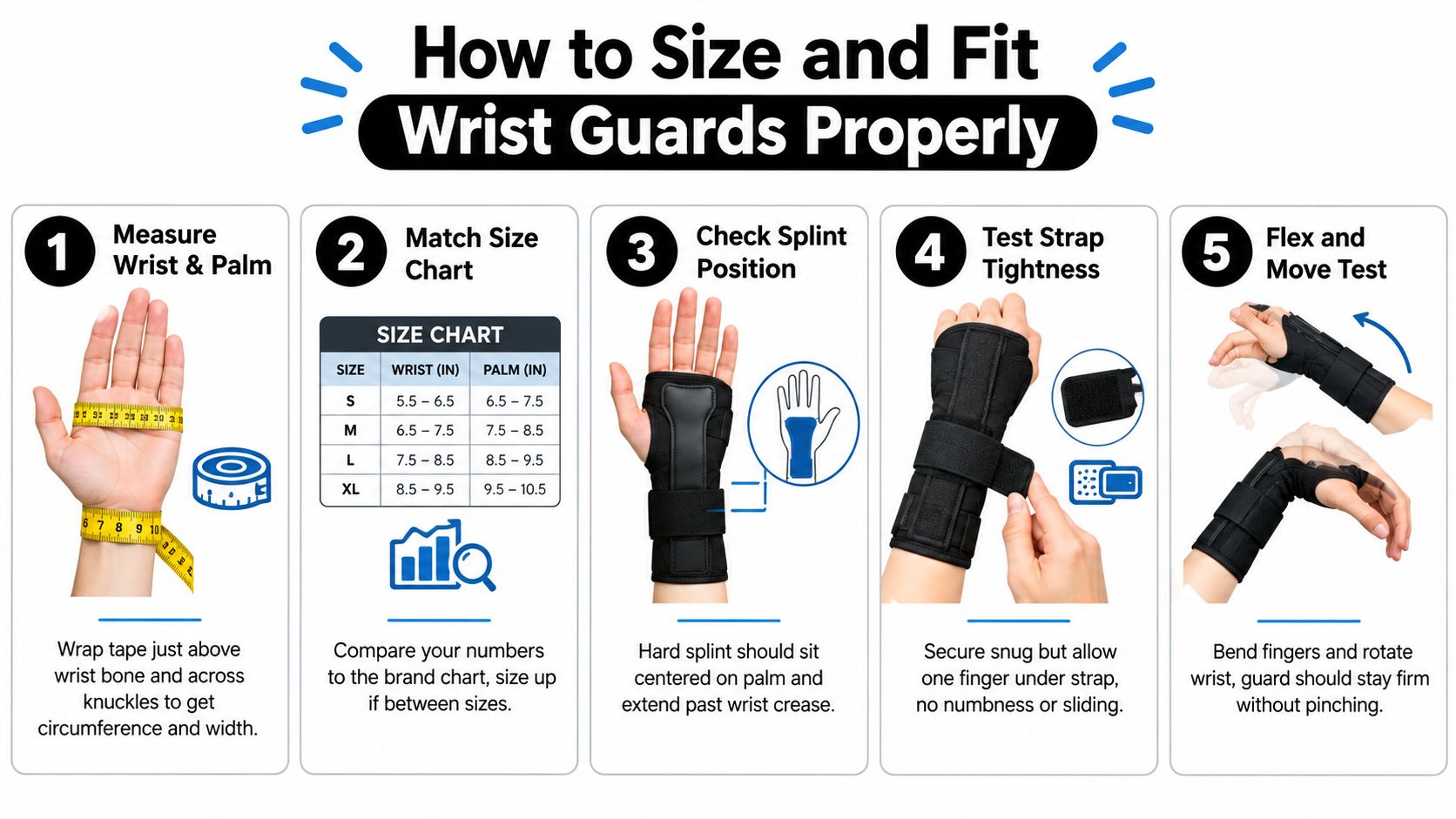
Measure first, don't guess
Measure two things before you compare sizes:
- Wrist circumference just above the wrist bone.
- Palm width across the knuckles.
Then use the brand's chart. Don't buy by age, and don't assume a bigger kid needs an adult medium. Hand shape changes the fit more than people expect.
For parents buying for younger riders, Blitz's guide to skateboards for kids is useful because board size, confidence, and protective fit usually go together.
Check forearm coverage, not just wrist snugness
This is the part many buyers miss. A New Zealand-focused review from AUT says a correctly designed wrist guard may reduce wrist-injury incidence by 38% to 68%, but it also warns that some guards sold in NZ are potentially too short and may transfer load proximally to the forearm, increasing fracture risk above the wrist joint (AUT-related review summary via Standards NZ page).
So when you try a guard on, don't just ask, “Is it tight enough?”
Ask:
- Does the splint sit centred?
- Does it run past the wrist crease?
- Does it extend down the forearm enough to give the load somewhere to go?
As a buying rule, I want the guard to cover a meaningful section of the forearm, not stop right where the impact problem starts.
Here's a visual demo that helps if you're fitting a child or buying online and trying to sanity-check what “right” should look like.
The three fit tests that matter
Once the guard is on, test it properly.
- Make a fist: The rider should be able to close the hand without the palm splint biting hard into the hand.
- Flex forward: There shouldn't be a big gap opening between the splint end and forearm.
- Shake the hand: If the guard shifts around, the straps aren't doing enough or the size is wrong.
Walk away from a pair if you get any of these:
- Thumb web pinching
- Finger numbness
- Noticeable sliding
- A splint that stops too short
A guard that passes those checks is already ahead of what a lot of people buy.
Materials, Construction and Durability
A wrist guard usually dies in boring ways, not dramatic ones. The foam packs out. The stitching at the palm starts to separate. The splint anchor loosens. By the time the rider notices, the guard still looks fine from a distance.
That's why material choice matters less for marketing and more for lifespan.
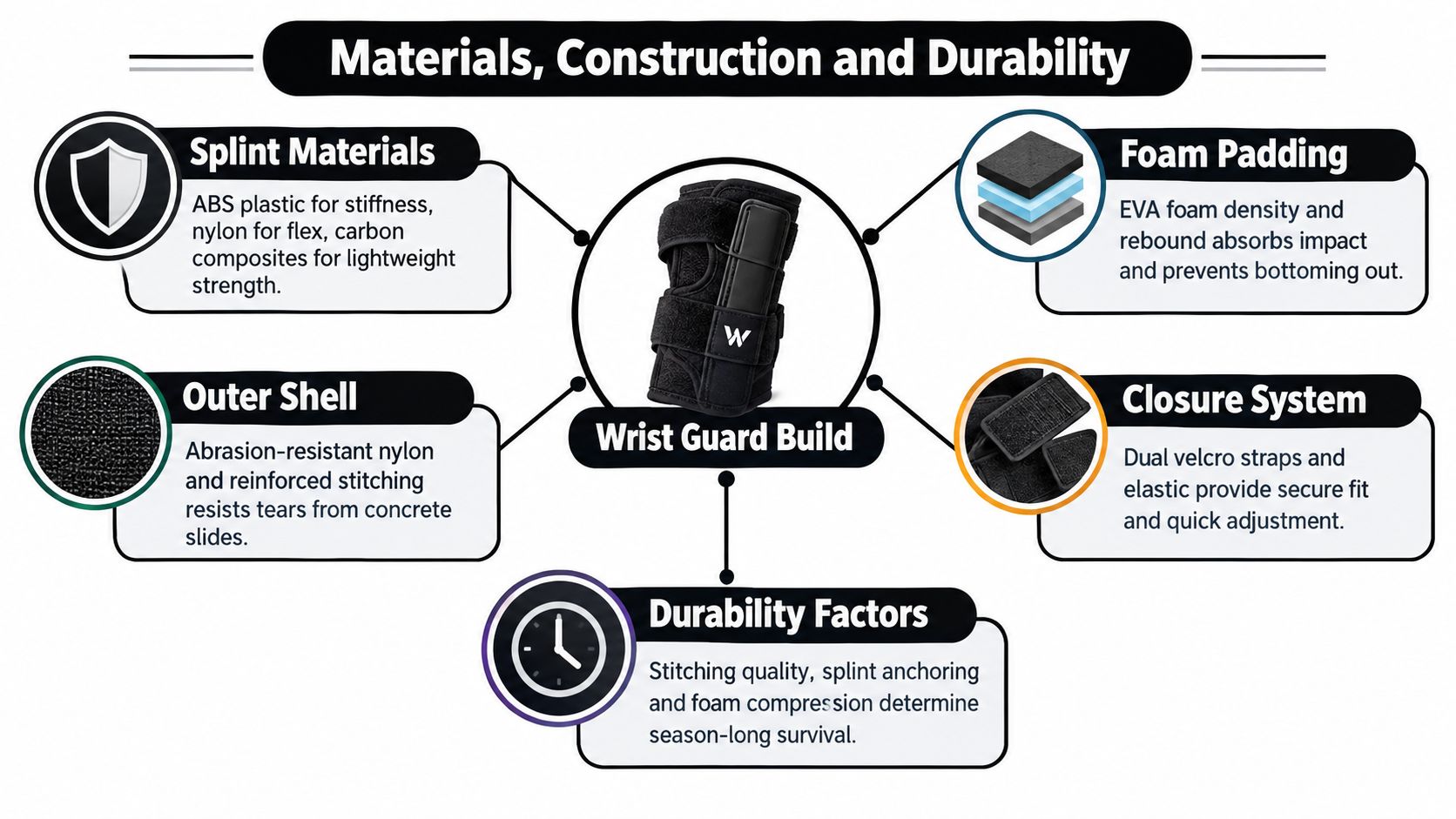
What usually lasts and what usually gives out
Look at four parts first:
- Splint material: Stiffer plastics tend to hold shape better under repeated hits, while more flexible builds can feel nicer day to day.
- Foam quality: Cheap foam feels fine new, then compresses and stays flat.
- Outer panel: The palm and lower edge take the abrasion. If the outer fabric is weak, that's where the guard goes first.
- Stitching and anchoring: Bad stitching kills guards faster than almost anything else.
The weak point is often the seam where the palm area meets the body of the guard. That zone gets scraped, folded, sweated in, and pulled on every time the rider puts the guard on.
What to inspect when two pairs cost about the same
If two guards sit in the same price band, compare these instead of the logo:
- Palm panel thickness
- Strap quality and hook-and-loop bite
- How securely the splints are fixed inside the body
- Reinforcement around high-wear seams
One practical example. Blitz Surf Shop's protective gear collection includes wrist guards alongside other skate safety gear, which is useful because you can compare construction details across categories instead of buying the cheapest pair blind.
Real trade-offs after a season
Heavier guards often protect better, but some riders hate pushing in them. Lightweight models feel good early, but the foam can lose its rebound sooner. Riders who do grab tricks or drag hands on falls usually wear the palm area fastest.
That doesn't mean there's one perfect build. It means durability has to match use. A casual cruiser and a rider skating rough park concrete aren't asking the same thing from the same product.
Protection Standards and What They Mean
Standards matter, but not in the way a lot of packaging suggests. A logo on the box doesn't rescue a bad shape, bad fit, or a splint that's too short.
For NZ buyers, the standards conversation also gets messy because skateparks and gear don't sit under one simple local rulebook.
What exists in New Zealand practice
Safekids New Zealand states that New Zealand currently does not have a mandatory or voluntary standard for skate park design, and says local authorities commonly use ASTM F2480-06 (2012) as guidance for in-ground concrete skatepark safety planning (Safekids reference noted on Cheapskates page).
That's a park-design point, not a wrist-guard certification. It matters because buyers often mix these up. Park guidance tells you something about facility planning. It does not mean every guard sold for skateboarding has passed a meaningful protector test.
What standards can and can't tell you
Wrist guards are commonly discussed in relation to EN 14120, which is used for wrist, palm, knee, and elbow protectors. In plain terms, standards in this area are trying to assess things like:
- Impact handling
- Abrasion resistance
- How protective parts distribute force
- Basic construction consistency
But they still have limits. They don't replace hands-on checks for fit, forearm length, splint geometry, or how the guard behaves when the rider grips a board and falls awkwardly.
| Standard | Region | What It Tests | Limit for Skateboard Use |
|---|---|---|---|
| ASTM F2480-06 (2012) | Commonly used as guidance in NZ skatepark planning | Skatepark design guidance for in-ground concrete facilities | Not a wrist guard performance standard |
| EN 14120 | Commonly referenced internationally for protective gear | Protective performance considerations for wrist, palm, knee, and elbow gear | Doesn't guarantee a good fit, enough length, or the right splint shape for a specific rider |
What “no standard” often means on cheap guards
If a very cheap online guard doesn't clearly explain its construction, coverage, or intended use, treat that as a warning sign. The risk isn't just lower quality. It's that you can't tell whether the shape and length make sense for skateboard impacts at all.
For helmet-specific certification and how it differs from other protective gear, Blitz's guide to the skate helmet clears up a lot of confusion.
Choosing Wrist Guards for Street, Park and Cruiser
The best guard is the one that matches how the rider falls. Not how they want to skate next year. Not what a sponsored rider wears in a clip. What matters is the actual crash pattern now.
A lot of buying mistakes happen because people shop by brand or price when they should be shopping by terrain.
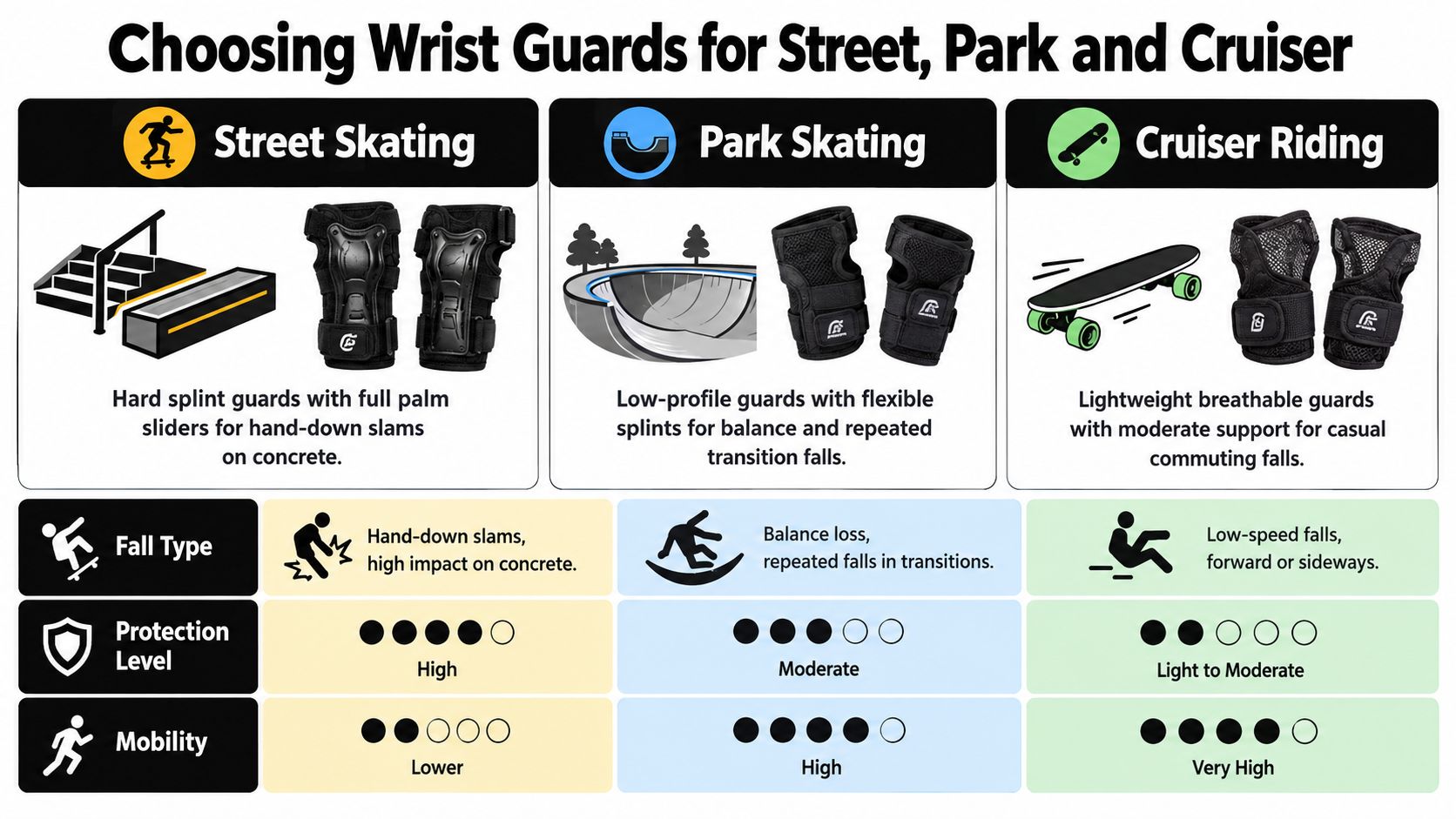
Street skating
Street falls are abrupt and ugly. Hands go down fast, often with bodyweight still moving forward, and the concrete usually isn't forgiving.
For street, I'd steer most riders towards:
- Hard splint guards
- Firm dorsal support
- A solid palm slider or plate
- Secure strapping that doesn't rotate
The downside is push comfort. Street riders notice bulk more because they're adjusting feet, carrying speed, and popping repeatedly. Still, if the rider is skating ledges, gaps, stairs, or rough ground, extra structure earns its place.
Park and transition
Park skating sits in the middle. The rider still falls onto hard surfaces, but movement is more fluid and many skaters want enough hand freedom to grab the board or move naturally through transition.
That usually makes a hybrid style the sensible choice:
- firmer support on top
- a lower-profile palm section
- enough mobility to keep the hands usable
Too soft, and it won't hold up when the rider slaps down on a fast transition fall. Too rigid, and some skaters stop wearing them because they hate how disconnected their hands feel.
If your local sessions revolve around bowls, ramps, and park layouts, Blitz's guide to skateboard parks is a handy read before you choose the rest of the setup.
Cruiser and transport boards
Cruiser falls are different again. They're often lower-speed but awkward, and they usually happen when the rider hits rough pavement, a crack, loose gravel, or steps off badly.
For that use, soft sleeve or lighter-profile guards often make the most sense because:
- they're easier to wear casually
- they fit under a sleeve
- they don't make a quick ride feel overbuilt
That last point matters. A moderate guard worn every ride beats a stiffer guard sitting in a backpack.
One rider can need more than one guard
This is normal and worth saying plainly. A rider who cruises to school during the week and skates park on weekends may not be best served by one do-everything pair.
A practical way to consider it:
- Street setup: highest support, most structure
- Park setup: balanced support and mobility
- Cruiser setup: easiest to keep on consistently
Parents sometimes resist this because it sounds excessive. I get it. But it's no different from using different shoes for running and tramping. Same feet. Different load, different job.
The right pair of skateboard wrist guards isn't the most technical one on the wall. It's the one that matches the actual fall pattern of the discipline.
Care, Maintenance and When to Replace
Wrist guards don't last forever, even when they still look tidy. Sweat, heat, abrasion, and repeated compression wear them out slowly. Most failures are visible if you know where to look.
How to clean them without ruining them
Keep it basic.
- Hand wash with mild soap: That gets rid of sweat and grit without hammering the materials.
- Air dry flat: Keep them out of direct sun and away from heaters.
- Separate removable parts if the design allows: If the splint can come out, clean the fabric body and dry both fully before reassembly.
Don't machine wash them unless the maker is very clear that you can. Agitation is rough on stitching, and heat is bad news for foams and plastics.
What to inspect each month
For a kid who skates often, or an adult who uses them a few times a week, a quick monthly check is worth doing.
Look at these points first:
-
Palm seam
Abrasion and flex combine. If stitching starts lifting, the guard is already on borrowed time. -
Foam rebound
Press the padding with your thumb. If it stays flat or feels dead, it's no longer doing the same job. -
Splint condition
Small cracks matter. A cracked splint may still sit in place, but it won't respond the same way on impact. -
Cuff tension
If the sleeve or cuff has stretched and the guard shifts easily, fit security is gone.
A wrist guard can look cosmetically fine and still be past its useful life.
Clear replacement signs
Replace the pair if you find any of these:
- Visible cracking in the splint
- Foam that bottoms out under pressure
- Straps that no longer hold firmly
- A cuff that won't stay snug
- A guard that has taken a heavy hit and now feels different
That last one gets ignored a lot. If a guard has done a serious job in a hard fall, retire it if anything about the structure, shape, or fit changes afterward.
How long they usually last in the real world
There isn't one fixed lifespan because wear depends on terrain, frequency, sweat, cleaning habits, and how often the rider slams hands-first. But for a beginner guard that gets honest use, one to two seasons is a realistic working life before protection starts to degrade qualitatively, and often visibly.
That doesn't mean every pair dies on schedule. Some casual-use pairs last longer. Some heavily used park pairs get tired much sooner. The point is not to wait for total failure. Replace them when the protective parts stop acting like protective parts.
Blitz stocks skate protective gear, including wrist-guard options, plus boards and hardware for riders who want to sort the whole setup in one place. If you want to compare fits, protection styles, and what makes sense for street, park, or cruiser use, have a look through Blitz Surf Shop.


