

You're standing at the counter with a board that feels slow, noisy, or harsh. The wheels look usable, but every push seems to lose energy, and the bearings sound gritty when you lift the board and spin them. In New Zealand, damp garages, coastal air, salty surf gear and rough chipseal can expose weak hardware quickly.
The good news is that skate wheels and bearings are usually the most noticeable parts to change. You don't need a completely new board to improve the ride. Pick the right wheel for your ground, fit the bearings properly, and protect them from water. That combination changes speed, comfort, grip and control far more than an impressive-looking number printed on a bearing box.
Why Skate Wheels and Bearings Matter for Every Rider
A Saturday at a Gisborne skate shop brings the same questions from different kinds of riders. A young skater wants a setup that handles rough footpaths. A parent wonders whether a cruiser's soft wheels will feel stable on the pavement. Someone who rides between jobs wants the board to hold speed instead of demanding another push every few metres.
Those riders are all feeling the same two components. The wheel controls how the board meets the ground, while the bearing controls how freely that wheel turns around the axle. If the wheel is too hard for broken pavement, every crack reaches your feet. If the bearing is dirty or damaged, the board feels sluggish even when the wheel itself is suitable.
Start with the surface beneath you
New Zealand riding surfaces vary sharply. Smooth skatepark concrete rewards a harder wheel with a lively, precise feel. Gritty paths and coarse chipseal punish hard urethane, while a softer cruiser wheel can absorb surface noise and roll over small imperfections with less chatter.
The bearing has a different job, but the result is just as obvious. A contaminated bearing can sound rough, resist acceleration and make a rider work harder. Water is especially destructive because it displaces lubricant, and surface rust can begin within hours after exposure, according to this skateboard maintenance guide for wet conditions.
Shop rule: Buy for the ground you actually ride, not the setup that looks fastest in a product photo.
Your riding style matters too. Street and park riders usually want quick response and predictable slide control. Cruisers need comfort and roll speed. Bowl and downhill riders need dependable grip, stable wheel support and bearings that tolerate more side loading.
Before changing anything, inspect the board. Spin each wheel, listen for grinding, check whether the urethane is chipped or uneven, and look for missing washers or spacers. If the deck and trucks are sound, replacing the wheels and bearings is often the cleanest way to make an old setup feel useful again. Ride within your limits and use appropriate protection, especially when testing faster hardware. These skateboarding safety and injury prevention tips are worth reading before you push a newly upgraded board harder.
How Skate Wheels and Bearings Work Together
Think of the bearing as the engine and the wheel as the tyre. The bearing lets the wheel rotate around the truck axle with reduced friction. The wheel turns that rotation into contact, grip and movement across the surface.
A standard skateboard bearing is the 608 format, with an 8 mm inner diameter, 22 mm outer diameter and 7 mm width. That specification is used throughout New Zealand retail and supports the universal fit built into standard skateboard wheels and trucks, as shown in this NZ skateboard bearing guide.
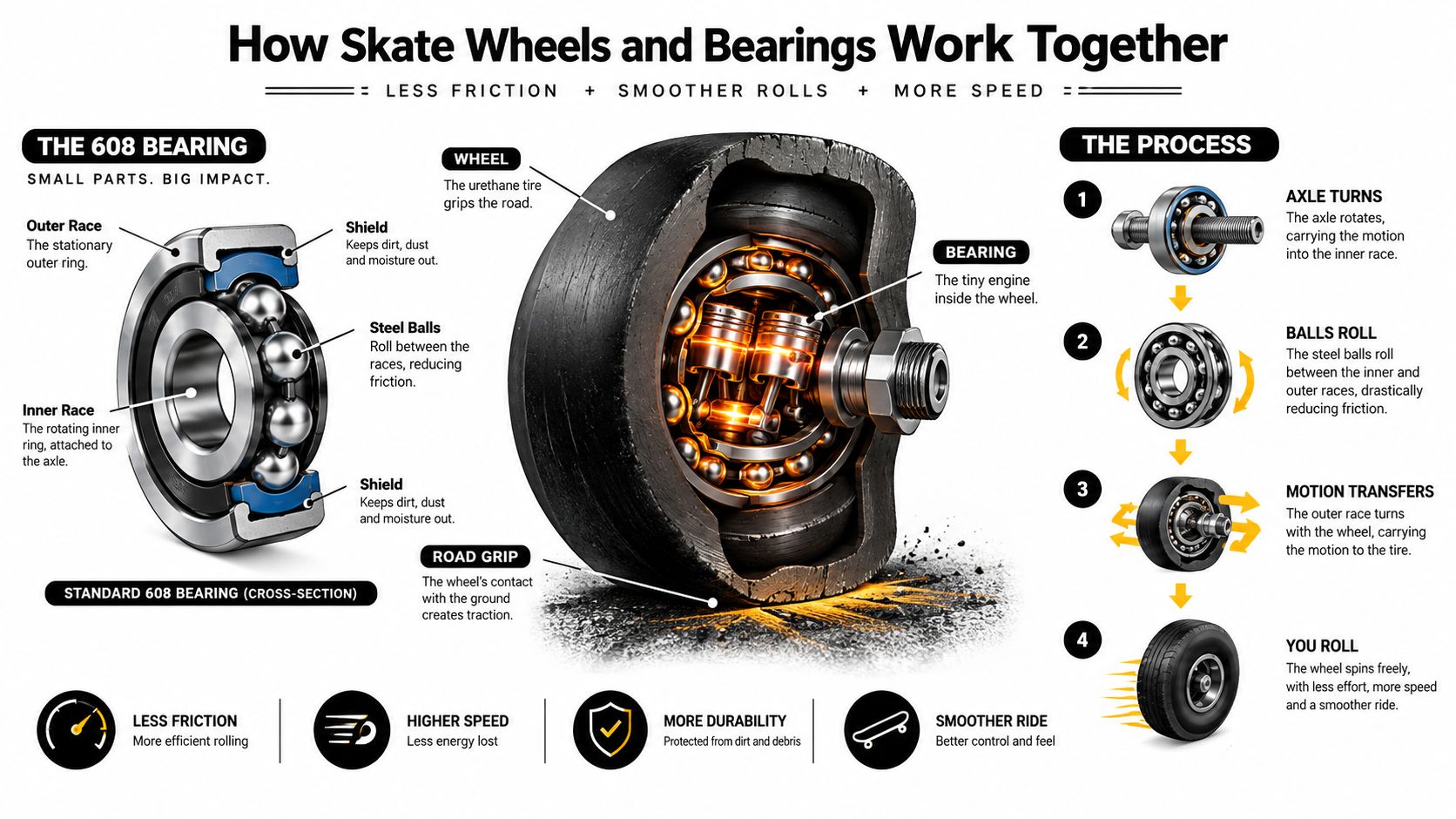
Inside the bearing, steel balls roll between an inner race and an outer race. A retainer spaces the balls, while a shield helps keep dirt out and lubricant in. The inner race sits on the axle, and the outer race presses into the wheel's bearing seat. When the wheel turns, the bearing transfers motion around that fixed axle.
The wheel decides how the ground feels
Skate wheels are made from polyurethane. Their durometer, or hardness, changes the ride. Harder wheels feel sharper and release into slides more readily on smooth concrete. Softer wheels provide more comfort and grip on rough paths, though they can feel less responsive for technical tricks.
Diameter changes the board's behaviour as well. Smaller wheels respond quickly and suit technical skating. Larger wheels carry momentum and handle imperfect surfaces more comfortably, but they can need more attention to wheel bite and truck clearance.
Contact patch matters as well. A wider area of urethane touching the ground generally gives a more planted feel. A narrower patch can make slides easier to start and can feel more nimble.
Read the guide to skateboard construction if you want the complete picture of how deck, trucks, wheels and bearings interact. The important point is simple: neither part works alone. A soft wheel can still feel slow if the bearing is rough, and a premium bearing can't make an overly hard wheel comfortable on coarse footpaths.
Bearing Sizes and ABEC Ratings Explained
Most skateboard bearing confusion starts with the letters and numbers on the packet. For standard skateboard wheels in New Zealand, the number to remember is 608, not an ABEC score. The 608 format uses an 8 mm bore, a 22 mm outside diameter and a 7 mm width, so it fits the standard wheel and axle arrangement used by most modern skateboards.
ABEC is a different measurement. It describes manufacturing tolerance used for bearing applications, but it isn't a direct speed, toughness or skate-performance rating. Bones explains that Bones Bearings are “Skate Rated not ABEC rated”, and points out that ABEC doesn't account for side loading, impact resistance, lubrication, ball-retainer type, installation or maintenance.
What the number does and doesn't tell you
| ABEC Rating | Tolerance | Common Brands Sold in NZ | What It Actually Means for Riding |
|---|---|---|---|
| ABEC 1 | Basic tolerance category | Generic entry-level bearings | It may be a low-cost option, but the number doesn't guarantee a smooth ride or long service life. |
| ABEC 3 | General tolerance category | Generic and complete-board replacement bearings | It identifies a tolerance class, not how the bearing behaves under impacts or side load. |
| ABEC 5 | Tighter tolerance category | Generic performance bearings | It may offer a higher specification on paper, but it doesn't automatically mean faster skating. |
| ABEC 7 | Higher tolerance category | Some Bones Reds listings and other skate bearings | The rating still doesn't describe the full demands of skateboarding. A skate-specific design can be the more sensible choice. |
| ABEC 9 | Very tight tolerance category | Premium-looking generic sets | A higher number can bring a higher price without solving poor lubrication, weak seals or bad maintenance. |
A bearing that spins dramatically when held in your fingers hasn't passed a useful skate test. Riding loads the bearing, and skating adds landings, vibration, dirt and sideways force. Brand construction, lubricant, shields, fit and care matter more than chasing ABEC 9.
That's why Bones Reds have become the default recommendation at the counter. They're skate-specific, widely available and positioned as a practical performance upgrade rather than a marketing exercise. For a broader overview of the parts on a complete setup, use this complete skateboard guide.
Getting the Fit Right with Cores, Spacers and Speed Rings
A wheel and bearing can be individually suitable and still perform badly when the hardware is assembled incorrectly. Most complaints about new bearings feeling rough come from fit, missing parts or an axle nut tightened against the wrong surface.
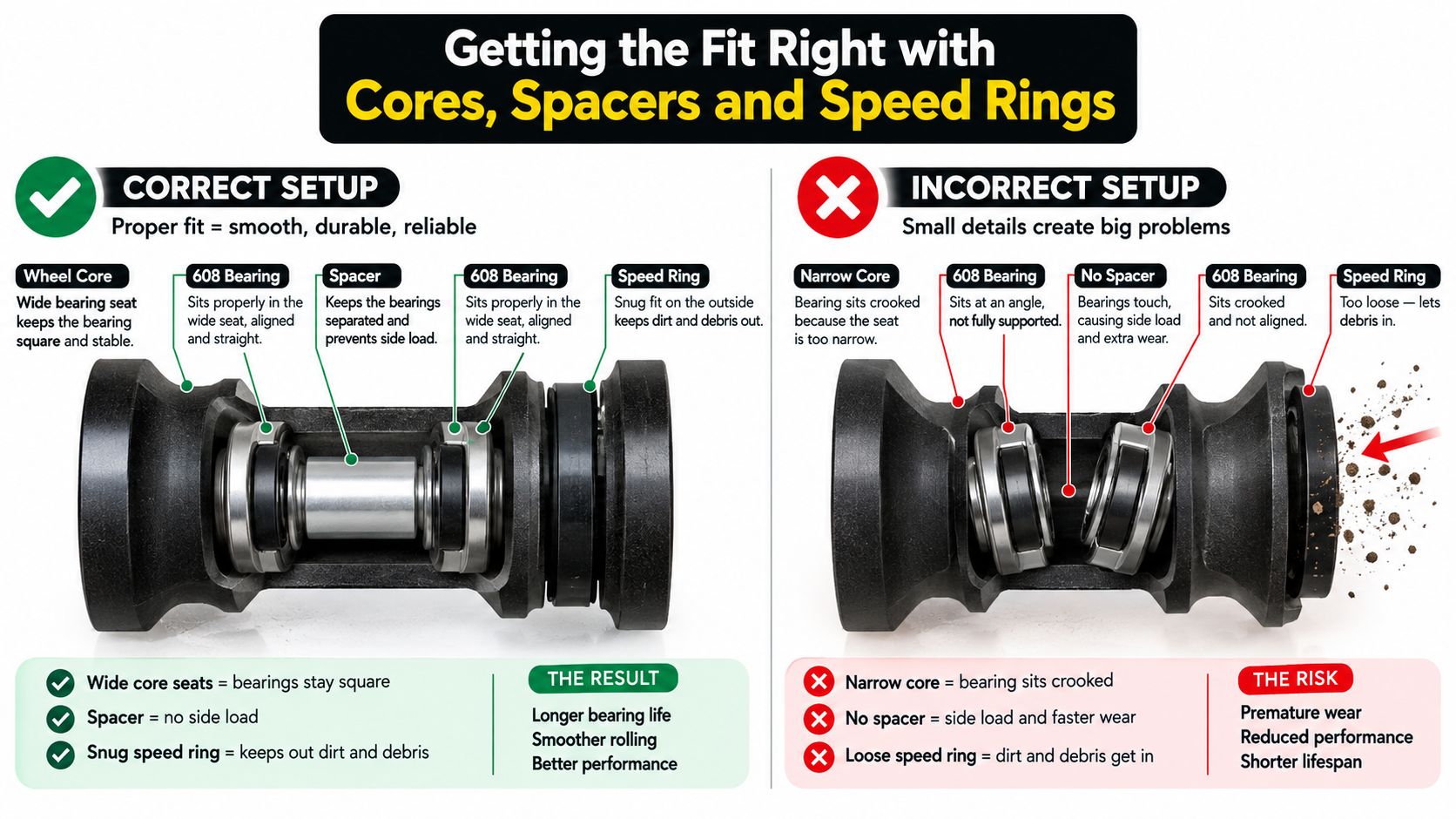
Start with the wheel core and bearing seat. The core is the internal section that supports the bearing. The bearing needs to sit squarely and fully in that seat. A supportive core gives the outer race a stable platform, while a poorly matched or narrow seat can leave the bearing crooked and vulnerable to side load.
Modern skate trucks in New Zealand generally use the standard 8 mm axle arrangement. Confirm your truck before buying unusual hardware, especially if you're working on an older, specialist or longboard setup.
The small parts prevent big problems
A bearing spacer sits between the two bearings inside the wheel. It helps keep the bearings aligned when the axle nut is tightened and when the wheel receives an impact. Without it, the inner races can shift relative to each other, leaving the bearings exposed to extra sideways force.
A speed ring sits outside the bearing, between the bearing's inner race and the truck hanger or axle nut. It gives the inner race a proper bearing surface and helps stop the nut from pressing directly against the shield or outer parts.
Use this fitting sequence:
- Check the wheel seat. Remove dirt and make sure both bearings will sit flush.
- Press the first bearing in squarely. Don't hammer the outer shield or force the bearing at an angle.
- Insert the spacer. Keep it centred between the bearing seats.
- Fit the second bearing. Press it down until it meets the spacer and sits fully.
- Install speed rings and axle nuts. Tighten the nut enough to remove play, but don't crush the assembly.
Bones Reds are supplied with spacers, while many budget bearing sets aren't. That difference is easy to overlook and worth checking before you leave the shop. If a rider installs new bearings without a spacer, hits a kerb and suddenly feels a wheel seize or bind, shifting under side load is a likely culprit.
Keeping Bearings Rolling Smoothly Through Maintenance
My first maintenance tip is always the same: keep bearings away from water. Don't ride through puddles, don't leave the board outside, and don't put it in the back of a ute beside salty, damp surfing gear. Gisborne's coastal air and sea spray make careless storage especially hard on steel bearings.
Water displaces lubricant, and surface rust can start within hours. After a wet session, dry the board immediately, remove the wheels if water has reached the bearings, let the parts air-dry overnight and clean or re-lubricate them if they feel gritty. Don't keep skating a bearing that sounds like it has sand inside.
A practical three-part routine
Prevention comes first. Store the board indoors and away from wet gear. Avoid sand, standing water and salt spray. A dry board with ordinary bearings will usually serve you better than an expensive set that gets repeatedly soaked.
Cleaning comes next. Use a skate tool or suitable socket to remove the axle nuts, keep the speed rings safe, and work the wheels off carefully. Remove the bearings with the axle or a bearing tool, wipe away surface dirt, clean them with an appropriate solvent such as isopropyl alcohol or mineral spirits, and let them dry completely before adding a small amount of bearing oil or suitable synthetic grease. Don't use cooking oil, and don't treat WD-40 as the final lubricant.
For a clear visual walkthrough of removing and replacing wheel bearings, use Punk Ride's practical bearing tutorial. The tutorial is written for scooter hardware, but the removal principles are useful for riders learning how a bearing sits in a wheel.
Replacement is the final call. If a bearing still grinds after cleaning and lubrication, the races or balls may be pitted. More oil won't repair damaged metal. Check the speed rings too. A crushed ring can make a fresh bearing feel worn almost immediately.
For a rider who skates regularly, a light clean every few months is sensible. Daily riders should inspect sooner, especially after dusty sessions or coastal exposure. Use the video below as another practical reference before dismantling your setup.
Choosing the Right Wheels and Bearings for Your Style
The most dependable all-round recommendation from the shop is Bones Reds bearings paired with Bones X-Series wheels. That combination gives NZ riders a balanced setup for everyday street skating, park sessions and general pushing without turning the purchase into a premium hardware bill.
For a beginner, I'd keep the choice simple. Choose a mid-range wheel around 53 to 54 mm with a hard street-oriented feel, then fit Bones Reds with the supplied spacer setup. You'll get a responsive board that isn't difficult to control, and you won't be paying for a bearing label that tells you little about real skate durability.
| Riding Style | Wheel Size | Durometer | Bearing Pick |
|---|---|---|---|
| Street and park | 52 to 54 mm | 99A to 101A | Bones Reds with spacers |
| Cruising and transport | 56 to 60 mm | 78A to 85A | Bones Swiss or X-Series bearings with suitable light lubricant |
| Downhill and slide-focused | 60 to 65 mm | 83A to 86A | Built-in spacer setup with Bones Super Swiss or a quality ceramic hybrid |
| Beginner all-rounder | 53 to 54 mm | Mid-100A range | Bones Reds |
Match the wheel to the ground
Harder wheels suit smooth parks, ramps and technical street skating. They feel precise and release into slides more easily, but rough paths transmit more vibration. Softer wheels are the better call for commuting and cracked pavement because they smooth the ride and maintain grip.
The skateboard wheel durometer guide is useful when you're comparing hardness rather than relying on a shop label such as “cruiser” or “street”. The wheel's size, shape and contact patch matter alongside the durometer.
For larger, softer wheels, use bearings with a properly supported core and check clearance around the trucks. Downhill and slide-focused riders should take spacers seriously because lateral force exposes loose or poorly aligned hardware quickly. I'd spend money on fit and reliable construction before ceramic parts, and I'd choose a skate-rated bearing over an ABEC number every time.
Local buying behaviour supports that recommendation. Bones Reds are listed at NZ$49.99 for an 8-pack, while Bones Super Reds are listed at NZ$84.99, creating a clear upgrade path for riders who want to spend more, as shown in this NZ bearing collection.
What an Upgrade Actually Feels Like on a Skateboard
Jake, a 17-year-old Gisborne rider, came into the shop with a board that had become noisy and reluctant to roll. He'd been pushing hard to keep speed, and the wheels were worn enough that the setup felt rough rather than lively. His complaint wasn't technical. He said the board didn't want to move.
We checked the wheels first, then spun the bearings individually. The old set had the familiar gritty feel of hardware that had seen plenty of street dust and damp storage. We fitted Bones Reds and paired them with a fresh set of wheels suited to his regular street and park riding, making sure the bearings sat squarely and the spacers and speed rings were in place.
The changes were easy to recognise
On the first ride, Jake noticed that the board carried more speed up the main street hill after each push. The setup sounded quieter as he rolled past the dairy, and the new wheels gave him a more predictable response when he moved from rough pavement to smoother skatepark concrete.
The bearings didn't turn the board into a different machine by themselves. The result came from matching fresh, properly fitted bearings with wheels that weren't worn out. The hard-working part was removing the grit, seating the bearings correctly and selecting urethane suited to where he skates.
He also changed how he stored the board. It stopped living near damp gear, and he began checking the wheels after wet weather rather than assuming the bearings were fine. That habit will protect the upgrade longer than chasing another ABEC label.
This is the pattern I see repeatedly. Riders who replace standard bearings that came with boards purchased elsewhere often describe a major difference, especially when the original bearings are rough, poorly lubricated or already contaminated. The gain is practical, not mysterious. A clean bearing, sound wheel and correct assembly let each push do more work.
Putting It All Together and Where to Buy
Before you order skate wheels bearings, run through this checklist. It prevents most counter visits caused by buying parts that are individually good but incompatible as a set.
- Verify the axle and bearing format. Standard skateboard bearings use the 608 format, with an 8 mm inner diameter, 22 mm outer diameter and 7 mm width. Check unusual trucks and specialist longboard hardware rather than assuming every setup uses the same arrangement.
- Choose wheel hardness for your surface. Smooth parks can take harder wheels. Rough footpaths usually feel better with softer urethane.
- Choose a bearing series, not an ABEC fantasy. Look at construction, skate-specific design, lubrication and reputation. Bones Reds are the sensible starting point for most riders.
- Confirm the core and bearing seat. The bearing must sit fully and squarely in the wheel. A supportive core matters when larger wheels carry more load.
- Check the spacer and speed rings. Make sure the spacer fits between the bearings and the speed rings sit outside the inner races. Don't tighten the axle nut against an incomplete setup.
- Plan maintenance before riding. Keep the board dry, inspect it after wet sessions and clean or replace bearings when they become gritty.
Buying locally and avoiding the usual mistakes
A local skate shop can check the wheel core, press bearings in properly and spot missing spacers before you ride away. Online ordering gives you access to broader stock, but check the product specification and allow for delivery to your part of the North or South Island. If you're unsure, take the board with you. A few minutes checking the axle, wheel clearance and hardware can save a frustrating rebuild.
Blitz Surf Shop stocks skate hardware including bearings and wheels, and its skate shop range gives NZ riders another place to review skate equipment and advice. The important thing is to buy a matched, compatible setup from a retailer that understands how the components fit together.
The mistakes that keep coming back through the shop are predictable: riding through water, storing the board beside salty equipment, tightening axle nuts without spacers, forcing bearings in crooked, choosing wheels without considering the ground, and paying extra for an ABEC number while ignoring maintenance. Fix those habits first. They'll make a bigger difference than another upgrade bought in a hurry.
Blitz Surf Shop offers skateboard wheels, bearings and hardware for riders building or repairing setups, with advice available through its Gisborne store and NZ-wide online service. Visit Blitz Surf Shop with your board details, wheel preference and riding surface, and choose a compatible setup before your next session.


