

Your front foot slips, you miss the turn, and suddenly you're wondering whether your board needs a new grip setup. Before changing anything expensive, check the wax. A warm-water bar carried into a cold session can feel hard and lifeless, even when there's plenty left on the deck.
Choose wax hardness by the actual water temperature at your break that week, not by the season or the island. When you're comparing surf wax for sale, the temperature band matters more than the scent, wrapper or familiar logo.
Why the Right Wax Matters in New Zealand Waters
The wrong bar is a straightforward problem with a relatively cheap fix. Wax is a consumable, not a permanent part of your board, and keeping a suitable spare makes more sense than repeatedly rubbing an unsuitable formula over slippery patches.
New Zealand has a substantial surfing community. Sport New Zealand's national surfing profile estimated that 4.3% of adults aged 16 and over, approximately 141,000 people, surfed during the previous 12 months in 2013–14. That's a historical participation estimate, not a current headcount, but it puts this everyday accessory in perspective.
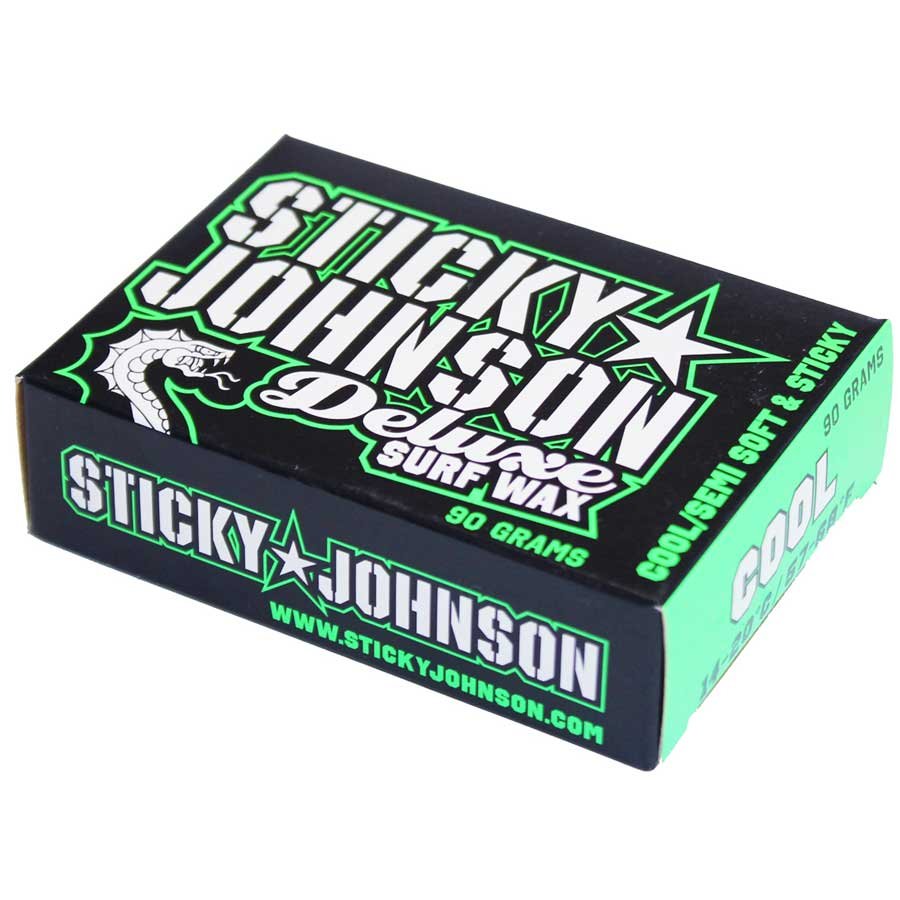
For a Gisborne surfer, a cool bar can be the sensible starting point through cooler conditions, while hotter summer sessions may call for a warmer formula. A single bar isn't automatically suitable for every session, and warming coastal waters make old seasonal habits less reliable.
Our guide to surfing in New Zealand gives broader context for planning sessions around the country. For traction, though, start with the conditions at the particular beach you're heading to, then choose the bar.
Matching Wax Hardness to Water Temperature
Match the bar to the water temperature at the break. Treat the following bands as a buying guide, not universal specifications: manufacturers draw their boundaries differently, so the temperature printed on the actual product takes priority.
This chart gives you a starting point before you compare labels.
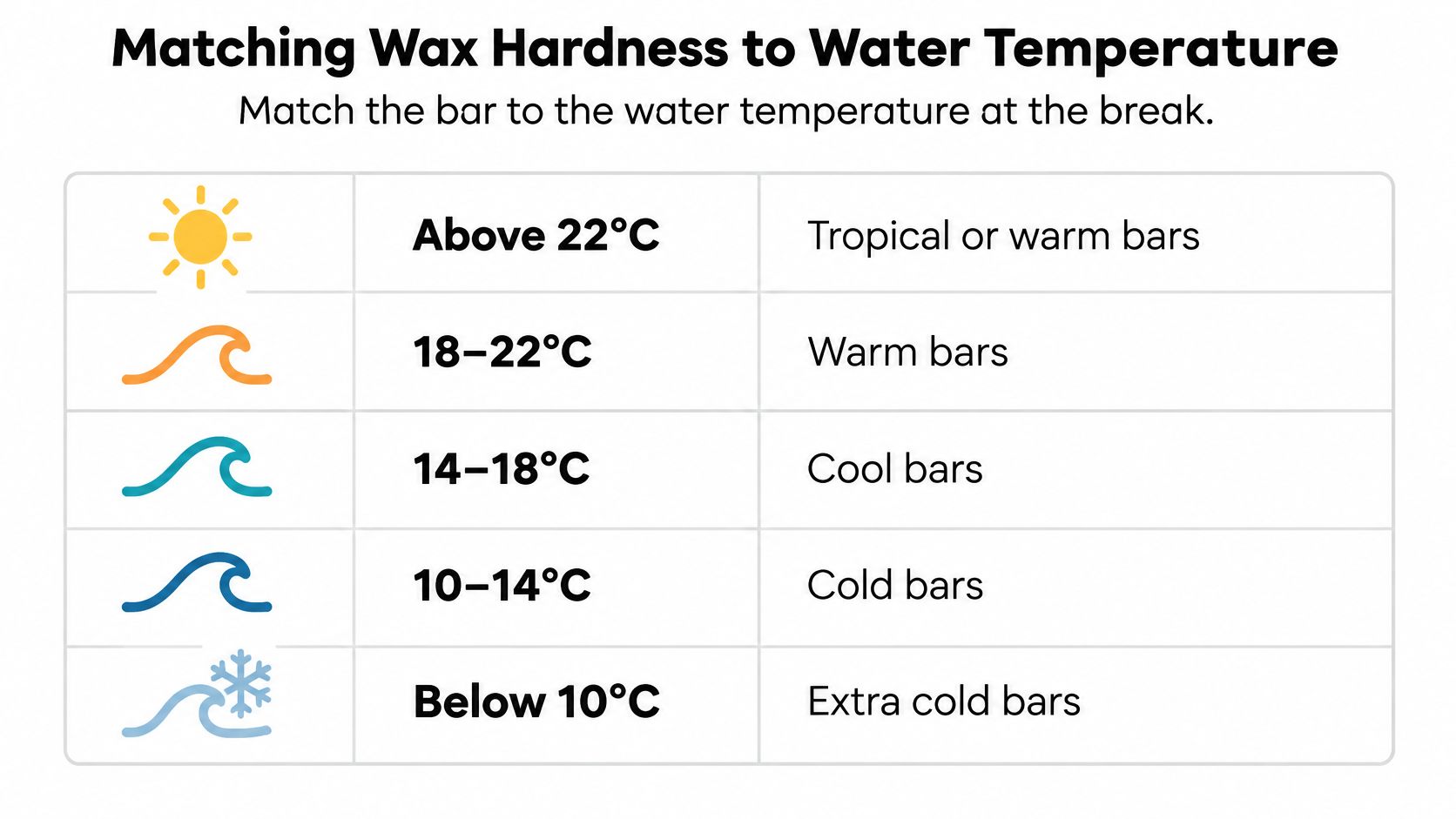
Water temperature and wax hardness guide for NZ breaks
| Water temperature | Wax category | Typical NZ conditions |
|---|---|---|
| Above 22°C | Tropical or warm bars | Possible hotter summer conditions in Northland or Bay of Plenty; confirm locally |
| 18-22°C | Warm bars | Possible warm Gisborne summer sessions or mild Hawke's Bay autumn conditions |
| 14-18°C | Cool bar | Autumn, spring and many Gisborne sessions; Wellington shoulder seasons |
| 10-14°C | Cold bar | Winter conditions in Wellington, Canterbury and the lower North Island |
| Below 10°C | Extra cold bar | Southern South Island winter, including Otago and Southland |
The regional examples are orientation points, not live temperature readings. Northland doesn't automatically mean tropical wax, and a January session in Gisborne doesn't automatically need a warm bar. Check the nearest reliable reading before committing, especially near a product's temperature boundary.
Why the calendar isn't enough
The Ministry for the Environment's ocean-health report describes annual average sea-surface temperatures ranging from about 25°C in northern subtropical waters to approximately 7°C in southern subantarctic waters. Those are broad ocean regions, not temperatures you should assign directly to your local swimming beach.
Unusually warm conditions can also overturn expectations. The Ministry's marine climate assessment records a March 2025 average sea-surface temperature of 19.9°C in Hawke's Bay, 1.09°C above its long-term average. Buying purely because it's autumn could therefore put you in the wrong category.
What hardness changes underfoot
Warm and tropical formulas are generally firmer, so they retain texture in heat. Cool and cold formulas are generally softer, allowing them to remain tacky when the water is colder. That's practical product-selection guidance, not a wax-performance finding from the ocean-temperature reports.
Too hard for the conditions, and wax can resist building useful bumps. Too soft, and it can smear or flatten under your feet. Direct sun and a hot deck complicate matters further, so apply wax in the shade rather than choosing a harder formula solely because your board has been baking outside.
Before a cold-weather mission, use our winter surfing guide to check the rest of your setup. For the wax itself, use this week's local reading and the manufacturer's band together.
The Main Types of Surf Wax and What Each Does
A basecoat builds the foundation; a topcoat adjusts the feel underfoot. Think of the basecoat as tyre tread and the topcoat as the softer compound that helps it bite on a wet road. You need texture as well as tackiness.
These blocks illustrate the distinction between a foundation layer and a grip layer.
Surf wax types and what they do
| Wax type | Job on the board | Typical use |
|---|---|---|
| Basecoat | Hard foundation that bonds to a bare deck | Applied first; refresh the surface as grip fades |
| Topcoat, such as Mega Johnson or Fu Wax | Extra stickiness on top of a basecoat or even standard topcoat | Cold sessions or when the foundation feels slippery; Fu Wax costs more than standard bars |
| Cool or cold bar | Softer, stickier grip for cooler water | Autumn, winter and East Coast cool-water sessions |
| Warm or tropical bar | Firmer formula that holds shape in heat | Summer sessions and warmer water |
Layer for a reason
Layering isn't compulsory. A temperature-matched bar can work perfectly well on its own, particularly if you've built an even texture rather than a smooth slab. A firmer foundation with a softer surface becomes useful when you want durable bumps and extra tack without covering the deck in soft wax.
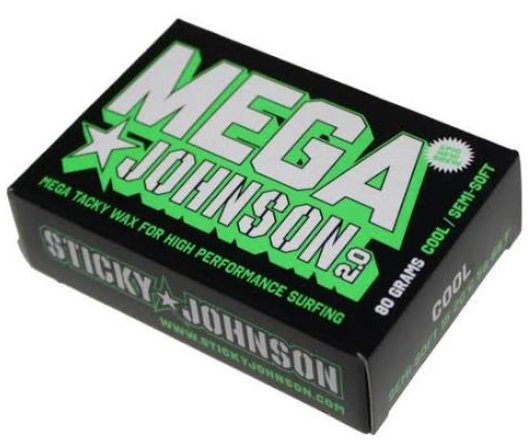
Sticky Johnson's Mega Johnson topcoat is worth considering if you want to try a dedicated grip layer. Apply it lightly over an established base rather than treating it as something to pile onto bare fibreglass. More product doesn't necessarily mean better footing.
Fu Wax is another very sticky option, with a higher cost than standard bars. I'd use it sparingly as a topcoat rather than spend the premium building the whole foundation. Reserving it for colder sessions or days when you particularly want that sticky feel is a reasonable budget choice.
Read beyond the wrapper colour
Check the temperature band, whether the bar is intended as a basecoat or topcoat, and the wording of any ingredient claims. Green isn't a universal technical specification, even where it's familiar shorthand for a local favourite.
A surfboard tail pad provides a different kind of traction and doesn't remove the need to look after the waxed area beneath your front foot. Don't use a thicker wax coating to compensate for a poorly positioned pad.
For many NZ surfers, a cool bar and a warm bar make a useful core kit. Southern winter trips or particularly warm destinations can require something outside that pairing.
How Much Surf Wax to Buy for a Season
Use this as a planning estimate, not a consumption guarantee. Board size, the area you wax and how often you strip the deck can change your requirements substantially.
Surf wax stock by surfing pattern
| Surfing pattern | Sessions per month | Suggested stock per season |
|---|---|---|
| Occasional surfer | 1-2 | One cool bar and one warm bar |
| Regular weekly surfer | 4-8 | One of each, replaced every one to two months |
| Daily or travelling surfer | 15 or more | Two bars of each type plus a spare topcoat |
These are suggested shopping quantities for the example surfing patterns, not measured usage rates. In the regular-surfer row, replacement means budgeting for replenishment if needed, not throwing away a bar on a timetable.
What moves you up a row
A longboard with a large waxed area uses more than a shortboard with a compact stance area. Travelling can also justify carrying spare formulas even when you won't use much of each. A spare bar is useful when the nearest shop isn't convenient.
Heat can waste wax before you reach the water. Keep bars in a reusable container, out of direct sunlight and away from a hot car dashboard. Don't leave soft wax loose in a boardbag where it can transfer onto the lining.
Replace the failed layer, not every surface mark
Wax needs attention when it's flat and slick, heavily contaminated, crumbly, or lifting away from the deck. A light combing can restore texture to a sound layer. It won't fix the wrong temperature formula or a base that no longer adheres.
For a proper reset:
- Collect the old wax. Use a plastic wax scraper over a sheet or bag, not directly over sand.
- Clean and dry the deck. Remove loose residue and let moisture disappear before applying fresh wax.
- Build the texture gently. Use light overlapping passes, then add the appropriate surface layer without pressing everything flat.
Buy the cool-weather replacement before you need it and replenish the warm bar ahead of summer. Stocking up before late November is a practical way to avoid discovering an empty wrapper when holiday sessions begin.
The Stories Behind Sex Wax and Sticky Johnson
Mr Zog's Sex Wax and Sticky Johnson have different origins, but both make more sense when you remember what surfers buy: a dependable feel underfoot. The wrapper might bring someone to a brand; the next session determines whether they keep using it.
The comparison below brings those different brand identities together.
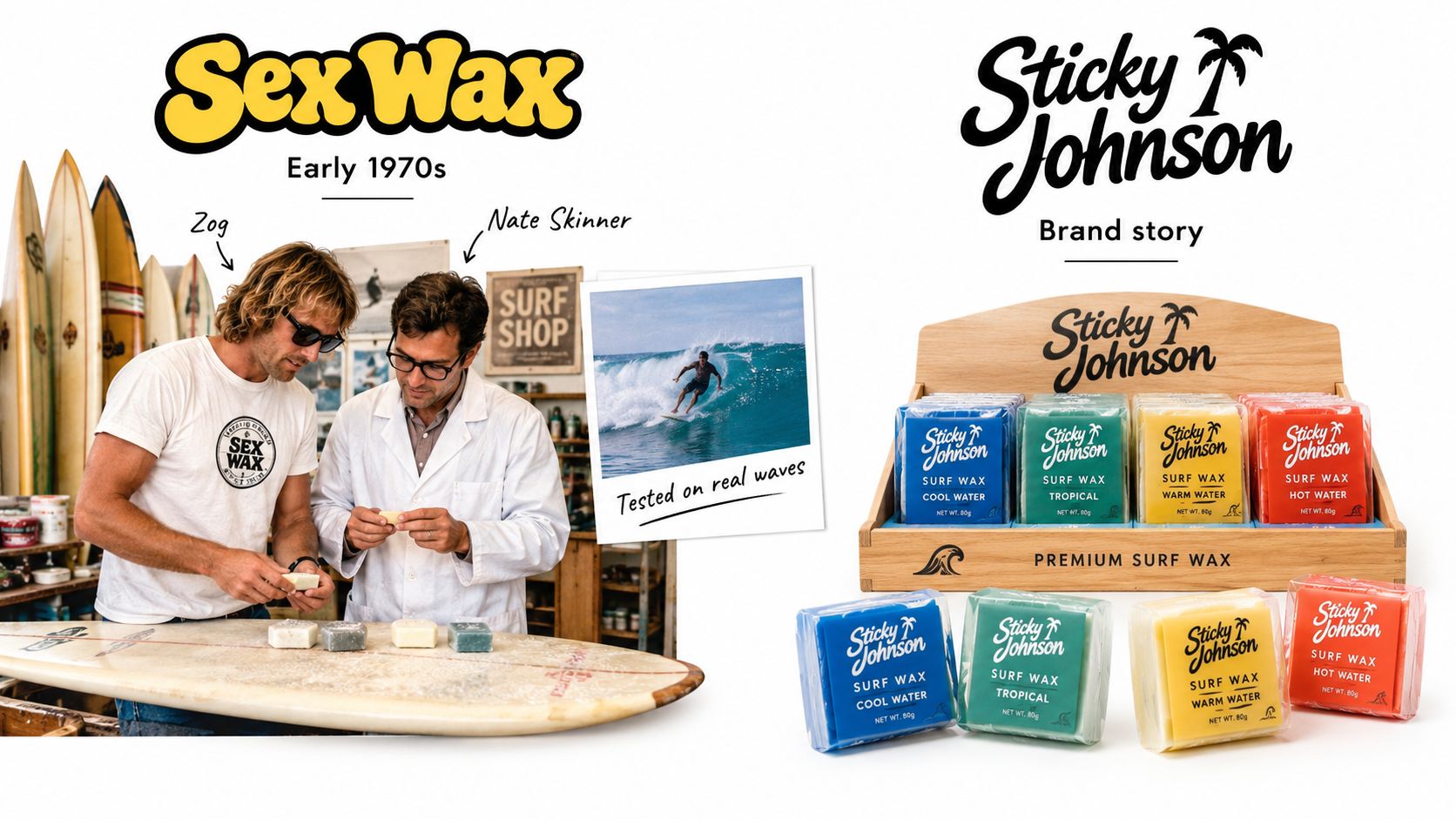
California prototypes and a Kiwi alternative
According to Mr Zog's Sex Wax history, surfer and surf-shop owner Zog developed the wax with chemist Nate Skinner in the early 1970s, testing successive prototypes in surfing conditions; the company dates its manufacturing and marketing history to 1972. Zog sold it personally from a Ford pickup, travelling between surf shops from Santa Cruz to San Diego, and word of mouth carried the product well beyond California.
Retailers initially hesitated over the suggestive name and the unproven product. Surfers did not.
By contrast, Sticky Johnson's own brand account dates its home-grown New Zealand business to 2008 and says its wax is made locally using environmentally responsible ingredients. The company positions its formulas around grip, durability and different water conditions; those ingredient and performance statements are the brand's own claims.
For Kiwi surfers, local manufacturing is a practical reason to reach for Sticky Johnson when the band matches this week's water. Check the temperature rating on the wrapper the same way you would with any imported bar, and keep both a cool and a warm formula in your kit so a swing at your break never leaves you on the wrong hardness.
Soup cans before a global identity
The Sex Wax factory history describes an initial roughly 20-by-20-foot garage rented for $20 a month, with soup cans used as moulds before tuna cans, plus a 50-gallon heating drum stirred with an old boat propeller. That same account records the move to a Goleta warehouse in 1975 and to Carpinteria in 1983.
The wooden cooling racks and homemade wrapping table are useful reminders that this was a practical manufacturing operation before it became a familiar surf-shop logo.
There's more surf-wax culture in this video.
The brand also extends beyond board traction, as our Sex Wax air freshener guide explains. For the board itself, don't overlook Mega Johnson topcoat because you already know Sticky Johnson's standard bars. It's a separate option for riders who want to adjust surface grip rather than replace a sound foundation.
Buying Surf Wax In-Store or Online in NZ
In-store versus online buying for surf wax in NZ
| Criterion | In-store | Online |
|---|---|---|
| Advice on this week's water | Staff can discuss local conditions | Start with the label and temperature band |
| Range | Core bars and common topcoats | Browse specialist topcoats and available formulas |
| Cost | Shelf price with no postage | Compare freight costs with the shelf price |
| Timing | Take available stock away immediately | Allow delivery time before a trip or swell |
| Checking before buying | Inspect the bar and label in hand | Read the product page closely for bands and claims |
Buying in person is particularly useful when you're unsure whether the problem is your formula, your application or an exhausted layer. In Gisborne, we can discuss the conditions around the breaks you're surfing. For another region, a current online water-temperature reading is a better starting point than guessing from conditions here.
The following comparison summarises the practical differences.
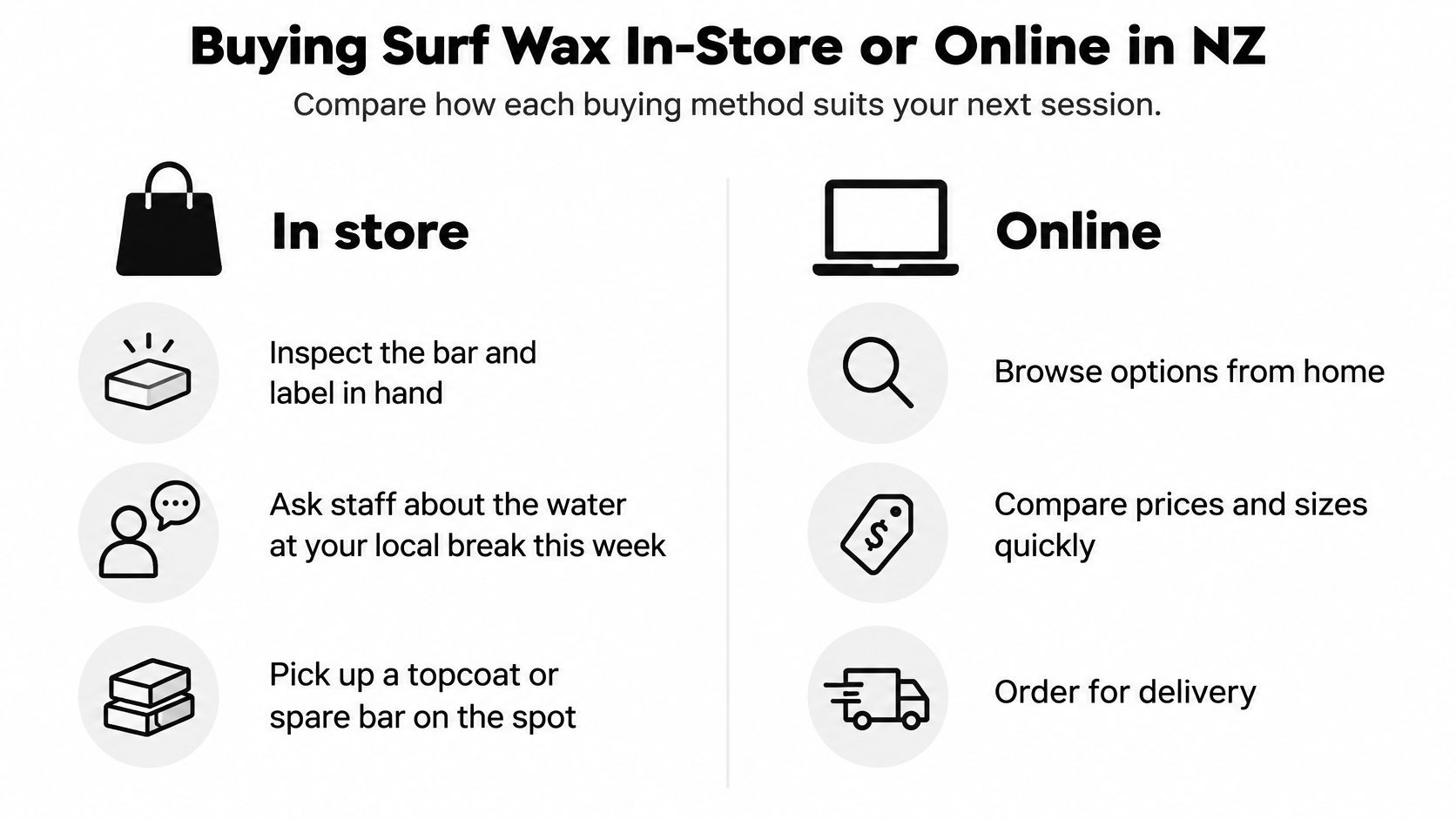
Check the bar before paying
- Confirm the temperature band. Read the actual formula description, not just the brand name or product photograph.
- Identify its job. A specialist topcoat isn't necessarily the right purchase for rebuilding a completely bare deck.
- Read environmental wording carefully. Ingredient and sustainability statements need specifics, not just a reassuring adjective.
- Plan ahead. Include the formula you'll need for the coming change in conditions, not only this weekend.
Cool and green-labelled formulas from Sex Wax and Sticky Johnson are the strongest local sellers because they suit much of the water encountered here. That's useful local context, not a reason to ignore the label when travelling.
Online buying works well once you know your formula. Compare bar sizes as well as prices, check what's available and allow for freight before a planned swell. Ordering an unfamiliar product solely because its wrapper looks right is less reliable.
Our guide to finding a surf shop nearby can help you weigh local advice against ordering convenience. For disposal, use a separate standard: whichever channel you choose, old wax still needs collecting rather than leaving beside the car.
Eco-Friendly Wax and Disposal in New Zealand
Eco-friendly isn't a complete ingredient description. Ask what the claim covers: plant-derived ingredients, reduced packaging, local manufacturing or something else. Those are different considerations, and none automatically proves a wax biodegrades safely in seawater.
Sticky Johnson's environmentally responsible ingredient wording is a company statement, and it doesn't settle every environmental question on its own. A sound purchase separates that claim from practical questions about performance, packaging and disposal.
What the beach evidence does and doesn't show
A 2025 study of New Zealand beach sediments across Northland, Waikato and Canterbury found that small microplastics made up more than 99% of particle counts, with an average concentration of 788 particles per kilogram. The study concerns beach sediment generally; it doesn't establish that surf wax, or any particular brand, caused that contamination.
Plant-based doesn't mean you should leave the scrapings on the beach.
Wax residue still matters at a local level. Whatever the wrapper claims, the scrapings you produce are yours to collect.
Keep removed wax contained
- Scrape into a bag. Work over a catch sheet or open bag so small pieces don't blow away.
- Use general rubbish. Put collected wax there unless your local waste service gives different instructions. Don't assume it belongs in recycling or compost.
- Keep scraps away from beaches, drains and car parks. Removing wax beside the boot of your car still requires collecting the residue.
- Apply fresh wax to a dry deck. Better adhesion helps avoid an ineffective layer that you'll need to scrape straight off.
The least wasteful bar is one that suits the actual water temperature at your break that week. A formula matched to real conditions holds its texture and stays on the deck longer, while an unsuitable bar gets stripped and binned within a session or two. Keep usable offcuts together and separate clean wax from sand-filled scrapings.
When comparing bars from Sex Wax, Wax Fresh or Sticky Johnson, read the ingredient, packaging and disposal details printed on each label. Those specifics answer the environmental questions above better than a broad green promise.
Pick a Cool and Warm Bar Before Your Next Session
Start with a cool bar and a warm bar, then confirm that they cover your actual conditions. That's a manageable everyday kit for many NZ surfers, not a claim that those categories suit every coastline throughout the year. A southern winter trip may need a cold or extra-cold formula instead.
Stats NZ's sea-surface temperature indicator reports generally warmer northern waters, cooler southern waters and seasonal changes, with coastal temperatures increasing by approximately 0.19–0.34°C per decade from 1982 to 2023. That long-term direction is another reason not to treat a familiar calendar-based purchase as permanently correct.
Make the switch deliberately
When the water falls below the range printed on your usual bar, change to the appropriate cooler-water formula. Don't keep adding a hard warm-water bar and hope extra thickness will make it tacky. When conditions warm, a firmer formula can provide better texture retention than a soft layer that smears.
Take both useful formulas when travelling between North and South Island breaks. Check the destination temperature rather than packing only what worked at home, and consider how you're storing the board between sessions.
- Sound foundation, insufficient tack: Try a light application of Mega Johnson or another suitable topcoat.
- Premium sticky feel: Fu Wax is an option, but its higher cost makes selective use sensible.
- Contaminated or lifting wax: Remove the failed layer instead of hiding it under more product.
Buy the fix, not the biggest pile
Blitz Surf Shop carries Sex Wax, Wax Fresh and Sticky Johnson, alongside surf hardware including fins, bodyboard fins, leashes, grips, paddles, roof racks, boardbags and earplugs. You can organise the wax and the rest of your hardware together rather than discovering a missing essential at the beach.
Tell us where you're surfing and what the existing wax is doing. A deck that feels hard and polished needs a different response from one covered in soft, sandy smears. Clear details make the recommendation more useful than asking for the stickiest bar regardless of conditions.
The practical decision is simple: match, buy, scrape and reapply. Choose the temperature band first, keep a useful spare and rebuild only when the existing layer needs it.
Visit Blitz Surf Shop online or in Gisborne for temperature-specific surf wax and the hardware to finish your setup. Tell us your break, the week's water conditions and whether you need a fresh foundation or extra topcoat grip, and we'll help you choose a suitable bar.


