

You're rolling along the cycle track after work, the footpath is clear, and the wind off the coast feels perfect for a smooth cruise home. Then the questions hit. Is this the right board for Gisborne's chipseal, can you ride it on the footpath, and do you need a long, stable setup or something lighter that's easier to push?
That's where longboard skateboards NZ buyers usually get stuck. Most overseas advice assumes smooth paths, different rules, and a skate culture that doesn't quite match New Zealand's mix of coastal roads, shared paths, hill suburbs, and everyday commuting. In New Zealand, the right board has to do more than look good. It needs to feel stable on rough pavement, fit the way you'll ride, and make sense for local rules and local terrain.
A 2023 Skateboarding New Zealand participation survey showed a 65% year-round riding base, 45% of respondents skating five or more hours each week, and 59% having skateboarded for ten or more years. It also found that street skating dominates at 81%, while downhill and vert remain established at 17.5% and 14% respectively, which helps explain why longboards continue to matter for cruising, downhill, and relaxed transport in NZ's skate culture (Skateboarding New Zealand participation survey report).

If you're choosing your first board, upgrading from a basic cruiser, or trying to work out whether a drop-through or downhill-style deck makes sense, this guide keeps it simple. You'll see how longboard types ride, how size and shape affect comfort and control, which parts matter on NZ surfaces, where you can legally ride, and what to expect from local retailers.
Introduction to Longboard Skateboards in New Zealand
Longboarding in New Zealand has always made sense in places where a smooth glide feels better than constant stepping. Te Ara records longboarding as a fit for cruising down streets and hills in the 1970s, especially in newly developed hillside suburbs, and says the style came back in the early 2000s. It also notes Robert Thomson's 2007 to 2008 longboard journey across Europe, the United States, and China, which covered 12,159 kilometres and earned a Guinness World Record for the longest journey by skateboard (Te Ara longboarding history).
That history matters because it matches how a lot of people still ride here. New Zealand riders often want a board for short errands, coastal paths, gentle hills, or just an easy roll after work. A longboard does that well because it gives you more deck under your feet, more comfort over rough ground, and more confidence when the road surface isn't perfect.
Practical rule: if your local route includes chipseal, cracked footpaths, or a bit of downhill, you'll usually be happier on a board that prioritises stability over tricks.
The ride choice gets easier once you stop asking, “What is the most popular board?” and start asking, “What do I need it to do?” A rider in Gisborne who wants a mellow roll to the beach needs something different from someone commuting across town or carving down hills on the way home. This guide breaks that down in plain language, so you can match the board to your street, your skill level, and your own sense of balance.
Understanding Longboard Types and How They Ride
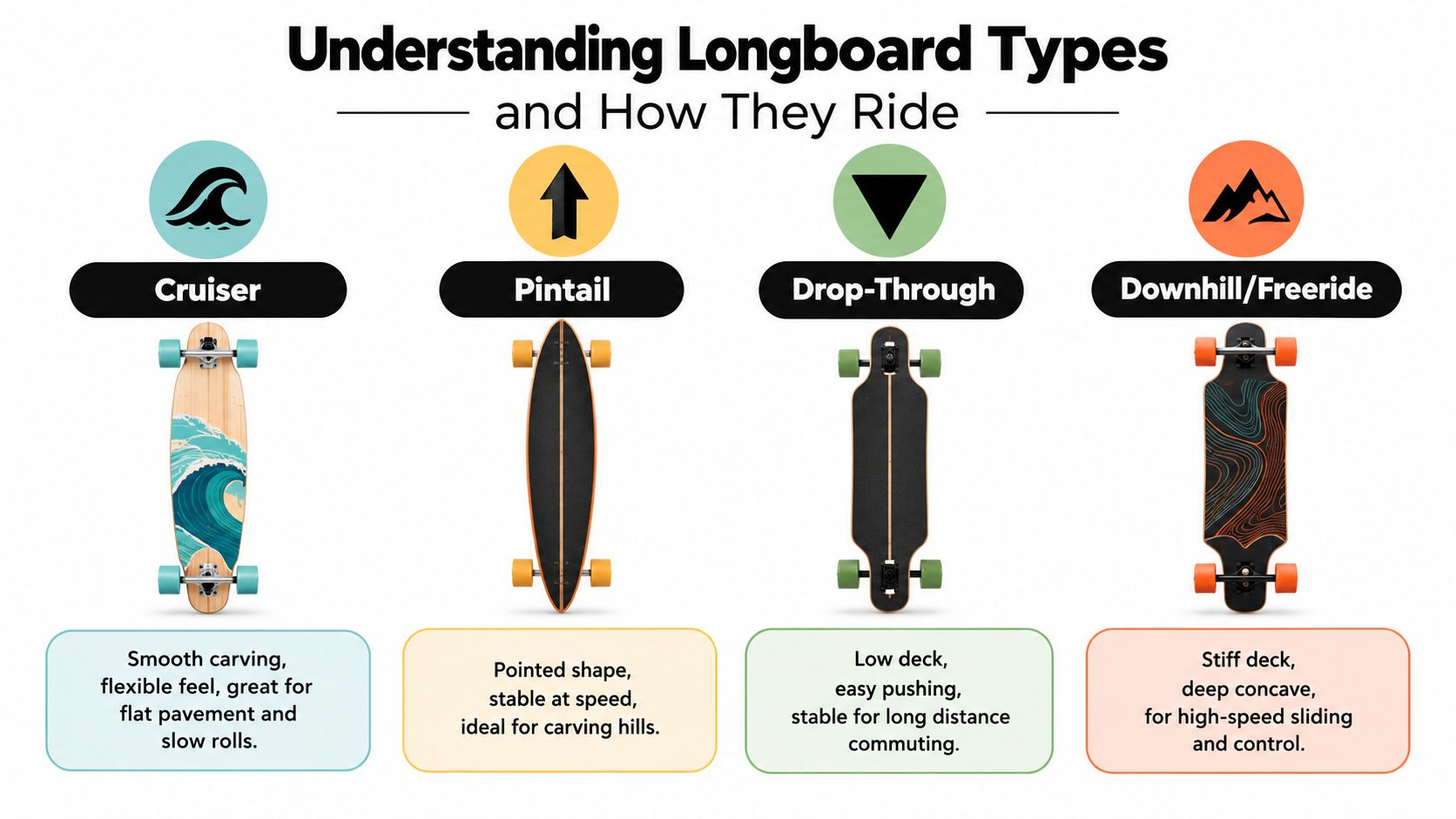
Think of longboard types like different kinds of shoes. Some feel like trainers, easy and forgiving. Some feel more like hiking boots, built for support. The board shape, mounting style, and flex all change how that “shoe” feels under your feet.
Cruiser, pintail, drop-through, and downhill or freeride
A cruiser is the relaxed option. It tends to feel loose, smooth, and easy to steer, which makes it useful for flat paths, beachside rolls, and casual town riding. A pintail narrows at the ends and feels more settled when you're carving on gentle hills or gliding at pace.
A drop-through board mounts the trucks through the deck, which lowers the standing platform. That lower stance makes pushing less tiring and gives commuting riders a calmer feel. A downhill or freeride setup is the more technical end of the range, usually stiffer and designed for control when speed or sliding enters the picture.
Simple way to think about it: the more a board favours low-effort pushing, the more it leans toward commuting. The more it favours stiffness and control, the more it leans toward faster carving and downhill work.
The best way to narrow your choice is to tie the board to one main use. If you want to cruise to the dairy, a relaxed board makes sense. If you want to cover more distance without feeling wobbly, a drop-through board earns its place. If you already know you'll be carving hills, a board with more control and a firmer platform is the better match.
For a deeper look at shape history and how deck forms evolved, the Blitz Surf Shop deck-shape guide is useful background reading.
How to Choose the Right Size and Shape for You
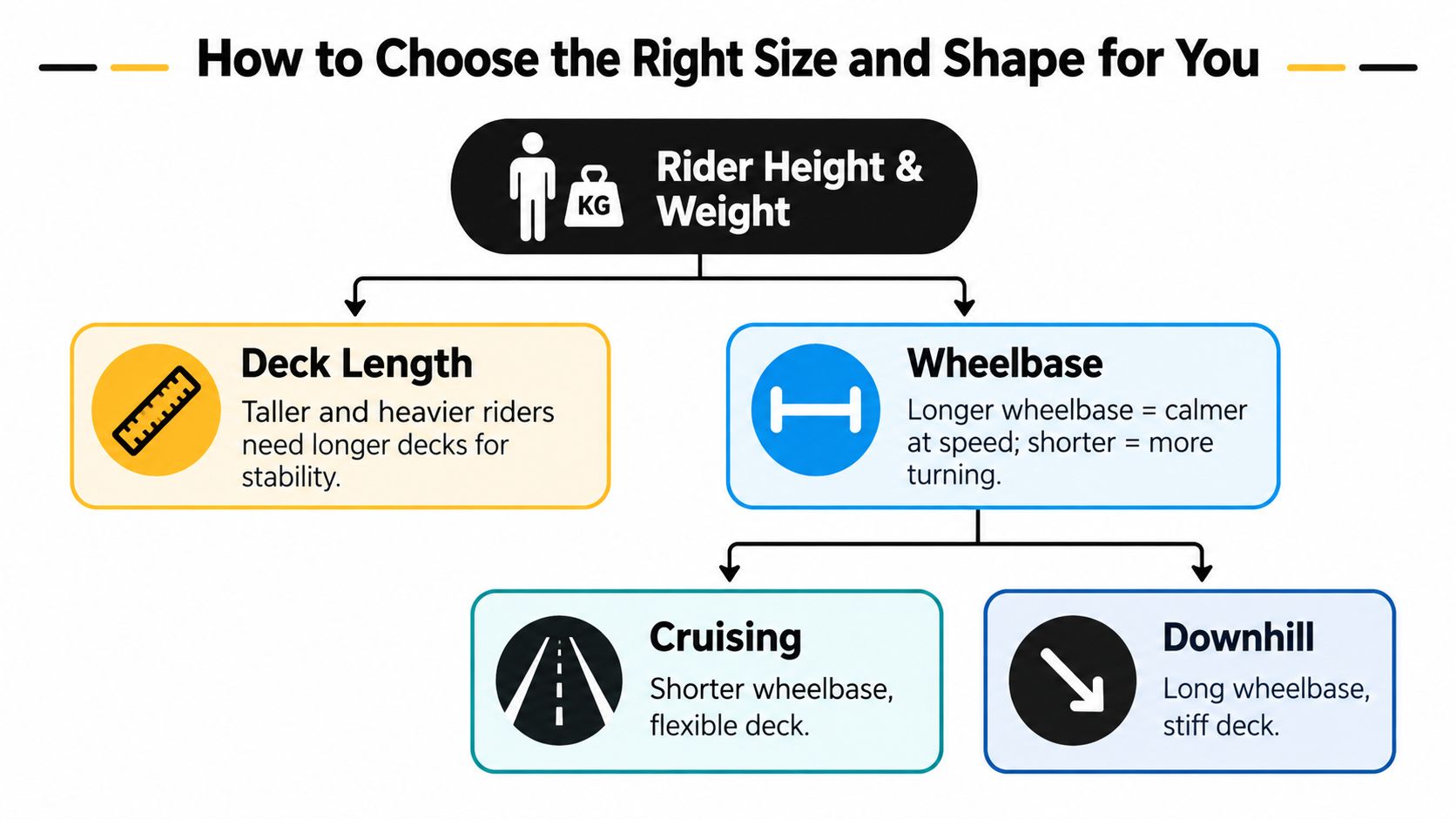
Sizing gets confusing because board length is only part of the picture. A longboard can be long and still feel twitchy if the wheelbase is short. It can also feel calmer if the wheelbase is longer. Deck width matters too, because your feet need space to stand naturally instead of hovering near the edges.
If you are taller, heavier, or wear bigger shoes, more deck under you usually feels better. That does not mean choosing the biggest board in the shop. It means looking for enough length and width to stand squarely, shift your weight, and steer without your stance feeling cramped.
Start with your body and your route
A longer wheelbase usually feels steadier at speed. A shorter wheelbase turns more quickly. That trade-off is the heart of sizing, and it matters on New Zealand streets where chipseal, footpath seams, and short town rides can change how a board feels from one block to the next. For commuting through a coastal town, a board that stays calm under your feet can make the ride feel less tiring.
Stability comes from length, width, and wheelbase working together, not from deck length alone.
The NZ retail example of a 35-inch deck, 9.0-inch width, and 24.75-inch wheelbase gives a clear picture of an entry-to-mid setup built for stable cruising. It also uses 8-ply hard rock maple, which adds strength and a firmer feel (NZ retail longboard specs). If rough footpaths are part of your route, that kind of construction is worth considering.
The best fit often comes from matching the board to one main job. A board for cruising to the dairy can feel different from one for commuting across town or one you want for faster carving later. Compare width, wheelbase, and how forgiving the deck feels under your feet. If you are unsure, local retailer support helps here, because staff can point you toward setups that suit your height, stance, and the roads you ride.
Wheels Trucks and Bearings Explained for NZ Surfaces
NZ surfaces change the whole conversation. Smooth skate park concrete is one thing. Chipseal, footpath seams, and patched coastal roads ask more from the setup under your feet. A board that feels fine in a car park can feel harsh on a suburban path.
What Each Part Does
Wheels do most of the work on rough ground. Bigger wheels roll over cracks and seams more easily, while softer wheels take the edge off vibration. Softer wheels give up some slide precision, and very large wheels can make a board feel bulkier in tight turns.
Trucks control steering and stability. Wider trucks usually suit wider decks, and an inverted kingpin or freeride-oriented shape can help a board feel steadier at speed. The local listing that shows 180 mm inverted trucks gives a good picture of the kind of hardware often paired with cruisy longboards for a planted ride, and Blitz Surf Shop's truck guide explains the setup choices in plain terms.
Bearings matter more for reliability than for magic speed claims. Clean, well-fitted bearings roll smoothly and last better, but they will not fix a mismatched setup. ABEC 7 appears on both examples in the NZ listings, which is common on complete boards aimed at practical everyday riding rather than specialised race use (NZ commuter longboard listing).
| Longboard Component Choices for NZ Riding | Common NZ Spec | Best For | Trade Off |
|---|---|---|---|
| Wheel size | 69 mm to 70 mm | Rolling over chipseal, seams, and rough footpaths | Bigger wheels can feel less nimble |
| Wheel softness | 78A to 83A | Comfort, vibration damping, casual cruising | Softer wheels give up some slide precision |
| Truck width | 180 mm on wider completes | Stability on wider decks and easier carving control | Less compact feel for smaller riders |
| Deck format | Drop-through or classic maple complete | Commuting, cruising, and confident foot placement | Less suited to technical park riding |
A second NZ-sold complete uses a 31-inch drop-through deck, 70 mm x 51 mm 80a wheels, and ABEC-7 bearings, which shows the commuting side of the market. Another uses a 44-inch, 8-ply maple deck with 70 mm wheels and 78A urethane, aimed more at higher-load riding and downhill confidence. Softer 78A to 80A wheels suit concrete and road seams because they cushion the ride, while the longer deck gives more control and helps calm speed wobble.
If your routes mix footpaths, chipseal, and short town commutes, start with the wheels and trucks. That is where the ride changes first.
Where You Can Ride Longboards Legally in NZ
New Zealand treats skateboards as wheeled recreational devices, and that matters because the rules aren't written for longboards alone. The practical answer is simple. Footpaths are allowed, pedestrians come first, and roads are something most riders should avoid unless they know exactly what they're doing and the situation is suitable (NZTA school community guidance).
Footpaths, shared paths, and roads
On footpaths, the expectation is courtesy. That means riding at a sensible pace, giving way, and not treating the path like a downhill lane. On shared paths, you need to stay aware of walkers, runners, and cyclists, because those spaces work only when everyone keeps their speed and line under control.
Road riding is the least comfortable option, which is why NZ safety guidance strongly advises riders to avoid roads when they can (NZTA safety advice). If you do need to cross or briefly enter a road space, slow down, scan for traffic, and follow the same careful thinking you'd use on a bike.
Practical rule: if your board movement would force a pedestrian to change pace or line, you're going too fast for that space.
Local council rules can add another layer. CBDs, waterfronts, and park entrances sometimes have posted restrictions, so it pays to check signs before a regular route becomes a habit. For riders practising on concrete or looking for smoother places to build confidence, the Blitz Surf Shop skate park guide is a useful companion.
The best everyday etiquette is straightforward. Keep your speed low where foot traffic is heavy, call out before passing, and choose routes where you can stop comfortably if someone steps across your path. That approach keeps the ride relaxed for you and predictable for everyone else.
Where to Buy Longboard Skateboards in NZ and What to Expect
Buying longboards in NZ usually comes down to three paths. You can shop at a specialist skate retailer, a surf retailer with skate knowledge, or a general outdoor shop that carries a limited range. The difference is not just product choice, it's how much support you get after the sale.
What good NZ retailers should help with
A good retailer should tell you whether the board suits cruising, commuting, or downhill use, not just hand over a deck and hope for the best. They should also be clear about stock, setup advice, and what replacement parts are easy to source later. That matters in NZ because imported gear can vary in availability, and a board that's easy to maintain saves time later.
Blitz Surf Shop is one example of a family-owned Gisborne retailer serving riders online and in-store since 1983, with NZ-wide delivery and free shipping over $165 on eligible items. It carries completes, decks, trucks, wheels, bearings, and protection, so riders can build or maintain a setup in one place while matching parts to local conditions.
If you're comparing retailers, focus on three things.
- Setup guidance: Can the store explain why one complete suits cruising and another suits downhill?
- After-sales support: Will they help with part swaps, sizing questions, or warranty issues?
- Product range: Do they stock boards, hardware, and safety gear, or only the board itself?
The Blitz Surf Shop skate shop guide is a useful reference if you want to understand how a specialist retailer thinks about selection and support.
The main value check is simple. A cheaper imported complete can look attractive, but a board that's already matched to NZ surfaces and backed by real advice often ends up being the better buy. That's especially true for first-time riders who want less guesswork and more confidence.
Beginner Versus Advanced Setups and Your Next Steps
A first board should feel steady under your feet. If you are learning in a coastal town, on chipseal, or across uneven footpaths, a stable deck and forgiving wheels make the first few rides much easier. A drop-through complete or a relaxed cruiser setup often helps because it sits lower and asks less of your balance when you push, start, and stop.
What to choose first
Start with comfort, not speed. A wider platform gives your feet more room to settle, and softer wheels help smooth out rough NZ pavement.
Once you can push, carve, and foot brake without thinking through every movement, your preferences become clearer. That is usually the point where riders can tell whether they want a more compact cruiser, a longer board for cruising, or something built for stronger downhill confidence.
For learners, control matters more than speed. For experienced riders, setup becomes more about terrain and intent.
Advanced riders often want a stiffer board, a longer platform, or a more technical freeride feel. That does not mean the board should feel hard to ride. It means the setup is tuned for a specific result, such as cleaner slides, better hill confidence, or a board that carries speed with less wobble.
Safety stays the same at every level. NZ guidance recommends a helmet plus protective gear such as wrist guards, elbow pads, knee pads, and closed shoes, and product-safety references identify AS/NZS 2063:2020 as the helmet standard for bicycles and wheeled recreational devices, including skateboards (product safety helmet standards). A NZTA safety guidance page also explains the basics for safe riding, and the message is simple, pads and a proper helmet are practical, not extra.
If you want a simple next step, choose the board style first, check that the size feels right, then look at where you will ride and whether the setup suits those streets. After that, focus on braking before you chase distance or speed. The Blitz Surf Shop complete skateboard guide is a useful place to compare ready-to-ride options if you want a matched setup instead of building one part by part.


