

At its core, freeride surf and skate is all about one thing: personal expression. Forget the points on a scoreboard or rigid competition rules. This is about finding your own flow, your own style, and your own creative lines on a wave or a hill.
Understanding the Freeride Philosophy
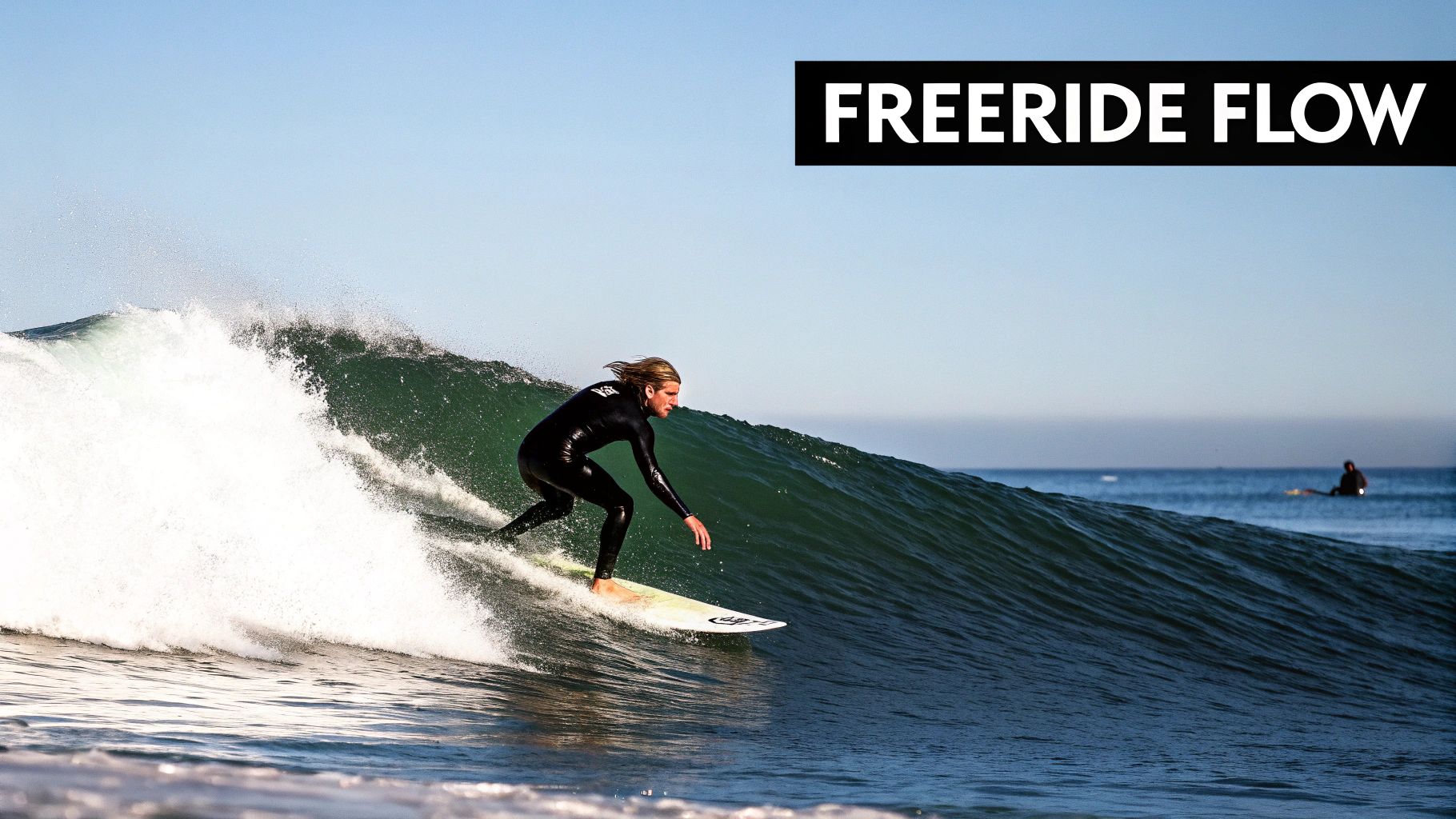
More than anything, freeriding is a mindset. It’s the art of looking at your environment—be it a glassy wave face or a winding road—and seeing it as a blank canvas for your own unique lines, not just a venue for pulling off tricks. It's about that deeper connection you build with your board and the terrain.
This philosophy holds true whether you’re on the water or the pavement. For a surfer, it might mean drawing a smooth, unexpected path across the face of a wave. For a longboarder, it’s all about linking seamless carves down a hill, feeling that push and pull of gravity with every turn. It's a world of adrenaline and skill, a bit like tackling any great outdoor challenge, from our local breaks to mapping out an ultimate guide to adventure in Lake Bled.
The freeride approach is all about celebrating your individuality. Instead of asking, "What trick did you land?" the real question is, "How did that ride feel?" This shift in focus is what makes it so welcoming for newcomers and so deeply satisfying for experienced riders.
The core idea is to use the natural contours of the land or sea to express your personal style. It’s less about technical perfection and more about the fluid conversation between you, your board, and your surroundings.
Wanting a skateboard or surfboard to go express yourself?
The Spirit of Expression
The freeride spirit is fuelled by creativity. It’s about ditching the rulebook and experimenting with different lines, body movements, and gear to figure out what feels right for you. This individualistic ethos has deep roots, especially with brands that have always championed doing things your own way. You can see this connection in our guide on the evolution and influence of Santa Cruz Skateboards.
A few things really define this spirit:
- Creative Line Selection: It’s about picking a path that’s interesting and feels good, not just the most aggressive or direct route down.
- Emphasis on Flow: The goal is to create a smooth, continuous ride, linking turns and manoeuvres together into something that looks and feels almost like a dance.
- Personal Style: It's all about developing your own unique way of riding that reflects who you are, far from the pressure to copy a specific contest style.
A Global and Local Movement
This mindset isn’t just a surf and skate thing. Here in New Zealand, our whole adventure sports culture is wrapped up in this philosophy. Just look at the freeride snow scene, where Kiwi riders are constantly mixing it up on the world stage.
There's a massive crossover of ideas and skills between the snow, surf, and skate communities, strengthening the entire freeride culture. We're all driven by a similar mindset and a constant push for better gear. You can see how Kiwis are making their mark by following events like the Freeride World Tour. At the end of the day, it's this shared passion that truly defines the freeride movement.
Two Sports, One Shared Freeride Philosophy
On the surface, the concrete jungle and the open ocean feel like totally different worlds. But for a freerider, they’re just two canvases waiting for the same kind of art. The freeride surf and skate movement is all about a shared mindset—a belief that the language of movement, flow, and personal expression is universal, no matter what you're riding on.
This whole approach is built on ideas that work just as well on a wave as they do on a hill. Core concepts like line selection, hitting that perfect flow state, and mastering your body mechanics are the threads tying these two passions together. This isn't just a vague comparison; the skills you build in one directly feed your progress in the other, creating a powerful feedback loop for any rider.
The Mirror Effect in Motion
Think about the basic movements. That powerful, driving bottom turn a surfer digs in to set up their line on a wave? It's almost perfectly mirrored in the deep, rail-to-rail carve of a longboarder bombing a mellow hill. In both scenarios, you’re compressing your body, twisting through your hips and shoulders, and applying just the right amount of pressure through your heels or toes to engage the board's edge.
It’s no coincidence. It’s the same fundamental principle of using your centre of gravity to control your momentum and direction. One happens on a dynamic, ever-changing wall of water, the other on static, sloping pavement, but the rider's input is stunningly similar. This is exactly why your winter skate sessions are so crucial for your surfing. We dive deep into this year-round synergy in our guide on how to stay stoked with winter surf and skate in Aotearoa.
Freeriding shows us that it's not about mastering two separate sports, but about mastering a single, unified art of board riding. The environment changes, but the rider's core connection to flow and movement remains constant.
This connection becomes even more obvious when you throw a surfskate into the mix. When you're practising pump-and-carve drills on a surfskate, you're not just skating—you're literally surfing on land. That rhythmic, full-body motion you use to generate speed without pushing is the exact muscle memory you need for trimming and gaining momentum across the face of a wave.
Universal Concepts Explained
The shared principles of freeride surf and skate go way beyond just physical movements. They represent a complete approach to riding that’s all about creativity and how you interact with your environment. This ethos is so universal it pops up in other board sports, too. For anyone keen to dive into a broader range of activities that capture this spirit, exploring options like multigliding sports camps can offer a wider perspective on flow.
This table breaks down how some of these core ideas translate across both sports.
How Freeride Concepts Translate Across Disciplines
| Core Concept | In Freeride Surfing | In Freeride Skating |
|---|---|---|
| Line Selection | Reading the sections of a wave and choosing a creative path that connects them all. | Seeing the natural curves and cambers in a road to link carves into a seamless flow. |
| Flow State | The magic feeling when conscious thought disappears, and you're just intuitively trimming along a perfect point break. | Effortlessly sliding through a hairpin turn, reacting instinctively to the pavement under your wheels. |
| Weight Distribution | Shifting weight between your front and back foot to control speed and pivot through turns. | The exact same principle is used to initiate a slide, hold balance in a carve, or pump through a flat section. |
| Rail Engagement | Burying the rail into the wave face is what gives a powerful turn its bite and drive. | Leaning into the edge to engage the "rail" of the wheels, providing the grip needed for a deep, satisfying carve. |
You can see the crossover is undeniable.
Ultimately, whether you're drawing a line on water or pavement, you're speaking the same language of motion. Every single carve on your longboard is getting you ready for a cutback on your surfboard, and every wave you ride deepens your understanding of flow when you're back on land.
Choosing Your Ideal Freeride Gear
Picking the right gear for your freeride surf and skate adventures is less about finding the “best” board out there and more about finding the right tools for your own personal expression. Your equipment should feel like a natural extension of your body, perfectly suited to the lines you want to draw. This guide will walk you through the key bits of kit that help you find that flow, whether you're on the water or the pavement.
This decision tree shows the two main paths in the freeride world, starting with you, the rider, and branching into either the surf or skate discipline. 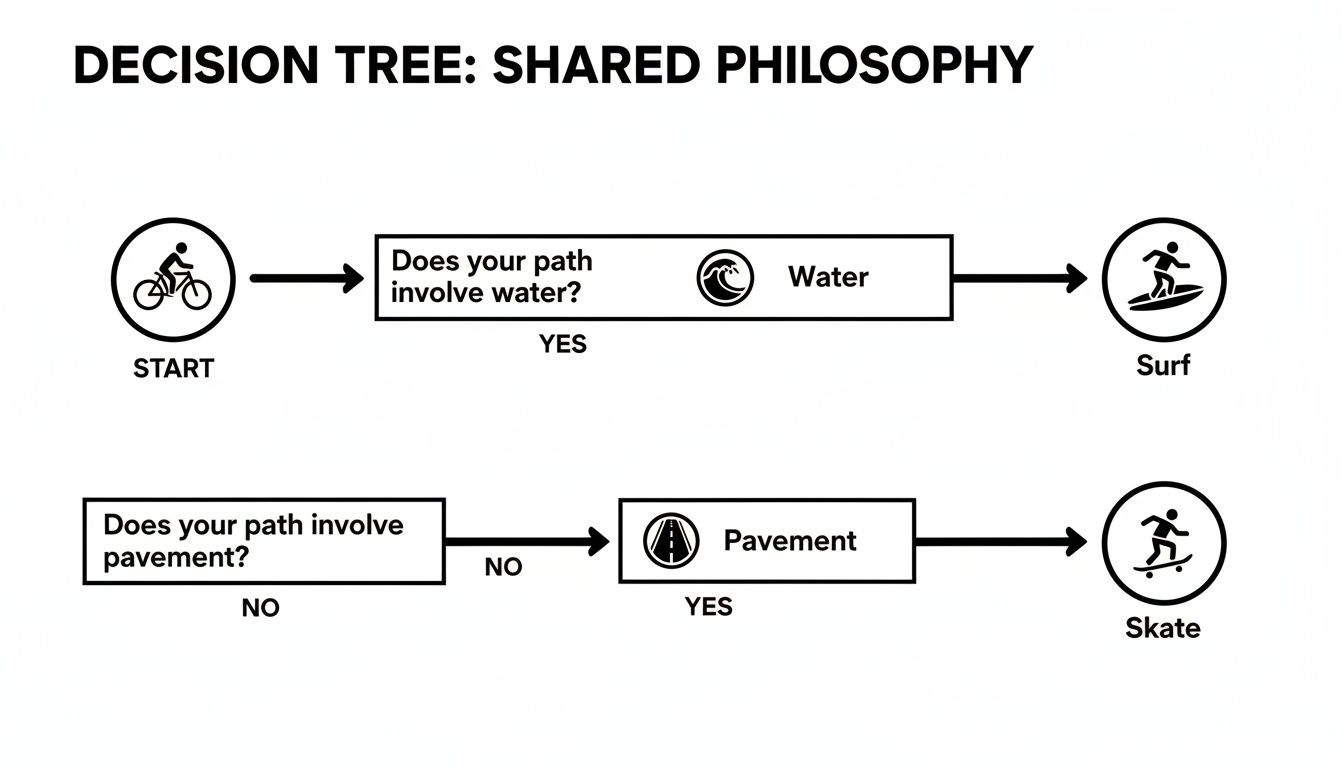 Ultimately, it shows that while the environments are different, the journey kicks off from a single, shared rider philosophy.
Freeride Surfboards for Creative Lines
When it comes to freeride surfing, those high-performance shortboards built for aggressive, vertical attacks often take a backseat. Instead, the focus shifts to boards that prioritise glide, flow, and the ability to hold a long, clean line. These shapes encourage a more soulful, creative way of riding waves.
Consider these options when you're building your freeride quiver:
- Mid-Lengths: These boards, usually floating around the 7-foot mark, offer a perfect mix of paddle power and manoeuvrability. They get you into waves early and give you a stable platform for drawing out long, arcing turns.
- Fish Shapes: Known for their speed and drive in smaller, mushier waves, twin-fin fish surfboards are masters at generating momentum. They let you flow through flat sections with a unique, skatey feel that’s hard to beat.
- Alternative Longboards: Modern single-fin longboards or versatile 2+1 setups are the ultimate tools for style and flow. They open up everything from graceful noseriding to powerful drop-knee cutbacks, turning any wave into a playground.
The fins you ride can completely change a board's personality. A twin-fin setup gives you a fast, loose, and skate-like feel, while a single fin encourages a more drawn-out, classic style focused on trim and positioning. Fiddling with different fin configurations is a huge part of the freeride journey.
Freeride Skateboards for Pavement Surfing
Just like in surfing, freeride skate gear is all about matching the equipment to your style. From surf-style carving to smooth, controlled slides, the right board, trucks, and wheels are essential for unlocking your potential on land.
Choosing your freeride gear isn't just a technical decision; it's a creative one. The right board doesn't just perform—it inspires a certain way of moving and seeing the terrain ahead.
A dedicated setup makes all the difference in your progression. For instance, trying to learn slides on a pintail cruiser can be frustrating and unpredictable. A purpose-built board provides the stability and control you need to build confidence safely.
Demystifying Skateboard Components
Getting your head around how each part of a skateboard works together is the key to customising your ride.
- Deck Shape: Top-mount boards offer a direct, responsive feel, making them great for carving. Drop-through decks lower your centre of gravity, which gives you excellent stability for learning to slide.
- Truck Geometry: The angle and width of your trucks dictate how your board turns. Surfskate trucks, like the ones on Carver boards, have unique geometries that allow for deep, rail-to-rail carving and pumping motions that feel just like surfing. For anyone wanting to dive deeper, you can discover the world of Carver surfskates and see how they bridge that gap between land and sea.
- Wheels: The size and durometer (hardness) of your wheels are critical. Larger, softer wheels (around 70-75mm, 78a-82a) give you a smooth ride and awesome grip for carving. On the other hand, harder, smaller wheels with a rounded lip are designed to break traction more easily, making them ideal for freeride sliding.
Essential Protective Gear
Finally, no freeride kit is complete without the right safety gear. Pushing your limits and progressing with confidence means knowing you're protected when things go sideways. Safety isn't about limiting your fun; it's about making sure you can keep doing it for years to come.
Your non-negotiable safety items include:
- A Certified Helmet: This is the most important piece of gear you will ever own. Always protect your head.
- Slide Gloves: For longboarders learning to slide, these are a must-have. They let you put a hand down on the pavement to control your speed and balance through a slide.
- Knee and Elbow Pads: Especially when you're starting out, pads give you the confidence to commit to new skills without being terrified of a painful slam on the pavement.
By carefully picking out your surfboard, skateboard, and protective gear, you set yourself up for a rewarding journey into the expressive world of freeriding.
Mastering Fundamental Freeride Techniques
Once you've got the right gear dialled in, the next step on your freeride surf and skate journey is getting to grips with the fundamental movements. Don’t think of these as rigid tricks you need to perfect; they're more like a vocabulary of motion. They are the building blocks you'll use to draw your own unique lines on the water and the pavement.
This section breaks down the core skills for both surfing and skating, looking at them as tools for creative expression. We'll follow a progressive path, giving you some solid drills to build that all-important muscle memory and confidence. The goal is to lay the foundation you need to safely push your limits and carve out a style that's all your own.
Expressive Techniques for Freeride Surfing
In freeride surfing, classic manoeuvres are less about scoring points with judges and more about finding harmony with the wave's energy. Think of them as different brushstrokes you can use to paint a path across an open face. Each one has a purpose, whether it's maintaining flow, managing speed, or linking sections together seamlessly.
Here are three foundational techniques, re-imagined for the freerider:
- The Bottom Turn: The Engine of Every Manoeuvre: This is hands-down the most important turn in surfing. It’s where you take the vertical energy from dropping down the wave's face and convert it into horizontal speed. For a freerider, a powerful, drawn-out bottom turn is a moment of pure connection, setting the stage for whatever line you see in your head next.
- The Cutback: The Art of Returning to the Source: A cutback isn't just about smashing the pocket. It’s a flowing, S-shaped turn that brings you back towards the wave's power source. It’s a stylish way to scrub off speed and reset your line, letting you stay in the most critical part of the wave for longer and opening up your creative options.
- The Floater: A Dance Along the Lip: Instead of aggressively whacking the lip, a freeride floater is about gracefully gliding along the crumbling section of a breaking wave. It’s a weightless, flowing move that helps you get through sections that would otherwise shut down, keeping your momentum and adding a touch of style to your ride.
Mastering these isn't about being aggressive; it’s about understanding how your body, board, and the wave can all work together in a fluid dance.
Foundational Skills for Freeride Skating
On land, the principles of flow and control are just as crucial. The beauty of freeride skating is that you can drill these movements over and over in a safe environment, wiring in the muscle memory that translates directly to the water. A smooth, empty car park or a mellow, low-traffic hill is all you need for a training ground.
A surfskate is more than just a piece of equipment; it's a simulator. The body compression and rotation you master in a car park for a cutback are the exact movements you’ll use in the water, building a powerful mind-body connection that bridges both sports.
Focus on these key skills to build your land-based flow:
Mastering the Deep Carve
The carve is the soul of freeriding on pavement. It's that smooth, rail-to-rail arc that just feels so satisfying. To really nail a deep carve, you've got to use your whole body.
- Lead with Your Head and Shoulders: Your board goes where you look. Start the turn by looking where you want to go and turning your shoulders.
- Compress and Extend: Bend your knees deeply as you go into the turn (compression), then push through your legs as you come out of the apex to drive the board forward.
- Use Your Arms for Balance: Keep your arms out to stay balanced, using them as counterweights to help you lean deeper into the turn.
A great way to practise this is by setting up some small cones or markers and weaving through them in a continuous, smooth "S" pattern.
Generating Speed with Pumping
Pumping on a surfskate is the magic that lets you build forward momentum without ever putting a foot on the ground. It’s the closest feeling you'll get to generating speed on a wave face. The technique relies on a rhythmic series of compressions and extensions, all timed with your carving.
It works by de-weighting the board during the transition between turns and then re-weighting it as you drive through the carve. You're effectively pushing against the turn to create speed. This is a game-changer for linking carves and keeping your flow on flat ground or even up gentle hills.
An Introduction to the Slide
For many, sliding is the pinnacle of freeride longboarding. It’s the ultimate expression of control, letting you manage your speed on steeper hills and add a dynamic, surf-like flair to your riding. The first slide most people learn is the Coleman slide, or push-up slide.
Here’s the basic idea:
- Setup Carve: Start with a wide, heelside setup carve across the hill to scrub off some speed.
- De-weight the Board: As you hit the apex of the carve, get low and place your back hand on the pavement uphill from your board.
- Kick Out and Look: Kick the board out with your back foot while keeping your front foot pointed forward. Crucially, keep looking down the hill where you want to go.
- Regain Control: As you slow down, bring the board back underneath you and stand up smoothly.
Learning to slide takes commitment and the right protective gear, especially a helmet and slide gloves. Start on a very gentle, grassy slope to get the feel for the movement before you even think about taking it to the pavement. These fundamental skills are your ticket into the expressive world of freeride surf and skate.
How to Progress Safely and Confidently
In sports defined by pushing your own limits, safety isn't some boring handbrake—it's the very foundation that lets you progress without constantly second-guessing yourself. For both freeride surf and skate, a smart approach to safety builds the confidence you need to really commit to new skills.
Think of it like this: a rider who feels protected is a rider who isn’t afraid to lean a little deeper into a carve or hold a slide just that little bit longer. Safety gear and a bit of environmental awareness are your best mates in progression, letting you learn faster and ride harder.
Ocean Awareness for Surfers
The ocean is a powerful and dynamic beast; learning to read its moods is the single most important skill any surfer can have. Before you even think about paddling out, take a few minutes on the beach to just watch. See what the water is doing.
This means looking for a few key things:
- Rip Currents: Figure out where the water is funnelling back out to sea. These channels often look choppier, maybe a bit discoloured, and will have fewer breaking waves.
- Tides and Swell: Understand how the incoming or outgoing tide is going to affect the break. Take note of the swell direction and size to get a feel for where the best waves will be and where any hazards might be lurking.
Respecting other surfers through good etiquette is just as critical. Following the rules of the lineup—like giving way to the rider closest to the peak—ensures everyone stays safe and can enjoy the session. This shared respect is a huge part of New Zealand's surf culture.
Our communities are seriously committed to water safety. Just look at the stats: during the 2023/24 patrol season, Surf Life Saving New Zealand had 4,329 active surf lifeguards and took a massive 40,626 preventative actions to keep people safe on the beach. That’s a huge jump from the year before and shows how much effort goes into protecting our coastlines.
Smart Skating and Essential Protection
On land, safety starts with picking your playground wisely. The perfect spot for freeride longboarding is a low-traffic hill with smooth, predictable pavement. Always walk your run first to check for potholes, loose gravel, or any other surprises that could ruin your day.
Safety isn't about avoiding risk; it's about managing it intelligently. A helmet and pads don't hold you back—they give you the freedom to fall, get up, and try again with confidence.
When it comes to gear, there are a few non-negotiables. A certified helmet is the most important piece of equipment you will ever own, period. As you start to get into sliding, a good pair of slide gloves becomes essential. They let you put a hand down on the pavement to balance and control your speed, turning what could be a nasty high-side into a controlled part of the maneuver.
Throwing on knee and elbow pads gives you that extra layer of confidence, encouraging you to commit fully when you're learning new stuff. A protected rider is a confident rider, and confidence is the key to unlocking that fluid, expressive movement we're all chasing. For a deeper dive, check out our guide on skateboarding safety and injury prevention tips. By making this stuff second nature, you're setting yourself up for a long and rewarding journey in the world of freeriding.
Exploring New Zealand’s Freeride Scene
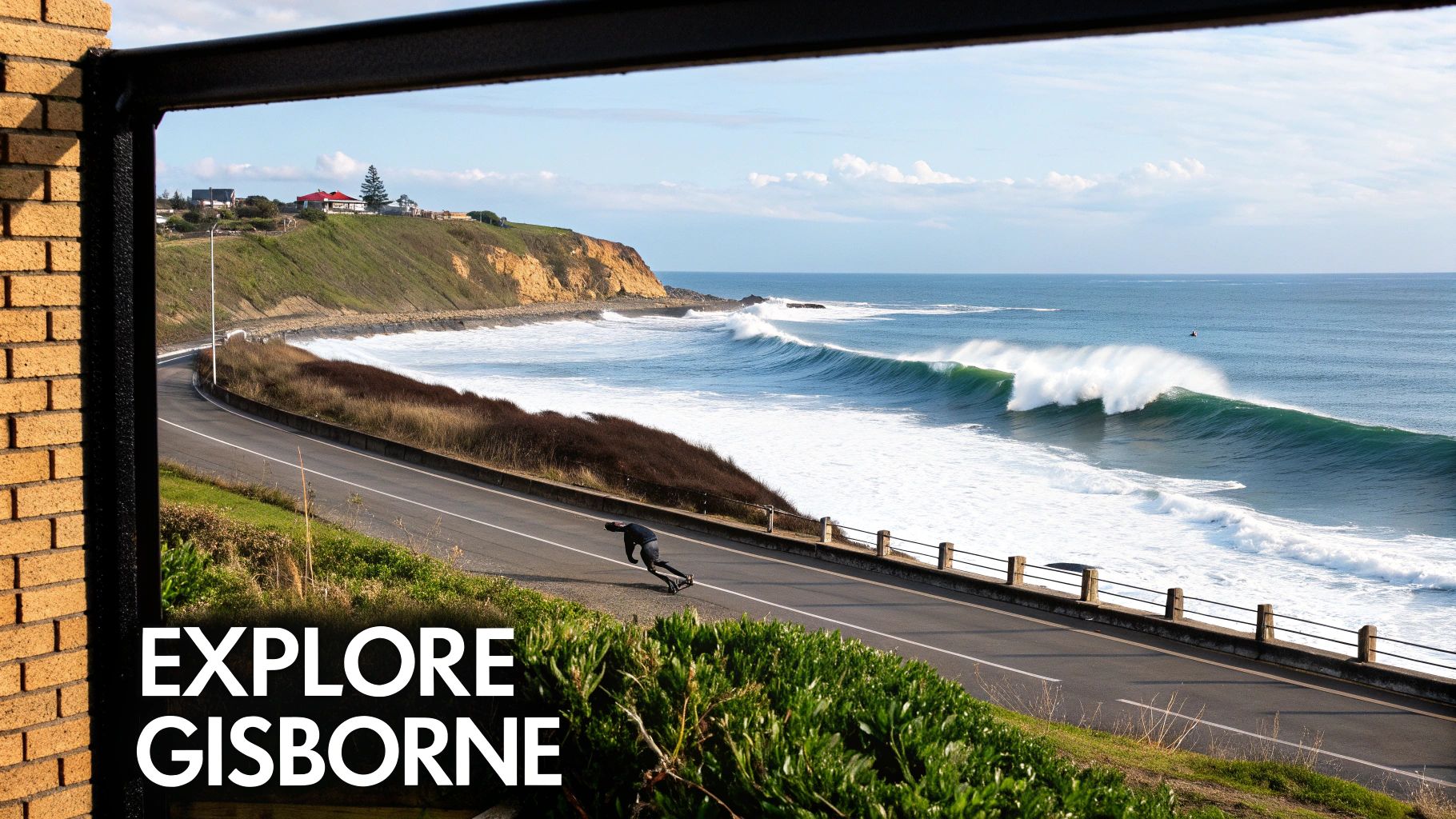
The global freeride movement has found its perfect home here in Aotearoa. With our rugged coastline and world-class terrain, this country is the ultimate playground for anyone looking to draw their own lines. While you'll find epic spots all over, the Gisborne and East Coast region really stands out as a freerider’s paradise. It’s got that magic blend of wave and pavement.
Here in Gisborne, the conditions just click with the creative ethos that defines freeride surf and skate. We're lucky to have these long, peeling point breaks that feel like they were custom-made for drawing out those extended, flowing carves. Waves like these give you the time and space to really connect your manoeuvres, pushing a more stylish and expressive way of surfing.
Then you’ve got the fun, rippable beach breaks at Wainui, which offer a totally different kind of canvas. They're perfect for dialling in sharper turns and generating speed—a dynamic environment to practise the skills you’ve been drilling on your surfskate.
Your Hub for Local Knowledge
Tapping into the local scene is always the fastest way to find the best spots and get your gear dialled for the conditions. Here at Blitz, we’re more than just a shop; we're a community hub where riders come together to share tips, stories, and crucial local intel.
Local knowledge is everything. Understanding a specific break's nuances or knowing which hill is running smooth can completely transform your session. We're here to be that resource for you.
We live and breathe this East Coast lifestyle, and our team is always amped to give advice on everything from board choice to what the conditions are doing on the day. Plus, with our live Wainui Beach surf cam, you can check the waves in real-time before you even leave the house. No more missing that perfect session.
Beyond the East Coast
While we're definitely partial to our home turf, the spirit of freeriding is alive and well all over New Zealand. From the powerful waves of Raglan’s iconic points to the steep, winding hills around Wellington and the scenic roads of the South Island, there are endless opportunities to get out and explore.
Each region has its own unique challenges and rewards, inspiring riders to discover the incredible landscapes Aotearoa has to offer. For a closer look at what makes our nation's coastline so special, check out our guide to some of the best surf spots in New Zealand.
This connection to place is at the heart of the freeride mindset. It’s about more than just the ride; it’s about experiencing the beauty of our country, one wave or one hill at a time.
Got Questions About Freeride? We've Got Answers
Diving into the world of freeride, whether it's on a board or in the surf, usually brings up a few questions. Let's tackle some of the common ones we hear from riders just starting out, so you can get on your way with a bit more confidence.
Can a Surfskate Actually Improve My Surfing?
One hundred percent. A surfskate is specifically designed to replicate that fluid, rail-to-rail feeling you get on a surfboard. Think of it as the ultimate cross-trainer for building the muscle memory you need for key moves like bottom turns, carves, and powerful cutbacks.
Putting in regular time on a surfskate has a direct payoff in the water, leading to more connected, powerful, and stylish surfing. It's honestly the best way to keep your skills sharp, especially on those flat days when the ocean just isn't playing ball.
What's the Most Important Safety Gear for Learning to Slide?
While all your safety gear matters, a certified helmet is 100% non-negotiable. Your head is your most valuable asset out there, and protecting it has to be the top priority, no exceptions.
After a helmet, a good pair of slide gloves is the next essential bit of kit. These are the tools that let you safely plant a hand on the pavement to check your speed, hold your balance, and really start pushing your slides with confidence.
We'd also highly recommend knee pads when you're starting out. They’ll save you from the most common knocks and give you that extra bit of courage to really commit while you're figuring things out.
Do I Need a Special Freeride Longboard to Start?
You can definitely carve on just about any longboard, but if you're serious about learning to slide, a proper freeride board will make your life a whole lot easier and safer. These decks are built from the ground up for exactly this kind of riding.
They usually have a symmetrical shape so you can ride them either way, and often feature drop-through truck mounts. This setup lowers your centre of gravity, which makes a huge difference in stability and control when you start to break traction. If sliding is the goal, getting on the right board will speed up your progress massively.
Ready to start your freeride journey? The expert team at Blitz Surf Shop has all the gear and local knowledge you need to find your flow on the pavement and in the water. Explore our collections and get equipped today at https://blitzsurf.co.nz.


