

A boogie board is your ticket to getting amongst the waves, offering instant fun without the steep learning curve of stand-up surfing. It's more than just a bit of foam; it’s a legit icon of Kiwi beach culture, perfect for everyone from the groms splashing in the whitewash to seasoned riders charging heavy surf.
Why a Boogie Board is Your Best Mate at the Beach
Often seen as just a stepping stone to surfing, the boogie board (or bodyboard, as the pros call it) is a super fun water sport in its own right. Its real magic lies in how easy it is to get started. Unlike surfing, which can take ages to get the hang of balancing, bodyboarding lets you feel the buzz of riding a wave on your very first go.
That immediate connection to the ocean is what gets everyone hooked. It’s something the whole family can get into—kids can safely ride the gentle whitewash near the shore while the adults can push out a bit further to catch bigger, unbroken waves. It’s a sport that grows with you, always offering a new challenge as your skills get better. You can go from gliding straight to the beach to mastering spins and aerial moves; the boogie board has a lifetime of fun packed into it.
A Welcoming Vibe in the Water
Bodyboarding has deep roots in New Zealand's surf scene, especially on the East Coast where spots like Gisborne's Wainui Beach are popular year-round. Even though it's sometimes in the shadow of stand-up surfing, this has created a really passionate and tight-knit community. A study from the University of Waikato even backs this up, showing that 82% of bodyboarders build strong connections through local comps and just sharing waves. This sense of community is especially strong for Māori and Pacific Island riders, who find a real sense of whānau in the lineup, making it a friendly place for anyone new to turn up. You can explore the full study on bodyboarding culture in NZ if you want to dive deeper.
A boogie board isn't just a piece of gear; it's a pass to join a community built on shared stoke and a love for the ocean. It breaks down barriers, making wave riding a joy for all ages and abilities.
Your First Step Into the Ocean
If you've ever thought about getting into wave riding, a boogie board is the best place to start. It teaches you the basics of ocean knowledge that you absolutely need for any water sport. You’ll quickly learn how waves work, how to spot a rip, and the unwritten rules of surf etiquette, all without the wobbly start you get on a surfboard. Getting your head around these fundamentals is key, and you can check out our guide on how waves form to build your confidence before you even get your feet wet. Here at Blitz Surf Shop, we reckon everyone should experience the thrill of the ocean, and a boogie board is the perfect way to kick off your journey.
Understanding Your Boogie Board's Anatomy
Picking the right boogie board can feel like a bit of a mission, but it's actually pretty simple once you know what's under the hood. Every board is a carefully layered sandwich of different materials, and each layer plays a massive part in how it performs out on the water.
Getting your head around the basic anatomy is the key. Think of it like a high-performance machine: you’ve got the engine (the core), the chassis for strength (stringers and mesh), the fast outer shell (the slick), and the steering system (rails and tail). Each piece works together to give you the speed, control, and flex you need to have a blast.
The Core: Your Board's Engine
The core is the essential part of your boogie board, providing buoyancy and shaping its performance on waves. The primary types you'll encounter are Polyethylene (PE), Polypropylene (PP), and Expanded Polystyrene (EPS), each suited for specific conditions and rider levels.
-
PE (Polyethylene) Core: This traditional, more flexible core excels in cooler water temperatures, making it a great choice for most of New Zealand's coastline throughout the year. The flexibility offers excellent control on the wave face, ideal for beginners and intermediate riders refining their skills.
-
PP (Polypropylene) Core: This is a lighter, stiffer, and more durable foam. PP cores are designed for speed and performance, often preferred by advanced riders in warmer waters or when tackling more challenging waves. Despite their stiffness, they provide strong recoil, enhancing power in turns.
-
EPS (Expanded Polystyrene) Core: Known for being the budget-friendly option, EPS cores are popular for their affordability. They are lightweight and provide good buoyancy, making them ideal for entry-level riders or those seeking a cost-effective board.
Due to its adaptability to local conditions, many Kiwi riders begin with a PE core board. As skills progress, a PP core might be the upgrade needed to enhance performance, while EPS cores offer an economical starting point.
The Skeleton: Stringers and Mesh
To give that foam core some backbone and structure, manufacturers add reinforcements—much like a skeleton supports a body. This is where stringers and mesh come into play.
A stringer is a composite fibre rod (sometimes more than one) slid right into the core. It acts like the board's spine, beefing up its stiffness and durability. A board with a stringer will resist bending in half in powerful waves and will snap back to its original shape faster. We call this recoil, and it’s what helps you generate speed.
Mesh is a thin layer of plastic netting laminated between the core and the slick (the bottom) or the deck (the top). It adds another layer of strength, stopping the board from creasing and helping it hold its rocker (the board's curve) over time.
A well-reinforced board with a stringer and mesh is a solid long-term investment. It doesn't just hold up in heavier surf; it gives you that responsive feel that helps you progress from riding whitewash to properly carving on open-faced waves.
The Slick: The Speedy Underside
The slick is the smooth bottom skin of your boogie board. Its one job is to cut down on friction and create a fast, smooth ride across the water. The two main materials you'll see are HDPE and Surlyn.
HDPE (High-Density Polyethylene) is a tough, reliable slick material you'll find on plenty of entry-level to mid-range boards. It offers a great balance of speed and resilience for everyday sessions. Surlyn is the premium stuff—a rubber-like plastic that provides amazing elasticity and projection. It can flex and bend with the board without creasing, snapping back to its original shape to generate more speed through your turns.
This diagram shows how the fundamentals of boogie boarding—waves, fun, and community—are all connected.
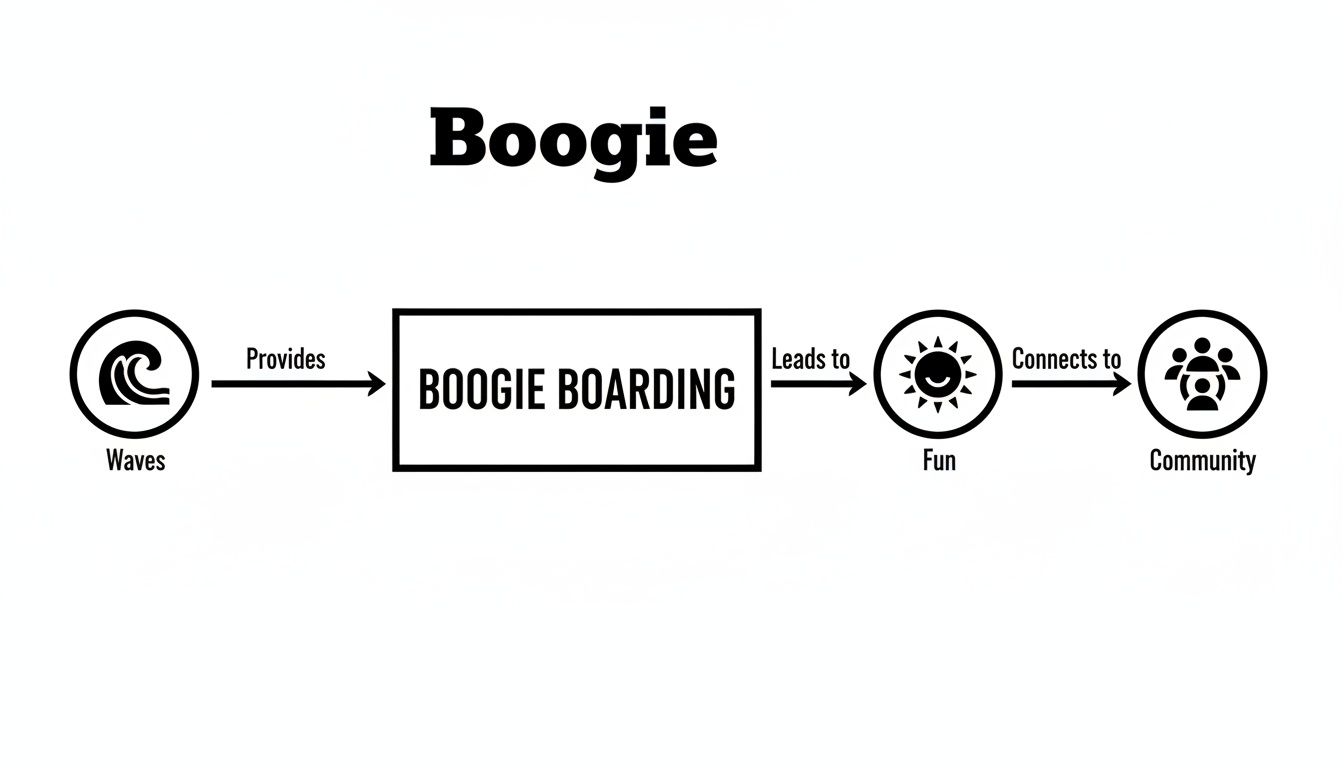
The simple flow illustrates that understanding your board's parts is the key to unlocking the fun and joining the wider community of riders.
Rails and Tails: How You Steer
Finally, we get to the shape of your board's edges (rails) and its rear end (tail). These are what determine how it bites into and interacts with the wave.
Rails are all about how the board "holds" in the water. 50/50 rails, where the seam is right in the middle, are super stable and forgiving—perfect for beginners. 60/40 rails, with the seam sitting lower down, offer more bite and control for turning, which suits intermediate and advanced riders looking to carve.
The tail shape also defines the ride. The crescent tail is the most common shape you'll see. Its curved design fits comfortably around your hips, giving you great stability and control. The bat tail, on the other hand, has a protruding centre point that provides more lift and a looser feel, making it a popular choice for riders who love to throw down tricks and spins.
By understanding these parts, you can confidently check out our wide range of bodyboards and pick one that’s built just for you.
How To Choose The Perfect Boogie Board Size
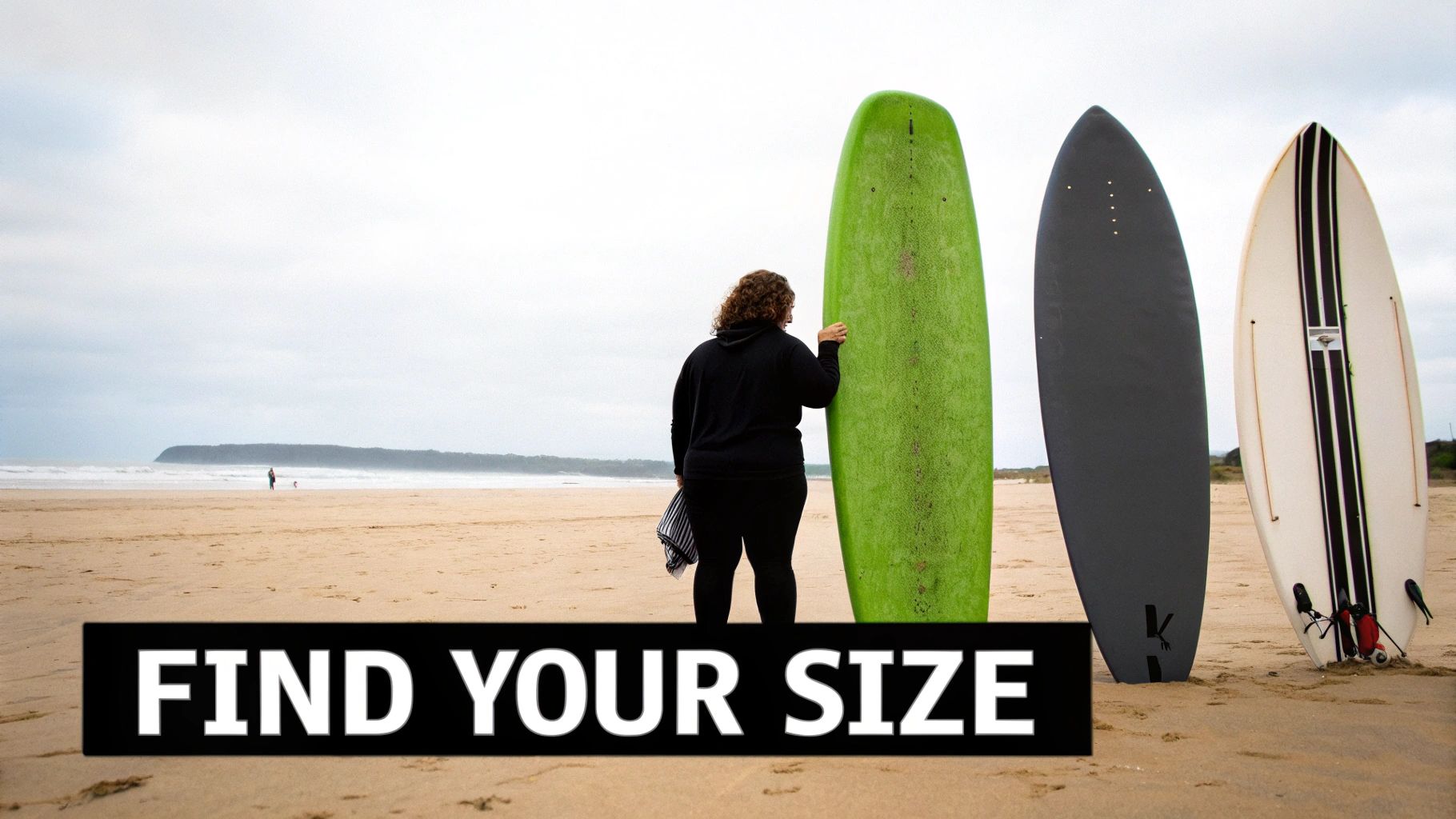
Getting the size of your new boogie board right is the single most important decision you'll make. Seriously. It’s the difference between effortlessly gliding across waves and spending your whole session struggling to stay afloat.
A board that's too small just won't have enough volume to support you, making it a mission to catch anything but the smallest whitewash. On the flip side, a board that’s too big feels like trying to steer a boat. It's clumsy, hard to paddle, and a nightmare to turn, which pretty much sucks the fun out of your time in the water.
The perfect size gives you that sweet spot of float (buoyancy) and control, letting you progress faster and get the most out of every single wave.
The Belly Button Rule: A Good Starting Point
You've probably heard of the classic "belly button rule." The idea is simple: stand the board on its tail, and the nose should land somewhere between your belly button and your chin.
This method is a quick, rough estimate and it works okay as a starting point. But it completely misses the most critical factor for how a board actually performs: your weight. It's your weight that dictates how much buoyancy you need, and that's way more important than just how tall you are.
Key Takeaway: While the belly button rule is a handy guideline, always prioritise your weight when picking a board. A board that properly supports your weight will give you far better float, speed, and overall performance, no matter your height.
For a deeper dive into how all the different factors play into your decision, check out our detailed guide on bodyboard construction and sizing. It'll help you get your head around the finer points beyond just length.
Your Weight Is The Deciding Factor
Think of your boogie board like a little boat. The heavier the cargo (that's you!), the bigger the boat needs to be to float properly. It’s the exact same principle with a bodyboard.
The right length and volume ensure your board sits perfectly in the water, giving you the platform you need to paddle into waves and ride them properly.
To make this super easy, we've put together a sizing chart that connects your weight directly to the ideal board length. This is the most reliable way to find your perfect match.
Boogie Board Sizing Guide By Rider Weight
This table helps you find the right boogie board length based on your weight, ensuring you get the best balance of float and control for your sessions.
| Rider Weight (kg) | Recommended Board Length (inches) |
|---|---|
| 20 - 35 kg | 36" - 38" |
| 35 - 55 kg | 38" - 40" |
| 55 - 70 kg | 40" - 41.5" |
| 70 - 85 kg | 41.5" - 42.5" |
| 85 - 100 kg | 42.5" - 43.5" |
| 100+ kg | 44" - 46" |
This chart is a solid foundation for your choice. If you happen to fall between sizes, think about your skill level. A beginner might benefit from sizing up a fraction for extra stability, while a more experienced rider could size down for better manoeuvrability.
Tips For Sizing A Kids Boogie Board
Buying a board for a growing grommet comes with its own challenge. You want something that fits them now but also has a bit of room to grow into, so you're not forking out for a new one every summer.
Here are a few tips to get it right:
-
Prioritise Current Weight: Always start with their current weight using the chart above. A board that's too big right now will just be frustrating for them to handle in the water.
-
Lean Towards the Upper End: If your kid is on the edge of the next size up, it’s generally a good idea to go for the larger board. This gives them immediate stability plus some growing room for next season.
Essential Gear For New Zealand Conditions
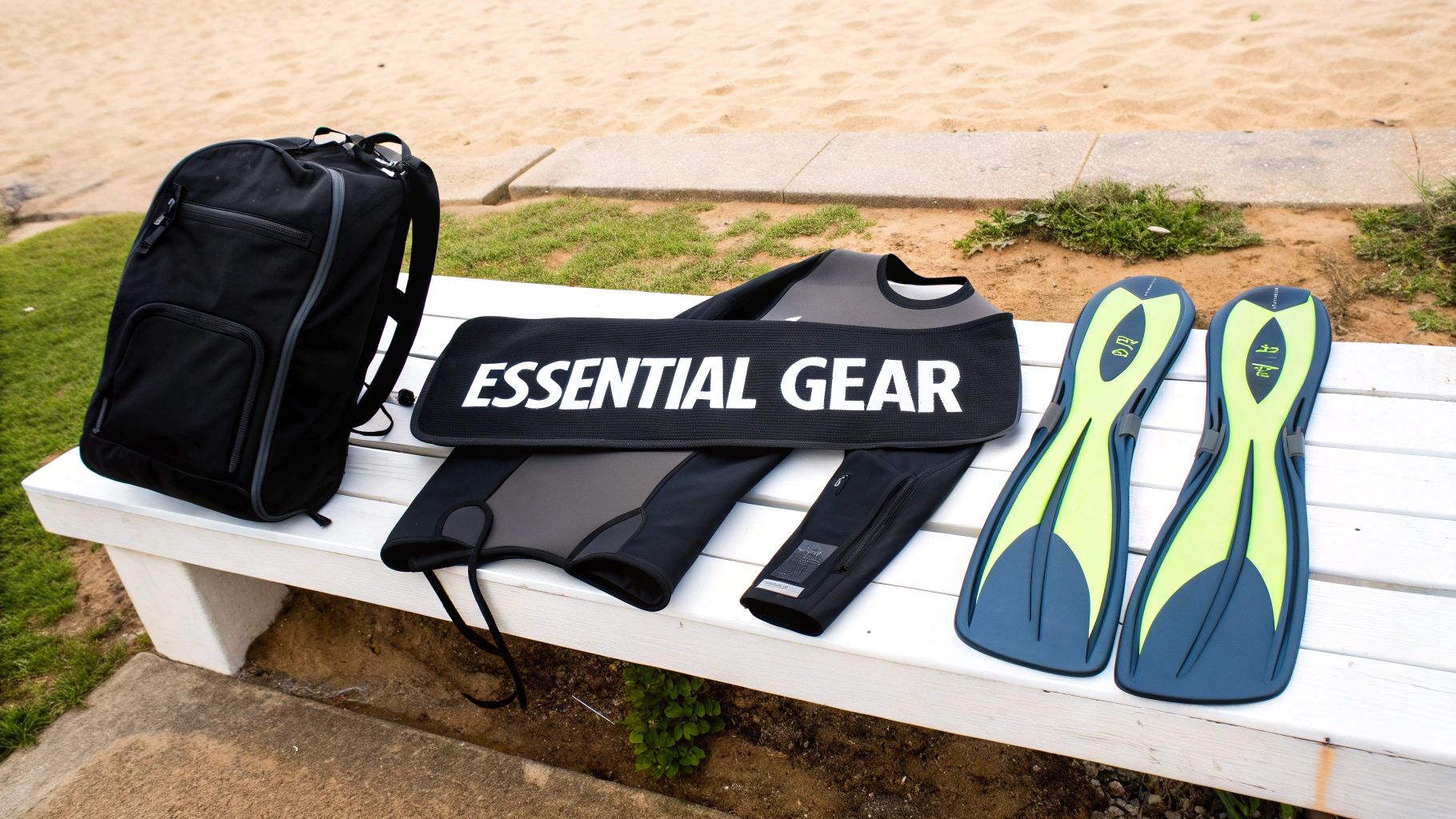
So you've found the perfect boogie board, and the stoke is real. But to truly make the most of New Zealand's incredible coastline—from the crisp winter swells on the East Cape to the mild summer waves up north—you'll need a bit more than just a board.
The right gear is your ticket to longer, safer, and way more enjoyable sessions. It’s all about staying warm when the water has a bit of bite, having the power to get into more waves, and making sure your kit lasts for many summers to come. Think of these accessories as your essential toolkit for unlocking the full potential of every trip to the beach.
The Wetsuit: Your Second Skin
Here in New Zealand, a good wetsuit isn't a luxury; it's an absolute necessity for anyone serious about spending time in the water. Even on a cracking sunny day, our waters can be pretty chilly, and a quality wetsuit is what lets you stay out for hours without turning into an ice block.
Top brands like O'Neill and Rip Curl have poured years into perfecting wetsuit tech to keep you both warm and flexible. The key is picking the right thickness, which is measured in millimetres (mm).
-
Summer Sessions (3/2mm): A "3/2" wetsuit means it's 3mm thick around your core and 2mm on the arms and legs. This gives you the ideal balance of warmth and flexibility for most Kiwi summer conditions.
-
Winter Warriors (4/3mm or 5/4mm): For the colder months, a "4/3" or even a "5/4" steamer is essential. That extra thickness traps more body heat, letting you surf comfortably right through winter.
The New Zealand surfing scene is growing fast, and quality gear is leading the charge. The market for NZ surfing apparel and accessories hit USD 621.0 million in 2022 and is expected to climb to USD 891.4 million by 2030. Wetsuits are a massive part of this, with apparel making up over 85% of the market's revenue. You can discover more about the growing NZ surf market to see just how popular the sport has become.
Swim Fins: The Engine for Your Ride
If you want to move from messing around in the whitewash to catching proper, unbroken waves, swim fins are non-negotiable. They are the engine that propels you through the water, giving you that crucial burst of speed to get onto a wave as it starts to break.
Trying to catch waves without fins is like trying to paddle a canoe with your hands—you simply won't have enough power. Fins transform your kick into powerful thrust, helping you:
-
Catch More Waves: That extra speed is the difference between catching a wave and watching it roll on by.
-
Maintain Control: Fins help you grip the wave face, giving you much better steering and control as you ride.
-
Get Out of Trouble: If you get caught in a tricky spot or a rip, fins give you the power to move to safety.
A good pair of bodyboarding fins is the single best investment you can make after your board. They immediately elevate your wave-catching ability and open up a whole new level of performance and fun.
Keeping Your Gear Safe and Sound
Once you've got your setup dialled, you need to look after it. A few simple accessories will protect your investment and keep you ready for action.
Board Bags: A padded board bag is a must-have for protecting your boogie board from dings, scratches, and the sun's damaging UV rays. Plus, it makes carrying your board and gear to the beach a whole lot easier.
Leashes: Your leash is your lifeline, keeping your board attached to you when you inevitably wipe out. Always use one. A coiled bicep leash is the standard for bodyboarding, as it stays out of your way while you paddle.
Bodyboard Wax: Just like with surfing, a good coat of wax on the deck of your boogie board gives you the grip you need to stay locked in. Apply it where your hands and hips will be to make sure you don't slip off during turns.
At Blitz Surf Shop, we stock a full range of hardware and accessories to get you sorted. For a closer look at our fins, leashes, and bags, you can check out our ultimate guide to bodyboard accessories. With the right gear, you'll be set for whatever the Kiwi coastline throws at you.
Your First Waves: Riding Tips and Safety
Alright, you've got your board and you're ready to go. Now for the best part: hitting the water and actually catching some waves. This is where the fun really kicks in, and with a few simple pointers, you'll be feeling confident right from your first paddle out.
For your first few sessions, your best friend is the whitewash—that's the foamy, broken part of the wave that rolls all the way to the shore. Think of it as the perfect training ground. Just wade out until the water is about waist-deep, spin around to face the beach, and get set.
How To Catch a Wave
As a wave starts heading your way, point the nose of your boogie board straight towards the beach. Right before it gets to you, give a solid push off the sand with your feet and hop onto the board. The whole idea is to get your board moving at the same speed as the wave, so it can pick you up and give you a shove.
It might take a few goes to nail the timing, but you'll soon get that awesome feeling of gliding across the water. Don't even worry about steering for now. Just enjoy the ride straight to the sand and get that core skill of catching a wave dialled in.
Your Basic Riding Stance
Once you're catching waves without much thought, it's time to work on your basic riding position, which is known as riding prone. It’s all about finding a stable, balanced spot on your board.
-
Hand Placement: Grab the nose of the board with both hands, roughly shoulder-width apart. This is your steering wheel and your main point of control.
-
Hip Position: You want your hips positioned near the tail of the board. This is your balance point and it's key to keeping the nose from diving underwater (we call that "pearling").
-
Body Weight: Keep your chest and upper body firmly on the board, using your core muscles to stay centred. Let your legs and fins drag in the water behind you; they'll act like rudders.
To steer, it’s all about subtle leans. If you want to go left, just apply a bit more pressure with your left elbow and hip. It doesn't take much, but you'll feel the board start to track across the face of the wave.
Safety First: If there's one rule in the ocean, it's this: never ride alone. Always go out with a mate or a family member and make sure you stay within sight of each other. The sea can change in a flash, and having someone nearby is non-negotiable.
Surf Safety and Etiquette
Knowing how to ride is only half the battle. Understanding how to stay safe and respect everyone else in the water is just as crucial. A little bit of knowledge here makes the beach a better, safer place for all of us.
Understanding Rips: Rips are powerful currents that pull water away from the shore. If you ever feel yourself getting dragged out, don't panic and don't try to swim against it—you'll just exhaust yourself. The golden rule is to swim sideways, parallel to the beach, until you're free of the current's pull, then head back in.
Respect Other Riders: Give people space. It’s that simple. In the lineup, the person closest to the breaking part of the wave has the right of way. Be patient, wait your turn, and never "drop in" on someone else's wave.
Protect Your Skin: The New Zealand sun is no joke, even on overcast days. Always slap on sunscreen and wear a rash vest or wetsuit to protect yourself. For a deeper dive, check out our ultimate guide to sun protection to keep you safe out there.
Why Riders Choose Blitz Surf Shop
Picking where to buy your boogie board is a bigger deal than just grabbing one off a shelf. It’s about getting the right advice from people who actually ride, so you can have the best possible time in the water. We've been at this since 1983, and Blitz Surf Shop isn't just a store; we're part of the Kiwi surfing and bodyboarding community, built from the ground up on genuine passion and local knowledge.
When you hit us up, you're tapping into decades of hands-on experience. Our crew in Gisborne and online aren't just staff; they're riders who know the local breaks like the back of their hands. We’ll give you friendly, straight-up advice to help you find the perfect board for your skill level, weight, and the waves you’re keen to ride. It's that personal touch that makes all the difference.
More Than Just a Board Shop
We take a lot of pride in having a massive range of gear that works for everyone. Whether you're after an affordable first boogie board for the kids or a high-performance machine to really push your limits, we've got you covered. Our selection has everything you need to get started and keep progressing.
To give our local and visiting riders a bit of an edge, we’ve also got some unique resources you won’t find just anywhere.
-
Live Wainui Beach Surf Cam: Check the conditions in real-time before you even leave the house. See exactly what the waves are doing and decide if it's the right day for a session.
-
Expert Local Advice: If you're in town, pop into our Gisborne shop for a chat about where the best waves are breaking. We'll give you honest insights to help you score the best session.
-
Nationwide Access: With NZ-wide delivery and shipping to Australia, we make sure everyone can get their hands on top-quality gear, no matter where they live.
At Blitz, we're not just selling products; we're sharing the stoke. We reckon that getting the right gear, backed by solid advice, is the key to unlocking a lifetime of fun in the ocean.
Supporting a Growing Community
The passion for bodyboarding in New Zealand is huge, and it's awesome to see. While the global market is growing steadily, here in NZ we see massive seasonal surges. Demand spikes by 65% during the summer months along East Coast spots like Gisborne. Our own numbers show that the humble boogie board, perfect for beginners, makes up 22% of all our board sales.
By choosing us, you're not just buying a board; you're joining a family that has supported Kiwi riders for generations. For a closer look at what makes us tick, check out our guide on why Blitz is New Zealand's go-to online surf store. We're here to help you start your journey and stick with you every wave of the way.
Common Questions About Boogie Boards
Even after you've got your head around the cores, slicks, and rails, there are always a few questions that pop up. We get asked these all the time in the shop, so we’ve pulled them together to give you some quick, straight-up answers.
Think of this as your final checklist before you hit the water. It covers everything from what to call your new board to keeping it in top nick for years to come.
Is There A Difference Between A Boogie Board And A Bodyboard?
You’ll hear both terms thrown around at the beach, and honestly, they pretty much mean the same thing. “Boogie board” was the original brand name from Morey Boogie, the legends who kicked off the whole sport. The name just stuck.
“Bodyboard” is what more experienced riders and the pros tend to use, especially in competitions. So, while you're not wrong either way, "bodyboard" often suggests a higher-performance model, whereas "boogie board" might make you think of the classic summer board for having a blast in the shore break. At the end of the day, it's all the same awesome sport.
How Do I Look After My Boogie Board?
Looking after your board is dead simple, but it makes a massive difference to how long it’ll last. Stick to these golden rules, and your board will be sweet for ages.
-
Rinse After Use: Always give your board a good hose-down with fresh water after a surf. This gets rid of the salt and sand that can damage it over time.
-
Keep It Out of the Sun: Never, ever leave your board cooking in the sun or a hot car. The heat and UV rays can cause the slick to bubble up and make the core go soft.
-
Store It Properly: Keep your board flat or tucked away in a padded board bag. If you lean it against a wall for ages, it can start to bend and develop a weird curve (or rocker) you definitely don't want.
Pro Tip: A quality board bag is one of the best investments you can make. It’s not just for getting to the beach without dings; it's the perfect spot to store your board at home, safe from sun and knocks.
Can I Stand Up On A Boogie Board?
Look, you can give it a crack in the shallow whitewash, but they’re really not made for it. Boogie boards have flexible foam cores and are much shorter than surfboards, so they just don't have the stiffness or volume to support you standing up.
That said, bodyboarding has its own style of advanced riding called “drop-knee,” where you have one foot flat on the deck and the other knee down. Riders pull off all sorts of amazing tricks from the normal prone (lying down) position, too. If standing up is what you’re really keen on, a soft-top surfboard is going to be a much better bet.
At Blitz Surf Shop, we're here to answer every question and get you kitted out with the perfect gear for your next adventure. Explore our full range of boards, wetsuits, and accessories online today.


